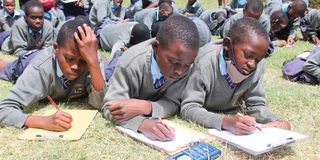
Schools across the country have closed for the August break after a tumultuous term, darkened by the deadly fire at Utumishi Girls Academy and renewed unrest in many other institutions.
The episodes reignited questions about discipline, safety, school management and the pressures facing young people. But they should also prompt a deeper reflection on the very state of our education. Over recent years, Kenya has changed the substance and form of learning. But the larger question, which lingers, is whether the institutions expected to deliver that change have changed with it.
That question struck home at a small school in Nairobi at the height of the unrest. In a bid to avert a looming strike, the management invited students to write down their grievances.
And while most of the complaints were familiar, the Grade 10 students seemed to have a markedly different set of demands. These included access to Wi-Fi, an end to extra lessons beyond normal class hours, and more unstructured time.
Their explanation was straightforward: as the first cohort to enter senior school under Competency Based Education (CBE), they were routinely expected to research, investigate and complete assignments that required access to digital information.
Needless to say, such demands should not be made to explain school unrest. Nor should they distract from the responsibility of students, teachers and school managers to resolve grievances without endangering anyone.
But the demands, no doubt, offer a revealing glimpse of the institutional strain created when a country changes its curriculum faster than it changes the system expected to deliver it.
By design, CBE answers to a different learning logic. It emphasises what a student can investigate, apply, create and demonstrate, rather than simply what they can remember. For that reason, digital literacy is not an optional convenience for entitled youngsters; it is, in fact, one of CBE’s stated competencies.
Unstructured time, on the other hand, is not necessarily idle time; on the contrary, it can be the space in which independent enquiry occurs.
Furthermore, studies have repeatedly shown that the length of time spent in a classroom is not, by itself, evidence that mastery has taken place.
Yet many schools still operate according to those very assumptions which the system CBE was meant to replace. Internet access, for instance, is still treated as a privilege, or a sign of errant behaviour, which must be restricted rather than facilitated and managed as part of learning infrastructure.
We have, therefore, created a fundamental contradiction in which a teacher prepared to deliver content occupies the same classroom as a learner expected to investigate it.
Timetables are designed to create as much time as possible for class instruction while the curriculum asks for learner initiative. School rules favour control while assessment is designed to test creativity, collaboration and independent judgement.
This is why preparing for CBE cannot be reduced to producing new textbooks, renaming subjects or issuing fresh assessment guidelines. It requires a total rethink that will challenge the fundamental assumptions that have driven the management of schools for years.
Further, parents and teachers will need to be equipped with the understanding that learner agency is not necessarily the same as indiscipline. How then will schools facilitate the agency while maintaining discipline?
For instance, when internet connectivity is part of the learning infrastructure, how do schools ensure that the digital gadgets that are so integral to learning are not misused? Further, schools will need equipped laboratories and libraries, appropriately trained teachers, manageable class sizes and timetables that allow projects and enquiry.
These are massive infrastructural and mind-set changes, but without them CBE will work best for children in well-resourced, mainly private schools, and remain largely theoretical for a majority of learners. The result will inevitably be a well-intended educational reform turning into yet another mechanism for widening inequality.
But the mismatch will not end at the school gate. In 2029, the first cohort educated entirely under CBE will enter Kenya’s universities. Some institutions have begun preparing, but the challenge is larger than revising admission criteria or training lecturers in new assessment methods.
Lecture halls organised for decades around content transmission will encounter students accustomed, at least in principle, to project-based assessment, continuous feedback, self-directed learning and digital access. Will universities merely accommodate a different kind of applicant, or reconsider their understanding of education itself?
CBE at its finest promises to produce adaptable problem-solvers for a labour market being transformed by automation, artificial intelligence and the declining shelf life of technical knowledge.
Yet much of that market still rewards certificates, institutional pedigree and experience more readily than demonstrable competence. If employers, professional bodies and the public service continue recruiting and promoting largely through such credentials and conventional examinations, young people entering the market will discover that the abilities celebrated in school carry less weight in the ‘outside’ world.
With a second cohort of CBE students due to enter senior school next year, and university admission for the first cohort less than three years away, the real national preparedness test is whether the entire chain comprising schools, universities, training institutions, employers and, even the government, is being reorganised around the kind of learner and worker CBE is designed to produce.
Dr Ageyo is the Editor in Chief of the Nation Media Group. He holds a PhD in media studies with a focus on science and environment communication. [email protected]