By the time Jaramogi Oginga Odinga died in 1994, Kenya knew the Odinga name but did not quite know his eldest son, Russian-trained economist, Dr Oburu Odinga. The public face of the house of Jaramogi was Raila Odinga.
He was restless, defiant, and already mythologised by detention and confrontation. Since 1982, Raila had spent nine years in detention after being implicated in the coup attempt, and his biography became a shorthand for resistance. He was a man the state could confine but never silence.
Oburu existed in a quieter lane, in offices and files, in the language of budgets and policy rather than street demos and prison cells. Even inside the family’s story, he seemed like the son history had parked at the edge of the frame, waiting for a cue that never came—until death, as it often does in politics, rearranged the cast.
As Oburu struggles to steady the Orange Democratic Movement, following the death of his larger-than-life brother on October 15, 2025, it seems that he has to engage the restless Winnie Odinga, Raila’s daughter who is gunning for trouble – taking cue from her father that in politics, power is grabbed, not given.
But as she does that, she finds herself cast against the ODM veterans who are eager to work with President William Ruto’s UDA, a better soft-landing in the power equation, rather than go solo or work with the opposition.
Winnie has found herself facing the same predicament that her father faced upon the January 1994 death of Jaramogi, who had left Ford-Kenya in a loose partnership with the then ruling party Kanu. Raila was opposed to the political arrangement. He would, years later, enter a similar deal with Kanu, but on his own terms and in his own outfit, the National Development Party, after the 1997 elections. Winnie is aware that if she lets go of her father’s party, the chances of fading away are real. But whether or not she can inherit the Raila supporters at the expense of her uncle Oburu makes the battle for ODM interesting. The current scenario is a replay of history.
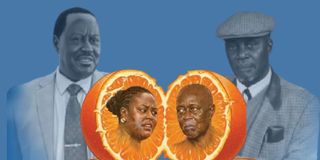
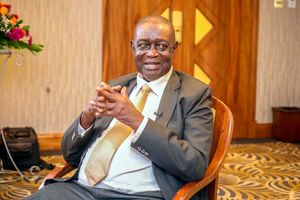
ODM leader Oburu Oginga (left) and former party leader Raila Odinga's daughter, Winnie Odinga.
Photo credit: Nation Media Group
In Jaramogi’s final years, the old man unsettled many loyalists by entering a controversial co-operation with Kanu. He insisted that engagement with power, rather than permanent trench warfare, was the practical route to reforms and development, and that it could open opportunities for opposition leaders who had spent years knocking at the gate. President Daniel Moi loved the deal. It cooled the political temperature, dulled the edge of dissent, and gave the state the optics of national unity without surrendering real control. But Raila and Ugenya’s James Orengo opposed it, joined by senior Ford-Kenya officials such as Paul Muite and Gitobu Imanyara, who saw it as self-serving and corrosive to the idea of principled opposition. The argument was never just about strategy; it was about identity. Was Odingaism a permanent refusal to kneel, or was it a bargaining instrument to be used when the moment demanded?
Raila did not take his father head-on. He resisted without rupture and opposed without publicly dethroning the patriarch. Yet by the time Jaramogi died, Ford-Kenya was already splitting, and the question of inheritance was no longer whispered. The house of Jaramogi faced a brutal reality: fight against the Kijana Wamalwa faction to control the party or risk being eclipsed. Raila chose re-invention. He formed the National Development Party, anchored in Nyanza, as both continuity and escape. It was continuity of the Odinga tradition of opposition politics, and escape from a party whose internal wounds had become permanent. It was also the start of something Kenya later understood instinctively: "Odinga" was the family legacy, but "Raila" became a brand that belonged to the crowd, strong enough to stand outside the Jaramogi shadow while still feeding on it.
While Oburu is now fighting to retain the spirit of Jaramogi, Winnie is, on the other hand, invoking her father’s image as history returns, not as a photocopy, but as a rhyme. It is now clear that with the death of Raila, the house of Jaramogi is at a crossroads, only this time the conflict is not between father and son, or between opposition and the state. It is a succession battle inside the royal house — between Oburu Odinga and Raila’s household — over who controls ODM, who speaks for the opposition, and who gets to carry the meaning of Baba when he is no longer there to absorb every quarrel and stitch every fracture.After Raila’s death, Oburu moved swiftly to claim the centre, as focus was turned to Winnie, the girl who became the symbol of a grieving nation as she brought back her father’s body from India.
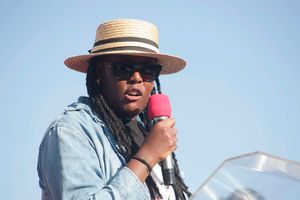
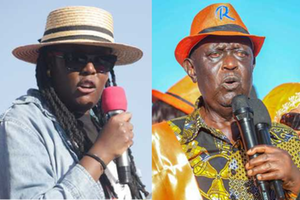
Former Prime Minister Raila Odinga’s children, Raila Odinga Jr and Winnie Odinga, attend a political rally at Kamukunji Grounds in Kibera, Nairobi, on January 18, 2026.
Photo credit: Evans Habil | Nation Media Group
Though Oburu is the elder, the surviving pillar of the old house, some pundits say there are internal family feuds that are at play. By positioning himself as ODM’s anchor, Oburu becomes the immediate beneficiary of Raila’s absence: he inherits the mantle, the party infrastructure, and a portion of followers who need a new command post. He also inherits Raila’s unfinished arithmetic. Oburu knows he has little muscle to chase the presidency, given his age, and neither does he have the kind of wealth and machinery required for a modern Kenyan presidential bid. So, he intends to turn to the oldest tool in a veteran’s box: alignment. His faction of ODM wants to reach out to President William Ruto, hoping to negotiate a 2027 arrangement that keeps him relevant, keeps ODM close enough to power to matter, and keeps the Odinga wing from sinking into irrelevance.
That instinct for bargaining has a long pedigree in Oburu’s political temperament. He was pulled into politics by the same force that kept him cautious for decades: his surname. After Jaramogi’s death, inheritance hung over the family, and Raila encouraged Oburu to step forward.
Oburu sought counsel from Prof George Saitoti, who tried to lure him into Kanu by invoking Jaramogi’s late rapprochement with Moi. But Oburu understood Bondo’s temperament. No Odinga could contest under Kanu without being accused of betrayal. So, he chose Ford-Kenya and contested, not as a firebrand but as a successor. His politics was administrative, cautious, and procedural. And in normal times, that style has survived. The problem is that ODM was never born as a normal party. It was born as a loud vessel with the image of Raila.
Raila’s power was never merely bureaucratic, and that is where Oburu’s inheritance begins to wobble. Oburu doesn’t carry with him Raila’s brand of politics, which is lived in emotion, in rally chants, in street songs, and in symbols that made him bigger than the institutions that hosted him.
Whether he can win the affection that Raila commanded is another thing. It is now clear that Oburu represents a faction that thrives on patrimony—on seniority, on "we were there," on the belief that history itself should confer obedience. In that sense, he resembles Raila in his last days, when the old warrior increasingly leaned on the sanctity of legacy to manage a party crowded with veterans and ambitious younger figures. While Raila’s myth could carry compromise without dying, Oburu does not have that myth. And that is where Winnie Odinga and her brigade of young Turks, including ODM Secretary General Edwin Sifuna, arrive to muddy the waters. It is clear that Raila’s death did not only end an era, but placed his daughter at the centre of Kenya’s political stage. For years, Winnie was visible alongside her father as a confidant. She was present in intimate moments of travel, strategy, fatigue, and fear, absorbing a private map of alliances and grudges that never appears in official statements. In the days after Raila’s passing, her composure transformed her into a national symbol. From India, where she had accompanied him, to the moment she returned to Nairobi, she carried herself with the calm of someone who understood that grief, in politics, is also a stage where legitimacy is measured.
At Nyayo National Stadium and later in Bondo, Winnie did not sound like a young politician auditioning for attention; she sounded like someone who had been listening for years. "The king is dead," she declared, "but long live the crown."
And then there was the image Kenya could not forget: Winnie clutching Raila’s iconic hat, the object that had sat on his head through decades of rallies, insults, arrests, victories, betrayals, and comebacks. The hat was never just fabric. It was shorthand for defiance and familiarity. When Winnie held it, she held the symbol that made a crowd feel it knew Raila.
Comparing Winnie and Oburu is to compare two kinds of power and two timelines of ambition. Oburu represents the politics of patrimony: authority that flows from inheritance, seniority, and the expectation that the elder should hold the household together. It thrives in boardrooms and backrooms, where bargains are made and survival is negotiated. Winnie represents the politics of proximity and timing: authority that flows from emotional closeness to the brand, fluency in the movement’s language, and the ability to speak to a restless generation that no longer respects titles the way their parents did. Winnie has age on her side. Youth gives her time, stamina, and room to grow. She can lose once and call it an apprenticeship. She can make mistakes and call them learning. She can build alliances slowly and still arrive at 2027 with energy intact. Oburu carries the weight of an era, and weight limits movement. His caution is read as fatigue, his compromises as retreat, his negotiations as a sign that he knows he cannot win by force.
But Winnie’s youth is also her hardest test, because she does not only fight Oburu; she fights an entire caste inside ODM—veterans, some born in Raila’s trenches, who have been teargassed, humiliated, defeated, betrayed, and still remained loyal, waiting decades for their own turn. They will not yield easily to a thirty-something whose political resume is thinner than theirs. They will accuse her of being a shortcut, a dynasty’s elevator. They will applaud her symbolism and then demand proof. Winnie can summon emotion, but she must still master the boring brutality of politics: nominations, coalitions, fundraising, turnout, discipline, and patience. The Raila brand can open the gate, but it cannot walk her through it. If she wants to lead, she must turn the funeral’s myth into a machine.
That is why Winnie throwing the hat into the ring changes everything. It tells ODM’s veterans that the Raila brand will not be handed to caretakers without a fight. It tells Oburu that the crown is not automatically his to hold, even if the throne is temporarily his to occupy. And it tells the country that the house of Jaramogi has entered a new era where the fiercest contest may be between uncle and niece—between the politics of patrimony and the politics of possibility.