President William Ruto with Iranian President Ebrahim Raisi during the State Visit at State House, Nairobi, on July 12, 2023.

Iran, one of the most sanctioned countries by the United States, is also a big buyer of tea, Kenya’s biggest agricultural export.
This week, Kenya and Iran rallied to mend fences over the quality of tea that ends up in Tehran, leading to suspension of the trade last year. According to the Tea Board of Kenya, a company was buying foreign tea, blending it with local leaves and sending to Tehran as purely Kenyan produce.
This is a $33 million (Sh4.29 billion) market for Kenyan tea, which makes it among the biggest. The UK, Pakistan, Egypt, Sudan and the UAE are the other key markets.
Keeping them happy is one challenge. Keeping their enemies happier is a bigger challenge. The US sees Iran as an enemy perennially targeting American and Israeli interests for annihilation. Kenya has kept ties with Iran tight for the last five decades. It also balances relations with Israel and the US.
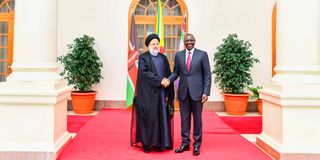
President William Ruto with Iranian President Ebrahim Raisi during the State Visit at State House, Nairobi on July 12, 2023.
On Wednesday, after the seventh Joint Commission for Cooperation meeting between Kenyan and Iranian officials, Agriculture Cabinet Secretary Mutahi Kagwe said Iran is a “brotherly and friendly nation.”
“As is common in families, there will be challenges but we will overcome them,” he said.
Mr Musalia Mudavadi, the Prime Cabinet Secretary who also serves as the CS for Foreign and Diaspora Affairs said Iran remains a strategic partner and a key market for Kenyan tea.
“Exports have grown from 3.2 million tonnes in 2020 to a record 13 million tonnes in 2024, with corresponding values rising from $5million to $33 million,” he said.
“We hope the lifting of the ban will pave the way for the resumption and expansion of Kenyan tea exports to Iran, bringing mutual economic benefits to our peoples.”
The joint Commissions are bilateral platforms to iron out issues affecting both sides. The two countries gave themselves 60 days to address the quality checks and lifting of the export ban.
Yet Uncle Sam was still watching. Mr Mudavadi said Kenya-Iran relations go beyond “maintaining the momentum of existing cooperation”.
“It is about unlocking new opportunities and scaling collaboration to greater heights. Over the years, we have built strong frameworks in trade, agriculture, health, education, science and technology, energy and cultural exchange,” he said.
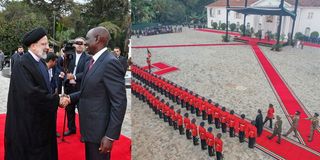
Photo combination of President William Ruto shaking hands with Iranian President Ebrahim Raisi and red carpet laid out out at State House in Nairobi, Kenya on July 12, 2023. PHOTO | PCS
After Wednesday, Kenya said it has “charted fresh pathways in emerging areas” such as climate-smart agriculture, manufacturing, transport and infrastructure, education and training, customs-to-customs linkages and renewable energy.
Iran, however, won’t have much legroom to expand the ties beyond what US sanctions allow – business that won’t assist Tehran to build a nuclear bomb in the eyes of the US.
Certainly, Kenya’s engagement with Iran could attract its wrath. Last week, American Senator James Risch proposed a change to the National Defence Authorisation Act for fiscal Year 2026, to review Kenya’s designation as a Major Non-NATO Ally, within 90 days.
It came a year after Kenya became the first sub-Saharan country to receive the designation, after President William Ruto’s state visit to the US in May 2024.
The senator’s proposal will assess Kenya’s foreign and diplomatic policies such as its alignment with China, Russia and Iran, as well as ties to troublesome armed groups in the region.
After the proposal, President Ruto defended engagements with China, saying Beijing had opened up markets for Nairobi. The Ministry of Foreign and Diaspora Affairs said Kenya would engage partners based on its interests.