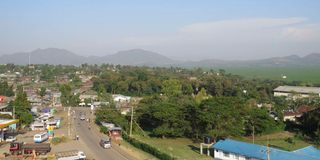
On July 20, 1962 — colonial governor Sir Patrick Renison made his way to the proposed lakeside town of Homa Bay. It was a place that, for a fleeting moment, held the promise of becoming a model for Kenya’s urban future.
Unbeknown to many, Homa Bay occupies a special place in the annals of our nation’s urban planning history. It was the first town in Kenya to be scientifically designed: water systems and sewerage infrastructure were laid out before a single house or office rose from the earth.
No other town had been planned that way; and no other town was officially opened. In terms of urban planning, Homa Bay was planned like the Tatu City in Ruiru, or the Konza City in Makueni. The idea was to have a planned lakeside town and a headquarters for the new South Nyanza District.
To the colonial imaginations, Homa Bay was not to follow the mistakes of Nairobi, the railway stop-over that turned into a haphazard collection of tin-roofed shops nicknamed “Tin City” – and in the wrong windy plains. From Nairobi, the colonial government had learnt a bitter lesson to an extent that there was an early campaign to uproot the city from the plains due to incessant flooding, frogs, and plague.
Unlike the haphazard growth of many towns across Kenya, which sprouted around the railways or grew from colonial stations into sprawling, often chaotic, urban centres, Homa Bay was designed to be different.
A product of its time, it was conceived as a pioneering symbol of organised urban planning, a modern port town that would serve as a model for Kenya’s post-independence future. In the early 1960s, as the colonial era waned and the nation’s leaders began to envision an urban landscape for the future, Homa Bay was supposed to represent a new standard. It would be a cotton and fishing hub.
Yet, Homa Bay’s story became one of unrealised potential, and its fate, a tragic metaphor for the failure of many ambitious development projects in Kenya. What went wrong?
At the heart of the dispute between the Kuria people and the newly created South Nyanza District lay a profound sense of political and cultural alienation. When the larger Gusii region was split by the colonial administration, the southern portion — dominated by the Luo — became South Nyanza. This reorganisation, though presented as an administrative convenience, ignored the delicate ethnic and political balance on the ground.
For the Kuria, who had long inhabited the area, the new arrangement was deeply unsettling. Their opposition was not simply a matter of where the district offices would be or what name the council would take, it was rooted in their fear of political marginalisation.
The Luo, already numerous and politically mobilised by Oginga Odinga, Achieng’ Oneko and others, stood to dominate the district’s council and resources, leaving the Kuria as a small minority with minimal influence over decisions that directly affected their land, livelihoods, and cultural life.
Culturally, too, the Kuria felt distinct. They shared more in common with the neighbouring Gusii than with the Luo, and they feared that incorporation into a Luo-majority council would erode their identity and subject them to decisions that did not reflect their interests or way of life. Their demand for their own council — based at Ikerege in their homeland — was an assertion of their right to govern themselves and protect their communal interests in the face of an administrative structure they viewed as unjust and threatening.
The second — and most significant — reason for Homa Bay’s stagnation was that it became a victim of Cold War politics played out in Kenyatta’s Kenya. At the heart of Homa Bay’s post-independence growth prospects was a proposed cotton textile factory, which Vice President Oginga Odinga had brokered with the Soviet Union. In the mid-1960s, the Soviets agreed to finance and construct the plant as part of their broader strategy to gain influence in postcolonial Africa by supporting industrialisation projects.
Homa Bay Town modern market.
Photo credit: George Odiwuor | Nation Media Group.
For Homa Bay, this promise represented not only a major step toward industrial development but also a chance to overcome the economic marginalisation it had endured since independence.
However, the timing of the project coincided with political crisis within the ruling party Kanu. In 1966, Jaramogi Oginga Odinga fell out with President Jomo Kenyatta and left to form the opposition Kenya People’s Union (KPU). This split crystallised ideological differences within Kenya, with Jaramogi leaning toward socialist and pro-Soviet positions, while Jomo Kenyatta maintained a capitalist, pro-Western stance.
Against this backdrop, the planned Soviet-supported textile factory in Homa Bay — a Luo-dominated area and Jaramogi’s political stronghold — became politically untenable. The government quickly abandoned the project, citing a supposedly unfavourable market survey: “The market survey for the textile products to be manufactured in connection with this project has revealed that the capacity already licensed by East African Industrial Licensing Council is just about adequate for the period up to 1970…the project will not be viable at this time.”
This explanation, while couched in economic terms, masked the reality that Cold War rivalries and domestic political vendettas intersected to deny Homa Bay the development it was promised. Supporting a Soviet project in Jaramogi’s backyard would have bolstered the opposition and undermined Mzee Kenyatta’s anti-socialist posture both domestically and internationally. In this way, Homa Bay became the “first victim” of the Cold War drama in Kenya: a town where development was sacrificed to maintain political control and align with the Western bloc.
Another factor was Homa Bay’s struggle for urban status. The lack of legal recognition left the town’s development at the mercy of South Nyanza civic authority, which was unable to advance its planned vision. As a result, Homa Bay remained little more than an idea on paper — a township without the governance infrastructure needed to bring it to life. In many ways, it became a microcosm of Kenya’s broader challenge: a nation striving to bridge the gap between its lofty ambitions and the hard realities of governance.
Why was the town denied urban status? The system, rigid to a fault, cloaked its decision in bureaucratic language: Homa Bay, it was declared, lacked the requisite population and, more critically, the “resources” to administer its own services. When the local Member of Parliament, Ngala Abok, raised the matter in Parliament, seeking clarity on what constituted a sufficient population for township status, the response from the Minister for Local Government was revealing. A town, he explained, required a population whose Graduated Personal Tax could yield sufficient revenue to sustain public offices, water services, and street lighting.
In 1971, the Minister for Local Government, Dr Gikonyo Kiano, came under pressure in Parliament to elevate Homa Bay’s status. “If the upgrading of Homa Bay will inspire some spirit of growth in that town, we shall consider it,” he remarked. Yet he admitted that there was no proper “machinery,” as he put it, for classifying emerging towns like Homa Bay. “It is the absence of this machinery that has made it difficult for us to know how to classify which town belongs in which category,” he conceded.
Homa Bay town residents watch as teams search for people who were on a boat that capsized on September 21, 2021
Photo credit: George Odiwuor | Nation Media Group
As a result, Homa Bay stumbled along a dark and uncertain path. Although a District Commissioner was stationed there, he could not even chair a development committee — because none existed. Despite having a carefully drafted town plan, Homa Bay remained unrecognised, a “town” only in theory.
It was not until 1974 that Homa Bay was finally declared an urban centre — but by then, much damage had already been done. The town lacked land for expansion, a problem that persisted in 1984 when it became a township, and into the late 1980s when it attained municipal status. Even today, Homa Bay controls only about 20 per cent of what is nominally its territory and has no adequate land for industrialisation.
Today, Homa Bay can no longer rely on the 1960 plan — nor even the 1974 masterplan, which has long since become obsolete. It was, in many ways, a town left to fail and Governor Gladys Wanga must be grappling with some of these historical realities.
Homa Bay’s story holds valuable lessons for today’s Kenya about what it takes to turn plans into progress, and vision into reality.
John Kamau is a PhD candidate at the Department of History, University of Toronto, Canada. Email: [email protected] @Johnkamau1