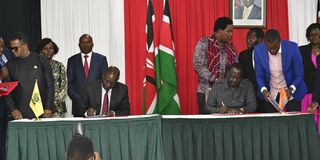
Kenyans' response to the signing of an MOU between ODM and UDA has been binary and precise. Those who welcome the idea are head-over-heels about it. On the other hand, the naysayers have shouted their opposition to it to the high heavens.
That is as it should be. An idea that is supported and opposed in equal measure has a very high likelihood of giving birth to a hybrid idea for the benefit of society. Kenyans have a civic responsibility to critically interrogate and discuss ideas that shape their collective future as a nation, for to take a back seat in this all-important matter is to allow politicians to run roughshod over the citizens.
There was an unforgettable spectacle as a score of supporters jumped into the pool at the KICC grounds, with their clothes and shoes on. To these supporters, what was unfolding before their very eyes was simply unbelievable.
Only two-and-a-half years ago, these same people were tearing into each other with accusations and counteraccusations of voter bribery and rigging to secure a desired presidential poll result. Many lives were lost in the demonstrations and melee that followed.
Therefore, seeing the same protagonists shake hands in a public display of dalliance and camaraderie was quite a spectacle. To the supporters, it was like being relieved of a malignant disease. This explains the manifest explosion of ululations, song and dance during the MOU signing ceremony. In the 2022 presidential poll, Raila Odinga was seen as the front runner both in terms of national support as well as the strong perception that he was the establishment candidate.
There was talk about Raila Odinga being a candidate of the "Deep State", a perception that was buttressed by the fact that the outgoing president at the time, Uhuru Kenyatta , publicly supported him, and at the same time chided his main challenger, William Ruto, as unsuitable for the presidency. On the other end of the political spectrum are Kenyans who argue that the MOU is a selfish move for self-preservation.
Some Kenyans strongly believe that it is one of those infamous "handshakes" that Raila is known to precipitate immediately he loses an election. Historians will record that Raila had handshakes with four successive presidents: Daniel Moi, Mwai Kibaki, Uhuru Kenyatta and William Ruto.
The fact that all these presidents saw the need for truce with Raila after presidential polls could be indicative of either Raila's adeptness at making himself politically relevant or the possibility that the presidents themselves did not feel safe enough with about half of the voters that Raila controlled giving the government a wide berth.
Lack of inclusivity in the government often creates a perception of illegitimacy in leadership, leading to unavoidable discomfort. The question is: why are Kenyans behaving as if they do not understand the nature of their own politics? Since time immemorial, politics has never been about the welfare of citizens. Rather, politics is about permanent interest, which is the pursuit of power by politicians.
There is a South African saying that "politicians are like bananas; they stick together, and none of them is straight." Politicians use citizens to gain power, but whenever that power is threatened, they close ranks to ensure self-preservation. Power confers the ability to control others.
Politicians exercise control for personal good and aggrandizement but couched in public good as a value proposition. To get power, politicians look for legitimacy from the citizens. To obtain legitimacy, politicians promise a slice of heaven down on earth.
The reality, however, is that politicians do not mean any well for the society over and above the opportunities to leverage societal goodwill to extract private benefits. That perhaps explains why politicians insist on being re-elected even when citizens are evidently fatigued by their ineptitude.
The phenomenon of electoral manipulation emanates from politicians' penchant for self-preservation. The situation is even more desperate in poor countries with low literacy levels. Politicians have mastered the art (or is it science?) of hypnotizing citizens to suspend the use of some of their critical faculties, including thinking and reasoning.
The rapprochement between President Ruto and Raila Odinga is not any different from what politics is about. Similarly, the politicians who are gravitating around the former Deputy President, Rigathi Gachagua, Martha Karua , Kalonzo Musyoka and the latest kid on the political bloc, Fred Matiang'i, are all positioning themselves to either gain or preserve political power. It is all politics. In any case, all these politicians have been very much part and parcel of the governance failures that they are now criticizing.
Politicians have a way of making citizens to believe that the world is ending the following day. Once citizens get into a state of panic, they become easier targets for manipulation. So, what is happening in Kenya's political landscape now fits perfectly well within the time-tested framework of realpolitik.
When Mount Kenya realized that their honeymoon with President Ruto was over, and that Deputy President Rigathi Gachagua's exit was imminent, the region retreated to its backyard and started to reorganize new alliances. Before his impeachment, Rigathi Gachagua distinguished himself as a vociferous defender of President Ruto as an honest and hardworking man who dedicated all his time and intellectual energy to work for Kenya.
Jubilee party legislators have conveniently forgotten that shortly after they were elected to Parliament on Azimio coalition tickets, they bolted out of the coalition citing their ideological convergence with President Ruto's UDA party. Today, Jubilee is at the forefront criticizing Raila for signing an MOU with UDA with which they themselves claimed to share ideological orientation.
What is good for the goose must be good for the gander too. In any case, Rigathi Gachagua has severally stated that Raila is not acceptable to Mount Kenya voters. It was, therefore, not conceivable for Raila to join a coalition of people who fiercely resent him.
The Abagusii have indicated that they will be presenting Fred Matiang'i as their presidential candidate in 2027. It is, therefore, understandable that the community is resisting infiltration by other presidential candidates and their political parties.
A recent demonstration against Raila Odinga at Kisii stadium should, therefore, be understood against the background of the community's need to project their own candidate at the expense of all other politicians and their formations. Political grapevine has it that Dr Matiang'i's candidature is being promoted by Uhuru Kenyatta.
As they support their candidate - and they have every right to do so - the Abagusii community should remember that in the last presidential election, Uhuru Kenyatta was supporting Raila Odinga who is known to have the twin advantages of a huge political war-chest and frenzied following across the country.
All the advantages notwithstanding, Raila did not win the poll. Kalonzo Musyoka has served in public service since 1985, rising to the position of Vice President. He feels a genuine urge to be promoted to the presidency.
Therefore, what Kenyans are witnessing currently is a mere storm in a teacup, the usual jostling for political relevance and positioning. It will subside once the 2027 elections are concluded, and the country will regain its sobriety.
Kenyans should not lose sleep over politicians bickering; these people are members of an exclusive club of professional extractors. Kenyans should learn to refrain from being drawn into politicians' fights.
Those fights are friendly fires started by politicians for selfish reasons but transferred to citizens to fight on their behalf. Whenever there are dividends to be reaped from the street battles, they fall directly into politicians' pockets.
However, the pains and costs land on citizens' flesh and bones, often spilling their blood, as the politicians laugh all the way to the bank. To be forewarned is to be forearmed.
Professor Ongore is a Public Finance and Corporate Governance Scholar based at the Technical University of Kenya. [email protected]