President William Ruto’s high-stakes trip to the United States delivered major financing deals and renewed diplomatic attention, but also exposed the delicate risks that now shape Kenya’s role in Washington’s evolving Africa strategy.
The visit could likely go down as one of the most consequential foreign trips of his presidency — delivering landmark financing agreements, resetting the structure of American development support, and placing Kenya at the centre of Washington’s Africa strategy under the current US administration.
But it also exposed emerging challenges for Kenya’s economic diplomacy, particularly around the sustainability of commitments, the geopolitics of great-power competition, and the pressure on Nairobi to demonstrate governance capacity under new direct-funding arrangements.
President Ruto is the first African leader to receive a full State Visit during the Joe Biden era and now the first to secure a major bilateral development framework under Trump.
“That duality is unusual in global diplomacy,” says State House spokesperson Hussein Mohamed.
The centrepiece of Dr Ruto’s visit was a Sh323 billion US-Kenya health deal, which redefines a 25-year partnership and makes Kenya the first country to sign the revamped US health model after USAid’s structural overhaul.
“In a period when developing countries are struggling with debt distress, the grant structure provides immediate fiscal relief and allows Kenya to invest without expanding its repayment burden,” Mr Mohamed says.
He adds that the agreement also signals US trust in Kenya’s governance and reform agenda and aligns directly with Kenya’s universal health coverage agenda.
“The framework supports key pillars of UHC: health workforce expansion, digital health integration, laboratory strengthening, and enhanced supply-chain transparency.”
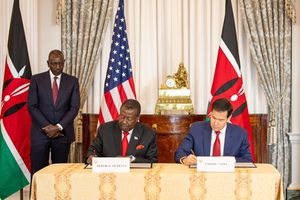
US Secretary of State Marco Rubio and Kenyan Foreign Cabinet Secretary Musalia Mudavadi sign the US-Kenya health pact as President William Ruto looks on.
Photo credit: PCS
The political symbolism is equally strong. Under President Biden, Dr Ruto received the first state visit by an African leader since 2008.
“Under President Trump, he is the first to secure a major bilateral agreement. This continuity suggests that Kenya has achieved rare bipartisan favour—no small feat in a town sharply divided along party lines.”
For the first time, US health funds will flow directly into Kenya’s Government systems.
For decades, US global health funding to African countries has been channelled through parallel NGO-run systems—an approach that yielded strong disease-control results but often weakened domestic capacity.
Critics argue that only an estimated 40 per cent of funds reached frontline healthcare, with the rest absorbed by administration, compliance, and implementing partners.
Analysts, however, see the direct funding not only as a vote of confidence but also as a test.
“Kenya must now demonstrate capacity, transparency, and efficiency in a high-visibility programme. Missteps—particularly at Kenya Medical Supplies Agency —could trigger automatic audits or funding freezes. The stakes are high,” argues Prof Gitile Naituli of Multimedia University of Kenya.
Another major win came through a pioneering $1 billion (Sh129.3 billion) debt-for-food security swap negotiated with the US International Development Finance Corporation (DFC). This is the first such instrument approved under the Trump administration.
At the same time, the elevation of Kenya as a regional security anchor and the designation of Nairobi as the new African hub for the US International Development Finance Corporation (DFC) added substantial diplomatic and economic weight to the visit.
Still, the trip had its misses.
Nairobi left Washington without firm progress on African Growth and Opportunity Act renewal or long-term trade access guarantees — critical issues for exporters.
Despite Kenya’s frontline role in regional stability, there was limited movement on security financing, and the new direct-funding model sets high governance and transparency expectations.
Exposure to Mr Trump’s unpredictable foreign policy further complicates Kenya’s long-term planning, raising fears of over-reliance on US security and financial guarantees.
President William Ruto with US Secretary of State Marco Rubio.
Photo credit: PCS
The deals also carry notable risks — including concerns over the privacy of Kenyan health data, possible geopolitical backlash from China, and heavier pressure on domestic institutions to absorb direct US funding.
And with US politics deeply polarised, some agreements, analysts warn, may face congressional or legal resistance, leaving parts of the package vulnerable to shifts in Washington’s political winds.
In April, similar pacts between President Ruto and China’s Xi Jinping sparked US fury, with US Senate Foreign Relations Committee chairman Jim Risch stating that “relying on leaders who embrace Beijing so openly is an error.”
The meeting deepened ties between Nairobi and Beijing with the signing of more than 20 bilateral agreements spanning infrastructure, trade, health, education, and digital technology.
With the new Kenya-US multibillion-dollar deals, it remains unclear how the Chinese government will react.
Prof David Monda, a US-based university lecturer and political analyst, cautioned that while President Ruto’s new agreements with the Trump administration mark a historic shift in Kenya–US relations, they come with significant geopolitical, legal, and strategic risks that Nairobi must confront with clarity and caution.
Prof Monda raised concerns about the privacy and governance of Kenyan health data under the new $1.6 billion health cooperation framework. He questioned the legal architecture governing sensitive personal medical information once it enters a system designed and financed by the US.
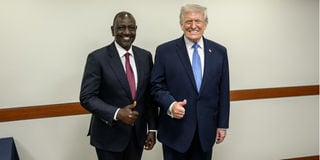
President William Ruto and US President Donald Trump after witnessing the signing of a peace deal between DRC and Rwanda in Washington DC, USA, on December 5, 2025.
Photo credit: PCS
“Which law ultimately governs the protection and storage of Kenyan health data—US law, Kenyan law, or international law?” he asked.
Without strong safeguards, he warned, Kenya risks ceding control over its most sensitive biometric and epidemiological data.
He also cautioned that the Ruto administration is entering into agreements shaped by what he referred to as “a Trumpian foreign policy doctrine that is unpredictable, contradictory, and transactional by design.”
“Trump’s positions swing dramatically depending on his impulses and the political winds. One day he supports something, the next day he dismantles it,” Prof Monda said.
This makes long-term planning difficult for allies such as Kenya, who rely on stability and consistency in foreign-policy commitments.
He cited the structural tension created by the simultaneous influence of former President Biden’s liberal-internationalist worldview and Trump’s America First doctrine.
“Ruto is caught between two fundamentally opposed foreign policy universes,” he noted. “Which one does Kenya align with? Biden’s multilateral, rules-based approach or Trump’s unilateral, transactional model?” This uncertainty complicates Kenya’s medium- and long-term strategic alignment with Washington.
Prof Monda expressed concern that Trump’s moves to dismantle USAid’s multilateral architecture weakens America’s traditional soft-power diplomacy—replacing decades of development cooperation with narrow, transactional bilateral deals.
“Kenya is entering into agreements in a highly asymmetrical relationship. The removal of multilateral buffers means Nairobi could end up with the short end of the stick,” he said. USAID’s prior global frameworks, he added, often protected smaller economies from overpowering bilateral leverage.