When Dhanji Liladhar Parmar died in Nakuru in 2018, aged 82, the obituaries remembered him as Jomo Kenyatta’s personal tailor — the man who cut and stitched the famous leather jacket from kudu hide.
Parmar’s story was more than a colourful footnote. It leads to a larger, rarely told truth: Indians did not just hem the jackets of Kenya’s independence-era politicians, but also helped design the political fabric of the nation. Yet Indians’ role has been silenced by postcolonial history, which has privileged African politicians and relegated Indians to the margins of public memory, where they are diminished as a “business community” or ignored altogether, their contributions treated as an afterthought.
Besides Parmar’s kudu-skin commission, which later gave him access to State House and government circles, there were many others who have been forgotten.
Mzee Kenyatta’s first love for leather jackets — including the one he wore during his trial, which had been stitched by Parmar — was thanks to a Nairobi bookbinder, Ambu H. Patel, who ran a modest publishing firm in the city. It was the start of a long family tie that saw Kenyatta’s daughter, Margaret Wambui, employed by Patel after Kenyatta was jailed and later exiled. Patel was already a seasoned Indian nationalist, and his premises doubled as a nerve centre for anti-colonial networking.
Patel, who would later publish Release Jomo Kenyatta, helped popularise the simple, explosive slogan that rolled off tongues in buses and markets: “Release Kenyatta!”
Long before independence, Indian-run presses were churning out pamphlets, petitions and protest literature for Africans. Decades earlier, when a young Jomo edited Muigwithania, the lifeline of his Gikuyu-language journal was advertising from Indian firms. In Harry Thuku’s day, too, Indians had supported his early East African Association and given him an office from which to agitate. While the colonial state saw Indians as useful intermediaries, many Indians in Kenya quietly chose another role: co-conspirators in the African struggle for self-rule.
It was not a coincidence that when Kenyatta stood in the dock during the Kapenguria trial, the face most Kenyans remember is that of British barrister Denis Pritt. But behind and around him was a phalanx of Indian and Goan lawyers: A.R. Kapila, Fitz de Souza, Jaswant Singh, JM Nazareth, DV Kapila and others. They were not just hired professionals. Many straddled Indian, African and Goan worlds in ways that made colonial officials deeply uneasy. From the late 1940s into the Emergency years, these lawyers defended Mau Mau suspects in hostile courts while the state quietly labelled them “undesirable” and “subversive”. Some edged as close to the line as they dared; others, like Pio Gama Pinto, sailed straight past it.
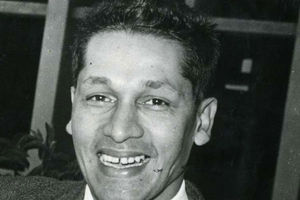
Pio Gama Pinto.
Photo credit: File | Nation Media Group
Born in Nairobi in 1927, educated in India, and chased by the Portuguese from Goa, Pinto returned to Kenya with a fire that would not be doused. He joined the Kenya Indian Congress and became close to leaders of the Kenya African Union (KAU). At the Daily Chronicle, he used the editor’s desk like a podium, turning the paper into the loudest Indian-owned vehicle for anti-colonial sentiment. Pinto persuaded the owner, D.K. Sharda, to print pamphlets in African languages — including Bildad Kaggia’s Inoro ria Gikuyu — ensuring that ideas travelled far beyond English-speaking elites.
When he was not editing, Pinto was broadcasting. As East African correspondent for All India Radio, his Swahili programmes openly criticised British rule. The colonial administration considered his commentaries a “veiled incitement to colour war” because of their consistent denigration of British authority in Africa. At the same time, he sat in KAU’s Study Circle with Kaggia and Fred Kubai, debating what a free Kenya might look like and how Africans, Indians and other communities might coexist within it. It cost him dearly. Pinto was detained during the Emergency and, after independence, assassinated in 1965 — a martyr claimed by many but remembered by too few.
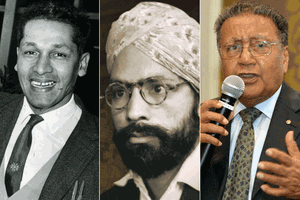
If Pinto helped radicalise the airwaves and press, a young Punjabi Sikh, Makhan Singh, gave shape to anger in factories and railway yards. In March 1935, thirty-nine workers — Hindu, Muslim and Sikh — gathered in Nairobi and launched the East African Trade Union. Makhan Singh became its honorary secretary and saw no contradiction between fighting for Indian workers and African ones since, as he said, exploitation did not check passports. Over the next fifteen years, he patiently stitched together disparate strikes and grievances into a coherent trade union movement that united Indian and African labour.
Makhan Singh (right) with Jomo Kenyatta soon after independence.
Photo credit: File | Nation Media Group
In April 1950, Singh crossed a line others within his community feared: at a public meeting he demanded immediate independence. The state’s response was swift. He was arrested within weeks and went on to serve eleven and a half years in detention — longer than any other political activist of his era in Kenya. Singh rejected several offers of freedom on the condition that he leave the country, never to return. To many African trade unionists, Makhan Singh was not an outsider. He was the man who had first shown them that unity in the workshop could be transformed into political power in the streets.
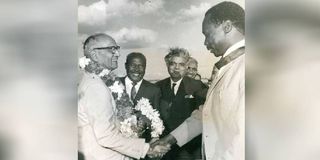
While trade unionists and editors who had found solace in Kiburi House fought in the courts of public opinion, another Indian figure worked from a different kind of office — the Indian High Commission. In 1948, Jawaharlal Nehru sent Apa Pant to Nairobi as independent India’s first High Commissioner to Kenya. An Oxford-educated prince from Aundh and a self-described Gandhian, Pant arrived with explicit instructions: build bridges between Africans and Indians, and demonstrate that the freedom of one colonised people was tied to the freedom of another.
From the moment his plane landed, his residence became an informal salon of Kenya’s anti-colonial politics. Trade unionists such as Makhan Singh and S.G. Amin, and politicians including Chanan Singh, became frequent visitors. They consulted him on communal representation, workers’ rights and the dangerous drift towards racial polarisation. Pant’s message was blunt: Indians had to integrate themselves with the African nationalist movement or risk being crushed between a racist government and a rising tide of African anger.
He did not simply preach unity from his desk. Pant travelled to Githunguri, where KAU leaders had set up independent African schools and the Kenya Teachers College to break missionary monopolies. There he met Kenyatta, Chief Koinange and Mbiyu Koinange, urging Africans and Indians to form a “powerful brotherhood devoid of colour” and to act as one political body. In early 1949, he toured Kikuyu reserves, delivering speeches on Gandhian teachings, Indo-African cooperation and the lessons Kenya could draw from India’s freedom struggle. When the colonial noose tightened around activists, he quietly helped some escape. Joseph Murumbi later recalled that it was only through the High Commissioner’s assistance that he boarded an Air India International flight in 1952, reached India and then made his way to London.
Pant was not alone. In the early 1950s, a new generation of Kenya-born Indians stepped into public life. Names that now float vaguely in national memory — C.B. Madan and Chanan Singh, both Punjabi Hindus elected to the Legislative Council; S.G. Amin, the Gujarati Muslim who led the Congress and sat in LegCo; Jaswant Singh, a Punjabi Sikh; and Goan Christians such as Nazareth, Fitz de Souza and Eddie Pereira — were then at the sharp end of colonial suspicion. They straddled the Kenya Indian Congress and KAU, defended Mau Mau cases, and quietly insisted that Kenya, not India or Goa, was home.
Parliament benches and courtrooms became quiet theatres of resistance, where Indians used legal arguments, procedural knowledge and their uneasy privileges to prise open spaces for African claims. Some, like N.S. Mangat — injured in the Jallianwala Bagh massacre of 1919 and later president of the Law Society of Kenya — embodied in their own biographies the long arc from British India’s repression to Kenya’s Emergency. Others kept a lower profile, horrified by how quickly a reputation like Pinto’s could lead to detention or deportation.
Sadly, the story we tell about Kenya’s independence often settles into a familiar pattern: African peasants, Mau Mau fighters and a handful of African politicians confronting a British state. It is a powerful story — but it is not a complete one. In that larger drama, Indians are usually cast as shopkeepers and dukawallas, or as silent bystanders, occasionally as compradors for the colonial regime. Some were. But many were not.
Behind the “Release Kenyatta” slogan was Ambu Patel, binding books and binding together a movement. Behind striking dock workers and railway staff stood Makhan Singh; behind seditious pamphlets and restless radio broadcasts was Pio Gama Pinto. In the hallways of the High Commission, Apa Pant coaxed Africans and Indians towards each other and away from the false comfort of communal isolation. Around courtrooms and council chambers moved Nazareth, de Souza, Kapila, Mangat and many others, testing how far law could be stretched in the service of justice.
These men — and others like them — did not fight in the forests of the Aberdares. They fought with typewriters, union cards, legal briefs and diplomatic passports. Their weapons were words, networks and a willingness to risk comfort for conviction. Remembering their struggle does not diminish African sacrifice; it enriches it.
It reminds us that the making of Kenya was never a single-race project, but a messy, fragile coalition of people who, in different ways, chose to stand against empire.