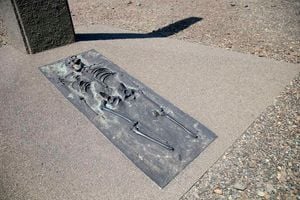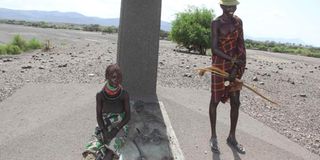
Ekiru Ewaton and his wife Esekon Lowa who take care of the artistic impression of a fossil skeletal remains of a 1,600,000-year-old pre-modern human now known as the Turkana Boy.

Kenya has added another heavyweight to its human-origins story: KNM-ER 64061, a two-million-year-old trove of Homo habilis bones from Lake Turkana.
In the latest January issue of The Anatomical Record, the fossil – which has finally been analysed – is being hailed as the most complete post-cranial skeleton of its kind ever found. It it reinforces a familiar truth: if you want to meet our ancestors, Turkana is where they keep showing up.
The findings have elicited interest as Lake Turkana shores continue to produce fossils with an almost unfair consistency, turning the badlands into a place the evolution story unfolds in bits like a jigsaw puzzle.
As lead researcher Fred Grine of Stony Brook University says: “There are only three other very fragmentary and incomplete partial skeletons known for this important species.”
Grine and his colleagues estimate that the individual was a young adult, standing about 1.6 metres tall and weighing roughly 30.8 kilos. They also determined that the arm bones of this H. habilis were heavy and thick like earlier australopithecines, with a forearm longer than that of the later Homo erectus. H. habilis may have, therefore, moved through trees more easily than H. erectus, but it remains unclear.
The Turkana Boy monument, at Nariokotome in Turkana North Sub-County. It is a gazetted site.
Discoveries are only one part. Making commercial sense out of them is the next frontier.
Scientists involved in the analysis of KNM-ER 64061 say the significance of the find is not that it is perfect – there are no lower legs and no feet – but that it is coherent. It includes parts of the shoulders and upper arms (collarbones and shoulder blades), upper arm bones, forearm bones, parts of the hips and lower spine.
Volcanic rocks
That kind of connected anatomy matters. A skull can hint at brain size or diet, while a body tells how a hominin carried itself through the world.
What looks like harsh emptiness, scrub and volcanic rocks is turning out to be an open-air museum of human origins, which, if well harnessed, could bring in millions of dollars.
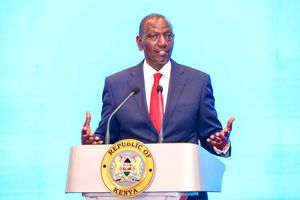
The broader value of KNM-ER 64061 is that it adds weight to Turkana as the home of human origins when there is focus on building a science museum in there. A presidential task force established in 2024 is overseeing plans to develop a museum and science park in the region, part of an attempt to turn scientific prestige into local opportunity.
The ambition is understandable. Turkana has produced a steady stream of globally important fossils, yet it remains among the least accessible parts of the country, with long distances, tough terrain and limited visitor facilities. Supporters say strategic investment could allow communities to benefit from a heritage that has long attracted international teams, while also helping protect fragile sites from damage and illegal collection.
KNM-ER 64061 also arrives when the Turkana Basin keeps delivering headline-making science – only compared to the world-breaking records of its athletes. While the athletes have turned their practice zone into a unique theatre, drawing in millions of dollars, the same cannot be said of the unique heritage in Turkana.
Last year, international media was excited when researchers uncovered ancient footprints confirming that Paranthropus boisei – the so-called “Nutcracker Man,” a large-toothed cousin of early humans that was not a direct ancestor – lived alongside Homo erectus, the early “upright walking man”.
The prints, preserved in muddy ground and dated to around 1.5 million years ago, were found in the same area Homo erectus tracks had been documented, confirming that two species were in the same landscape at the same time.
Dr Kevin Hatala, the study’s lead author from Chatham University in the United States, said that was “the first direct snapshot of the two species together on the same immediate landscape”.
Unlike bones that can be scattered by time and erosion, footprints are moments of life captured in motion – bodies passing through, leaving evidence that lasts.
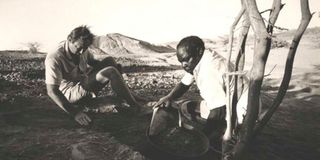
Kamoya Kimeu (right)and Richard Leakey at work. Mr Kamoya was instrumental in the discovery of the Turkana Boy fossil.
Also last year, the journal Nature reported the discovery of a partial skeleton on the eastern shore of Lake Turkana dated to roughly 1.5 million years, including the first hand bones of the “nutcracker man”.
This included a long, powerful thumb, short fingers and a mobile fifth digit – features that scientist say gave the species strength and precision comparable to grips seen in modern humans and African apes. Foot bones and teeth were also uncovered, deepening debate over which hominin species could have produced the stone artefacts found in the same sediments. That puzzle is what excites researchers.
Tourism attraction
“Unfortunately, in these localities with multiple species, without the hominin dying with the stone tool in its hand, we can’t say for sure which hominin made the tools. We can now say both would have been capable,” said Carrie Mongle, an anthropologist at Stony Brook University, according to IFLScience.
That uncertainty is why Lake Turkana region keeps drawing researchers back as scientists attempt to unravel the puzzle.
Turning that into a tourism attraction is the challenge facing tourist and heritage organisations. Though the discoveries have increasingly positioned the country as a leading centre for paleoanthropological research, competing with Ethiopia’s famous sites such as Hadar, which also claims a central place in the “land of origins” narrative, there has been little investment on the same.
On the tourism side, the devolved government of Turkana has continued with the Tobong’u Lore (Welcome Back Home) initiative, tying identity and economic promise to the archaeological record.
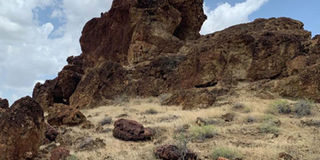
Sibiloi's petrified forest.
Advocates say a strong heritage programme can create jobs – guides, hospitality, transport, crafts – while giving locals a greater stake in protecting the fossil fields and telling the story on their own terms.
The biggest attraction to the region still remains the Turkana Boy, the near-complete Homo erectus skeleton was found in Nariokotome in 1984 and dated to about 1.6 million years. So important is the skeleton that in July 2024, it was taken on a European tour as part of Kenya’s “Welcome Home” tourism push, drawing thousands of people.
It is thought that if the planned museums and science park are realised, they could become more than exhibition halls.
Turkana has the potential to build a “Silicon Valley” of human-origins science: a cluster where museums, laboratories, field schools and technology meet in one place. A strong campus could attract visiting scholars and students, host conferences and create demand for specialist skills such as fossil preparation, conservation and scientific illustration. Researchers say in such an ecosystem, new opportunities could grow – local research support services, heritage-tech start-ups, training programmes and partnerships that turn a dry and distant landscape into a global centre of learning and innovation.
Turkana’s story does not end with the earliest humans. Later Stone Age sites in East and West Turkana have yielded pottery and domesticated animals, pointing to long continuity in human history. From deep prehistory to more recent lifeways, the basin holds a long narrative of adaptation – written across bones, footprints and artefacts.
With KNM-ER 64061 added to that growing archive, Kenya’s human-origins story gains a rare new chapter: not just a skull fragment, but a body – an ancestor preserved in enough detail to invite new questions about how we lived, moved and survived. And once again, the answer appears to be buried in Turkana, the place the past keeps insisting on being found.
A science park in Turkana would do more than house fossils in glass cases. It would turn discovery into infrastructure, bringing roads, laboratories, training, jobs and visitors to a region too often treated as distant and disposable.
It would anchor research where the evidence lies, build local skills to protect fragile sites and ensure communities in this extraordinary landscape are not just spectators to world-class science, but beneficiaries of it.
For decades, Turkana has supplied the world with proof of where humanity came from. A science park is how Kenya ensures the world also sees where that story can go next.
Follow our WhatsApp channel for breaking news updates and more stories like this.
John Kamau is a PhD candidate in History, University of Toronto. Email: [email protected]