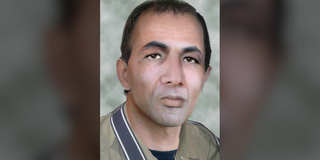
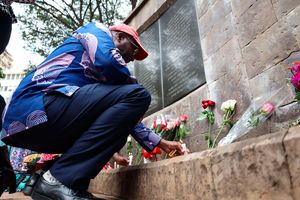
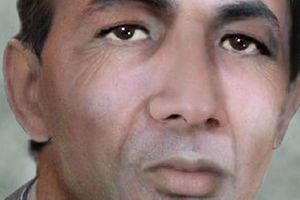
Saif Al Adel, the man who led Osama bin Laden’s personal security team when Al Qaeda militants detonated explosives in Nairobi and Dar-es-Salaam on August 8, 1998, is the last of 21 extremists yet to be jailed or killed, as security agencies across the world still hunt for him.
Intelligence sources globally believe that Saif has now taken charge of Al Qaeda.
At the time, Saif was in Afghanistan. He had helped bin Laden and Al Qaeda followers relocate to Tarnak Farms several months before the attacks.
Among his last known whereabouts was the Karte Parwan district of Kabul, where he lived until three years after the attacks. He had played his role in the terror attacks from Afghanistan.
The 1998 attacks left 224 people dead and more than 4,500 wounded. To date, out of a list of 21 suspects, only Saif remains at large.
In evading security agencies, he has assumed multiple identities. Saif Al Adel, Muhamad Ibrahim Makkaw, Ibrahim Al-Madani, and Muhamad Salah al-Din al-Halim Zaydan are the aliases that have been made public.
Following the deadly terror attack, a total of 900 officers attached to the Federal Bureau of Investigation (FBI) were deployed to several countries to collect evidence and arrest the plotters.
The aftermath of the bombing of the US Embassy in Nairobi on August 7, 1998. The US Supreme Court on May 18, 2020 ruled that Sudan must pay hundreds of millions of dollars in punitive damages to some victims of the 1998 attacks. PHOTO | FILE | NATION MEDIA GROUP
“The Rewards for Justice Programme, United States Department of State, is offering a reward of up to $10 million for information leading directly to the apprehension or conviction of Saif Al Adel,” the FBI says in a statement published on its website.
The FBI holds that Saif is an Iran-based Al Qaeda senior leader and also the leader of the Hittin Committee, which governs and coordinates the extremist group’s transnational activities.
He is wanted in connection with the August 7, 1998, bombings of the United States Embassies in Dar-es-Salaam and Nairobi.
The United Nations (UN) believes that Saif succeeded bin Laden in February 2023. Bin Laden was killed during a US ground raid in May 2011. Ayman al-Zawahiri, an Egyptian doctor who was also among Al Qaeda leaders, died in a US drone strike in July 2022.
According to the Wilson Center, an organization chartered by the US Congress, Saif’s leadership style is philosophical compared to that of his predecessors.
“Adel’s leadership style has differed from his predecessors. Bin Laden was known as a charismatic philosopher-poet, while Zawahiri specialised in strategy and propaganda.
Adel was widely viewed as a shrewd and seasoned military tactician, who rose quickly through Al Qaeda’s ranks. He was initially an instructor on explosives, then led bin Laden’s personal security team, and more recently directed Al Qaeda military operations,” the Wilson Center states.
In Egypt, not much is known about Saif, not even his date of birth.
Documents from his home country show that he was born on either April 11, 1960, or April 11, 1963.
“Since the identity behind his nom de guerre is unknown, it is impossible to say anything about his family or childhood. There is some indication that he did not have a traditional Islamic education,” a document on his Egyptian life reads.
When he penned a memoir in 2005 about Abu Mus`ab al-Zarqawi, Saif wrote that he partly used an abundance of free time to memorise the Quran, a task to which primary Islamic education is almost exclusively devoted.
He was in the Egyptian military at the time of writing the memoir and was promoted to colonel in the special forces in 1987.
In 1987, he was arrested in Cairo and charged with attempting to revive the Jihad Organisation (tanzim al-jihad), which six years earlier had been responsible for the assassination of Egyptian President Anwar Sadat.
His prosecution became famous and is known as the National Security Case. It led to the arrest of thousands of Islamic activists.
Tanzim al-jihad is also believed to have attempted to assassinate former Egyptian Interior Minister Hasan al-Basha and journalist Makram Muhammad Ahmad.
“It was also claimed at the trial that he had been involved in a plot to destroy the Egyptian Parliament building, simultaneously driving a bomb-laden truck into the building and crashing a hijacked airplane into it as well,” documents reveal.
Kenyan and American security officers on site following the bombing of the US Embassy in Nairobi on August 7, 1998. An almost simultaneous bombing was carried out at the US Embassy in Dar es Salaaam, Tanzania.
Photo credit: File | Nation Media Group
On May 6, 1987, Saif was among more than 400 individuals jailed, with Major Muhammad al-Baram of the Special Forces and Special Guard being one of the other convicts.
In prison, Saif differed with tanzim al-jihad members.
In 1998, he fled to Saudi Arabia before eventually settling in Pakistan. Saif’s involvement with Al Qaeda had started in 1990, when he would travel between Afghanistan and Pakistan to train militants.
American authorities established that between 1990 and 1992, Saif was based in Peshawar, Pakistan, and would often travel to Afghanistan to train militants at the Jihad Wal camp near Khost.
Another terror suspect, L’Housseine Kherchtou, informed US security agents that Saif trained him on explosives.
“At some point in 1992, Saif travelled to Khartoum and conducted explosives training at the Damazine Farm,” a US dossier stated.
Saif later bragged to Mohammed Odeh, an Al Qaeda member serving a life sentence in Florida, US, that he took part in the 1998 attacks on Kenya and Tanzania as part of Al Qaeda’s expansion plans.
He asked Odeh to head to Somalia through Kenya and understand the terrain, a clear indication that Saif had already risen through Al Qaeda’s ranks. The documents state that at the time he was serving in Al Qaeda’s military committee.
In 1993, Saif was key in establishing Al Qaeda training camps in Somalia and the Ogaden region of Ethiopia.
In August 2024, Washington confirmed that it had received Sh43.2 billion from the Sudan government to compensate victims of the Nairobi and Dar-es-Salaam bombings.
“We are pleased to announce that the United States received the $335 million provided by Sudan to compensate victims of the 1998 bombings of the US Embassies in Kenya and Tanzania and the USS Cole in 2000, as well as the 2008 killing of USAID employee John Granville,” a statement from the US Department of State read at the time.
In December 2024, a US judge ordered that seven missing files linked to the compensation of victims be traced. At the time, the case had been pending for 26 years.
“This case cannot continue due to the missing files. I therefore direct the deputy registrar to trace them,” Justice Lawrence Mugambi said then, as he urged the victims to relax as the matter was being solved.