The renewed push to cap career diplomatic appointments at 70 percent, with the balance going to non-career people, is gaining traction among MPs in a proposed law that is reigniting debate over whether Kenya’s foreign service is being undermined by political patronage.
The draft Foreign Service (Amendment) Bill 2026, sponsored by Mwingi West MP Charles Nguna, seeks to amend section 20 of the law to ensure that career diplomats get the lion’s share of the positions of the country's foreign missions.
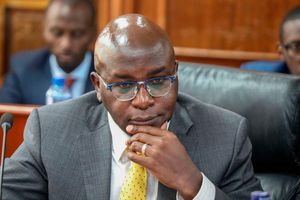
Mwingi West MP Charles Nguna at a past event.
Photo credit: Boniface Mwaniki | Nation
The Bill has already undergone pre-publication scrutiny by the National Assembly committee on Defence, Intelligence and Foreign Relations, chaired by Belgut MP Nelson Koech, and cleared for publication and introduction into the House.
“This Bill aims to strengthen institutional governance by ensuring that career diplomats bring continuity, institutional memory, and technical expertise,” says Mr Nguna, noting that “this will enhance Kenya’s global image as professional envoys improve credibility and effectiveness in advancing national interests abroad.”
Currently, the Foreign Service Act has no parameters on the appointment of non-career appointees. Once seen as elite postings for seasoned diplomats, ambassadorial roles are now increasingly viewed as landing spots for rejected politicians and regime loyalists.
Section 20 of the Foreign Service Act is not sufficient in terms of qualifications of who gets appointed as High Commissioner, Ambassadors and diplomatic and consular representatives, only stating that their nomination “shall reflect a fair balance between career diplomats and other appointees.”
The Bill says the office of a high commissioner, ambassador, diplomatic or consular representative shall be a State office in line with Article 260 of the Constitution, which lists the categories of State officers.
Except for the president and his deputy, all other State officers are vetted and approved by the National Assembly for appointment upon nomination by the president.
The law further defines the duties of the head of mission to include the pursuit of the foreign policy objectives of their country in the host country, to act as a personal representative of the head of State in the other country and to be an official representative of the republic at official functions in the host country.
“The head of mission shall be responsible for the management and administration of the mission and all members of the foreign service at the mission, including the locally engaged staff of the mission,” the law states.
Kenya’s successive administrations have handled diplomatic appointments based on the fact that diplomacy has always been inseparable from politics. But even as this unfolds, International Diplomacy experts are questioning whether the country is getting the right people to push the country’s strategic national interests in their missions, as it emerged that some of the current holders of these positions have no clue about what they are required to do.
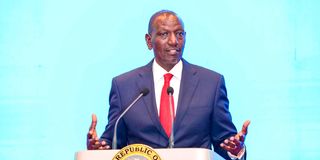
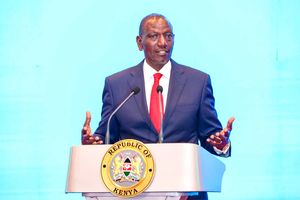
President William Ruto and Mwingi West MP Charles Ngusya Nguna at a past event. Mr Nguna proposed the new law.
Photo credit: Photo | Pool
The MP, in his second term, says that passing the Bill as originally drafted will support Kenya’s foreign policy goals in guaranteeing that representation abroad is consistent with long-term strategic national priorities. International relations expert Prof Macharia Munene says that the proposed Bill is ideal, but “it is up to the president's policies and who he decides to appoint to do what.”
“The intention is ideal, but it is likely to become cosmetic depending on how he handles the bureaucrats. Career officers are good for technical matters, but not all are good at the policy or political level,” said Prof Munene.
Amb Erastus Mwencha, a distinguished International Diplomacy expert and an economist recognised as a key architect of Africa’s regional and continental economic integration, says that diplomacy has shifted from intelligence gathering to pushing commercial interests.
He notes that while the Bill means well for the country, “it’s upon the president to appoint people who will ensure that Kenya’s strategic national interests are safeguarded.” “What parliament is trying to do is the right thing. In the protocol of international diplomacy, heads of foreign missions are appointed by the president to represent their country,” says Mr Mwencha.
Amb Erastus Mwencha
Photo credit: File | Nation
He adds that it’s not bad to appoint politicians as heads of missions in foreign countries, citing the example of former US president, the late George HW Bush (senior).
“The problem is that we go for individuals who lost an election as a reward.” “The sad thing is that they don’t articulate national interests in their host nations but political and personal interests,” says Mr Mwencha, adding, “It’s good to have well-trained diplomats as heads of missions because they know where a country should head,” he says.
The former US president is cited as one of the most well-qualified US presidents due to his extensive diplomatic and administrative background. His major diplomatic roles include ambassador to the United Nations between 1971 and 1973.
He also served as Chief of the US Liaison Office in China from 1974 to 1975, a role equivalent to an ambassador before formal diplomatic relations were fully restored. “Because of the country’s strategic issues, the president can appoint someone who can take care of interests that benefit their country,” says Mr Mwencha.
Contrary to views that the Bill is cosmetic and does not address Kenya’s strategic national interests, Mr Koech says the Bill “is a necessary step towards restoring professionalism and credibility in Kenya’s foreign service.”
Notably, Mr Koech defended the proposed law, saying it is not about numbers alone, but about outcomes, and that if enforced with integrity, it will ensure that Kenya’s foreign service is professional, credible, and strategically aligned with our national interests.
Nonetheless, the Belgut MP says political appointees in Kenya’s diplomacy are often chosen for loyalty or political connections, “giving them direct access to power and sometimes strong deal‑making ability, but they risk inconsistency, short‑termism and fragmented foreign policy.”
“In contrast, career diplomats rise through professional training, bring institutional memory and ensure credibility, stability and coherence in Kenya’s global engagement,” says the MP.
He notes that for Kenya’s global standing, political appointees can raise visibility but may undermine credibility if poorly prepared, while career diplomats reinforce predictability and influence in multilateral forums.
“Far too long, ambassadorial appointments have been dominated by political patronage, undermining the institutional memory and technical expertise that diplomacy requires,” says Mr Koech. Prof Munene notes that Kenya’s founding president, Jomo Kenyatta, “was very careful as to who he appointed to which station.”
“The first six ambassadors of independence reflected Kenya's non-alignment posture and the political interests of such heavyweights as Jaramogi, Masinde Muliro, and probably Paul Ngei,” says Prof Munene.