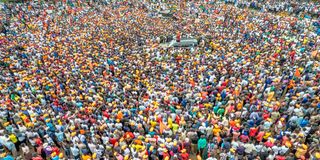
Politics in Nyanza now comes with a price tag. Campaigns for political office are heavily driven by personal resources and patronage, with the cost of winning support often calculated per head.
Behind the colourful rallies, packed stadiums and “spontaneous” crowds lies a mobilisation economy in which leaders are expected to spend millions of shillings to put people on the ground.
Public expectations are increasingly shaped by the prospect of immediate handouts at town hall meetings and campaign stops, creating a barrier for young and less affluent candidates.
A crowd is no longer simply a measure of enthusiasm. It has become a commodity to be assembled, transported, fed and paid.
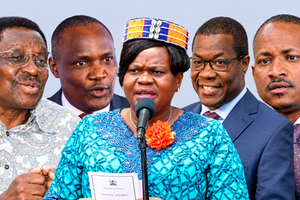
The issue came into focus recently when a clip of Homa Bay Woman Representative Joyce Osogo Bensuda detailing the millions of shillings she had spent hiring buses to ferry people to an event went viral.
On October 2, Dr Osogo hosted an event in Homa Bay town and, in the video, outlined her plans to ferry people to the meeting. Dubbed the Jua Kali Artisan Day, the event drew hundreds of people from across the county.
It brought together traders from the 40 wards to receive Sh78.1 million in cash and equipment from the Uwezo Fund, Women Enterprise Fund and National Government Affirmative Action Fund.
While some attendees walked to the stadium, witnesses said others were ferried in school buses. The video, apparently recorded in her living room, shows the MP planning weeks ahead to ensure a large turnout. Dr Osogo says she intends to spend more than Sh1 million paying people to attend the event, with each expected to get Sh1,000.
In the same clip, Dr Osogo refers to an earlier event in which she says she paid every attendee Sh300. The MP says she hired 56 buses to ferry people to an event in Ndhiwa. She claims to have spent Sh840, 000 on paying attendees.
“This is besides the cost of hiring the buses and the amount spent on T-shirts and umbrellas,” she says in the clip.
She describes the earlier mobilisation as modest compared with what she is planning for the stadium event, adding that she had improved her strategies.
Woman Representative for Homa Bay County, Joyce Bensuda,
Photo credit: File I Nation Media Group
“I must tell you these things so that you can convince those who have dissenting voices,” she tells her planning team in the clip, apparently anticipating complaints from people who might feel underpaid.
The lawmaker then says she pays Sh400 for every person invited to her events, though the amounts may vary.
“Those without merchandise get Sh1,000. I must tell the attendees that those uncomfortable with what they are to get should not bother going to the event,” she says.
For the stadium event, she says she has lined up 62 school buses and plans to spend Sh1.5 million on mobilisation.
Contacted, the MP confirmed the authenticity of the video.
“Are you referring to the video where I was captured in my house? It has nothing to do with the Orange Democratic Movement,” she said, responding to claims that ODM leaders are using money to ensure large gatherings.
Several leaders in Nyanza are in the same predicament. The need for crowds can turn an ordinary meeting into an expensive undertaking.
A Weekly Review investigation has traced the process, from the time mobilisation instructions are issued to the arrival of people at a venue. Leaders spend money on school buses and other vehicles, with groups and individuals paid varying amounts.
Those mobilised include grassroots organisers, youth groups, boda bodas, women’s groups, opinion leaders and ordinary people. Each plays a role in a network coordinated by local mobilisers, with rates negotiated for transport, food and cash.
For some, attendance comes with transport and food. For others, there is cash payment. The rates vary, depending on the size, location and significance of an event.
Then there is the politics of expectation. Leaders may be reluctant to spend millions but are compelled to do so.
In a political culture where crowd size is interpreted as a measure of influence, mobilisation is becoming an unofficial cost of participation.
ODM chief Oburu Oginga and other party leaders have publicly urged members to mobilise for functions.
Kisii Governor Simba Arati and ODM party leader Dr Oburu Oginga at Sameta grounds in Kisii County during the 'Linda Ground' function on January 25, 2026.
Photo credit: Ruth Mbula | Nation Media Group
Interviews with politicians, grassroots mobilisers, transporters and locals suggest the practice is distorting political participation, creating a system in which attendance is increasingly transactional.
In Nyanza, where political loyalties have been rooted in personalities and parties, the death of former PM Raila Odinga opened a new chapter in the region’s political contests.
As politicians scramble to inherit his political constituency, the battle for visibility is becoming a battle for crowds. For those who know where to find them, crowds have become a business.
For Mr Emmanuel Sirunda, a boda boda in Ugunja, Siaya County, the business was rewarding on the day President William Ruto met grassroots leaders in Kisumu.
By 6am, Mr Sirunda was at the shipyard, among thousands of delegates who had travelled from across Nyanza for the meeting.
Once inside, he and other delegates were handed red cards bearing unique codes, with the national coat of arms printed on the back. The card appeared to be little more than an identification pass. By the end of the day, it had acquired a different significance.
The delegates went for a buffet as they waited for the President. When Dr Ruto finally appeared at 2pm, the gathering erupted in cheers. The sea of supporters was a curious blend of orange and yellow, with ODM and United Democratic Alliance (UDA) caps and branded merchandise dotting the crowd.
Mr Sirunda was among 150 representatives from Ugunja constituency. The other constituencies in Siaya – Bondo, Rarieda, Alego Usonga, Ugenya and Gem – had similar numbers.
“We were being taken care of by representatives of our area MPs. School buses were hired and we were promised ‘something’ at the end of the day, courtesy of State House. All the delegates had to do was cheer the President,” Mr Sirunda said.
When the day ended, every person walked away with Sh5,000. There was, however, a condition. The red card issued at the beginning of the day had to be produced before the money could be collected. With more than 10,000 delegates, the cost was an estimated Sh50 million in payouts.
“I wouldn’t have made such an amount in the day,” the rider said.
The gathering offered more than a glimpse into the President’s efforts to cultivate support in Nyanza. It also exposed an emerging economy around political mobilisation, in which turning up at a rally can become a day’s work.
For people who depend on casual jobs that earn them less than Sh200 a day, political mobilisation can offer Sh500 to Sh5,000.
The opening of the Raila Amolo Odinga mausoleum in Bondo on October 7 offered another chance for mobilisation. There was pressure to produce a sizeable crowd. People had to be mobilised from Bondo and neighbouring counties.
President William Ruto and Mama Ida Odinga during the handover and dedication of the Raila Amolo Odinga Mausoleum in Bondo, Siaya County.
Photo credit: PCS
That is where people like Sally Akinyi*, come in. She has spent months building a network of individuals she can call whenever a politician needs a crowd.
Connections with politicians and locals have turned Ms Akinyi into a broker of sorts. Ms Akinyi says she is regularly contracted to mobilise crowds for two MPs who are eyeing governorship, a parliamentary aspirant in Kisumu Central and occasionally President Ruto.
“Politicians need to appear popular wherever they go and show their opponents and sponsors they have a following. In Bondo, I went with people to show support for Dr Ruto,” she said.
Ms Akinyi added that when an event is in Kisumu town, every hired person is given Sh500. For assignments outside the lakeside city, it is between Sh1,500 and Sh2,500, with transport provided separately.
Her biggest mobilisation involved about 200 people. Ordinarily, she works with around 50.
The scale of the operation was visible in Bondo. The Weekly Review team counted 23 vehicles that ferried women and young people from Kisumu.
They included 12 vans, each with a passenger capacity of seven to eight people, though the number was higher in some. Three buses and eight assorted vehicles were also used.
President William Ruto addresses members of the public after inspecting the Dhogoye Bridge and the ongoing road works in the area, Bondo, Siaya County.
Photo credit: PCS
Ms Akinyi, however, said the business is not always lucrative. After an assignment, a politician may claim to have spent money on other items or services, leaving mobilisers struggling to pay the people hired.
“When that happens, we understand because we have developed a working relationship with politicians. Sometimes we are not paid cash, but through economic empowerment or bursaries. I explain to my team,” she said.
For hired crowds, political allegiance is fluid. What brings them to a rally may not necessarily be commitment to the politician on the podium but the prospect of making money for the day.
For some, it is quick money that requires neither a CV nor formal employment.
In Kisii and Nyamira counties, leaders aligned with the broad-based government organise economic empowerment events almost every week.
Residents are given amounts ranging from Sh100 to Sh2,000. The money distributed appears to depend, in part, on attendance, with the available cash given to those present.
Some programmes bring together women’s groups, widows or choirs. These formations can attract larger allocations because they are established and with identifiable members.
Interviews with associates of leaders allied to the broad-based government suggest that some of the economic empowerment programmes are funded by the state.
“Our woman representative gets money from State House. It would be difficult to sustain our such weekly programmes without that support,” said an aide of a lawmaker.
The leaders also distribute bags food, which are ordinarily meant for relief, to their supporters.
“The packages you see us dishing out, mainly consisting of rice and beans, are from the government,” said an aide of a UDA lawmaker in Kisii County.
Umbrellas, caps, T-shirts, wrappers and other merchandise are obtained from the UDA main office, with local teams given the responsibility of branding them.
Reported by Rushdie Oudia, Ruth Mbula, Domnic Ombok and George Odiwuor