For nearly four decades, Raila Amolo Odinga dominated Luo Nyanza politics, building a following that survived five unsuccessful presidential bids. A year after his death, the community remains divided over his successor, with divisions within the Orange Democratic Movement (ODM) threatening its future ahead of the 2027 General Election.
The dispute marks Luo Nyanza’s second major leadership transition since independence. The first followed the death of Raila’s father, Jaramogi Oginga Odinga, in 1994, when Raila emerged as the community’s undisputed leader.
Luo Council of Elders Deputy Ker James Ayaga says the current transition has exposed divisions among leaders struggling to agree on the community’s future.
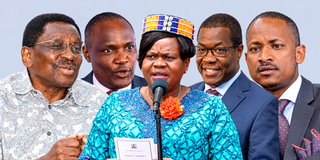
“The community has been very chaotic. Luo Nyanza is at war because the current leaders don’t want to sit together to question themselves on how to behave after the demise of the Luo community's political and social kingpin,” Mr Ayaga says. He identifies Siaya Governor James Orengo, Embakasi East MP Babu Owino, Treasury Cabinet Secretary John Mbadi, Energy Cabinet Secretary Opiyo Wandayi and Homa Bay Governor Gladys Wanga among those at the centre of the succession contest.
Kisumu Deputy Governor Dr Mathew Owili, Chairman of the Luo Council of elders Ker Odungi Randa led Nyanza residents in an intergenerational dialogue at Ofafa Memorial Hall on October 13, 2027 to fulfill Raila Odinga's last wishes.
Photo credit: Rushdie Oudia | Nation Media Group
Mr Ayaga says the disagreements have extended into Raila’s family. He recalls that after Jaramogi’s death, Mr Orengo and Kisumu Governor Anyang’ Nyong’o appeared better positioned to lead, given their political experience. Raila, however, charted his own path after falling out with leaders in Ford Kenya, his father’s party. Mr Ayaga attributes Raila’s rise partly to his ability to engage rivals without publicly alienating them.
“You know, if not for Raila, that period when Jaramogi died would have been worse than this one. Young man, Raila was a schemer. A very good schemer. Whoever you thought was his enemy was the first person he wanted to meet,” he says.
He argues that Raila’s authority rested on political judgement, relationships and popular confidence, warning that education, wealth and public office alone cannot produce a comparable leader.
Mr Ayaga also attributes the current confusion to ODM’s participation in a broad-based government with President Ruto’s United Democratic Alliance (UDA). Unlike Jaramogi, who died firmly in opposition, Raila died while his party was working with the government, an arrangement that has divided opinion over development opportunities and political concessions.
National Assembly Minority Leader Junet Mohamed says competition is inevitable after a dominant leader’s death, but politicians seeking to replace Raila have underestimated the sacrifices required to build his following.
Homa Bay Governor and ODM Chairperson Gladys Wanga addresses party supporters during a political rally at Kirembe Grounds, Kisumu on May 31, 2026.
Photo credit: Alex Odhiambo | Nation Media Group
“You cannot become Raila in a year, or in three months. They are lying to themselves. You have not even spent an hour in jail and you want to be Raila. Being Raila is not instant coffee,” the Suna East MP says.
Mr Mohamed says Raila’s political authority stemmed from his long struggle for democracy and constitutionalism, including more than eight years in detention, rather than the offices he held or the party he led.
He says no current leader matches Raila’s combination of political experience, public appeal and personal sacrifice, adding that voters will determine the community’s future.
“In the end, the people will decide, and the people will show us where to go. They will give the way and show the right person that they think should be the leader,” he says.
Mr Mohamed maintains that ODM should remain in the broad-based government, the arrangement Raila left behind, and support President Ruto’s re-election. He argues that the region is beginning to benefit from development after decades of perceived neglect.
He cites road construction in Migori, where he says one or two roads are being built in each constituency.
Mr Mohamed also urges ODM supporters to abandon the belief that the Luo community belongs permanently in opposition, where political mobilisation has often involved street protests and clashes with police.
He nevertheless acknowledges that Raila would have been ODM’s strongest presidential candidate had he lived, arguing that potential replacements lack the electoral strength to mount a serious challenge.
Homa Bay Senator Moses Kajwang’ questions ODM’s decision to support Mr Ruto’s re-election without preserving the option of fielding its own presidential candidate.
Focus on policy and development
He says the party weakened its bargaining position by ruling out a presidential bid before negotiations with UDA, which should have pitted competing candidates against each other.
“We should never have declared that we are not going for the presidency. We should have said that ODM is going to field a candidate for the presidency, so that when we sit at the table, we are sitting as equals,” Mr Kajwang’ says.
He urges ODM to focus on policy and development rather than personalities or government positions. He also cautions against claims that Raila had settled on a political arrangement for 2027, saying the former Prime Minister always kept several options open.
Comparing Raila’s leadership to the biblical story of Moses, Mr Kajwang’ says the community must choose a successor to the leader who shaped its politics for four decades.
Raila’s influence extended nationally, he says, with politicians building careers either by opposing or aligning themselves with him.
“You were either suffering from ‘Railamania’ or ‘Railaphobia’. There will not be one single kingpin who will emerge, who will become a Raila,” he says.
Mr Kajwang’ describes Raila as a figure forged through detention, imprisonment, street protests and exile, arguing that wealth, elective office and proximity to power cannot reproduce his legacy overnight.
He also sees the broad-based government as an opportunity to secure projects neglected by previous administrations, citing the proposed Lake Victoria Ring Road.
Energy Cabinet Secretary Opiyo Wandayi describes the succession contest as healthy competition that will eventually clarify the region’s leadership.
Energy and Petroleum Cabinet Secretary Opiyo Wandayi.
Photo credit: Dennis Onsongo | Nation Media Group
He says the confusion would have been greater had Raila died while ODM was entirely in opposition, arguing that the former Prime Minister deliberately chose to work with President Ruto.
Mr Wandayi says the arrangement has benefited the community and warns leaders against holding the President to ransom over development commitments. He predicts Nyanza voters will support Mr Ruto in 2027, citing the region’s growing recognition of the value of working with the government.
Uriri MP Mark Nyamita attributes the succession crisis to ODM’s failure to establish structures capable of sustaining the party beyond Raila’s personal influence.
He says many supporters followed Raila because of their belief in him, not necessarily their commitment to ODM as an institution. His death has forced politicians to demonstrate what they can offer voters independently of his reputation.
“There are many people who are around Baba just for convenience, but never believed in a thing that he actually stood for,” Mr Nyamita says.
He says voters increasingly judge leaders by tangible improvements, including roads, markets and electricity connections, rather than political loyalties.
“If my party, the ODM party, fails to do credible nominations, it will be the end of the party. I can tell you for free,” he says.
Under Raila, Mr Nyamita says, dissatisfied aspirants could be persuaded to remain in ODM because the party leader had the national influence to offer alternatives. Without that authority, disputed nominations could drive supporters away.
Suba South MP Caroli Omondi says the crisis predates Raila’s death, tracing it to the departure of founding members and disillusionment among leaders who felt ODM was abandoning its original identity.
He dismisses claims that the broad-based government represents a settled political legacy, arguing that Raila would have opposed political goonism in Nyanza and the privatisation of sugar factories.
Mr Omondi claims that only Wycliffe Oparanya and Beatrice Askul had Raila’s blessing to join the government, while others negotiated their entry independently. These assertions about private discussions were not independently established in the account presented.
He adds that Raila had contemplated leadership changes before his death but offers no evidence that the plans had been finalised.
Political commentator Joshua Nyamori compares the succession struggle to the uncertainty that follows the fall of a large tree, as those who depended on it search for a new home.
He argues that President Ruto has emerged as a potential political anchor because Raila left the region closer to the Head of State through the broad-based arrangement.
Mr Nyamori estimates that seven or eight in every 10 Luo Nyanza voters would support Mr Ruto if an election were held now. This is his assessment, not a cited opinion poll.
Raila rose through years of detention and opposition politics before becoming Prime Minister in the coalition government formed after the disputed 2007 election. Despite losing successive presidential contests, he remained central to national politics, forging alliances with former adversaries, including Presidents Daniel arap Moi, Uhuru Kenyatta and, ultimately, Mr Ruto.
His final political arrangement with Mr Ruto followed the deadly Gen Z protests of 2024 and brought ODM into a broad-based government.
The question facing Luo Nyanza is whether that arrangement can endure without the leader who negotiated it, and whether ODM can preserve its identity as competing factions pursue different paths.
A year after Raila’s death, the community has yet to agree on a successor. The 2027 election and ODM’s nomination process will test the party’s ability to manage the transition and could reshape the region’s political loyalties.