Happening Now: NTV KENYA LIVE | Senate Proceedings
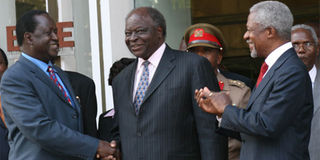
President Mwai Kibaki and Prime Minister Raila Odinga shake hands as Former UN Secretary General applauds in this January 26, 2008.

New information reveal intrigues that shrouded mediation efforts as Kenya teetered on the brink of anarchy following the disputed 2007 elections.
Part of the information contained in United Nation’s archival documents also reveal the mediators’ frustration with the PNU side for its insouciant attitude despite the dire situation.
Delicate talks were about to begin when President Mwai Kibaki, threw spanner in the works by announcing half of his cabinet. In a note marked confidential Lynn Prescoe the then United Nations Under-Secretary General for Political Affairs wrote to the then UN Secretary General Ban Ki-Moon on January 8,2008 stating, “The timing of the announcement is worrying and illustrates President Kibaki’s aversion to current mediation efforts “
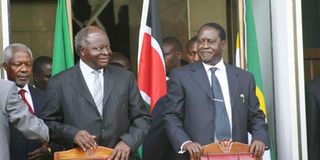
President Mwai Kibaki and Raila Odinga stand next to each other before signing a grand coalition deal at Harambee House witnessed by the chief mediator, Kofi Annan, in 2008.
Kibaki’s announcement came just hours after President John Kufuor of Ghana arrived in Nairobi in his capacity as African Union chairman, and just before the departure of US Assistant Secretary of State Jendayi Frazer who had advised the government not to make cabinet appointments until it had entered into a dialogue with the Raila-led ODM.
Kibaki’s actions were part of his political game to establish control and to have an upper hand in his negotiations with Raila who dismissed the move as a public relations gimmickry meant to deflect and undermine international mediations.
Meanwhile as the crisis deepened, Ban-Ki Moon dispatched John Holmes the United Nations Under Secretary General for Humanitarian Affairs and Emergency Relief on a fact finding mission. During the trip Holmes spent time meeting mediators and political players and also travelled around the country to assess the humanitarian situation.
International pressure
In a note marked “confidential” which he sent to Moon at the end of his three day mission, Holmes lamented how his trip had left him with mixed feelings. Although he expressed optimism about an early power sharing deal, he advised the Secretary General that immense international pressure needed to be exerted on the parties to reach a deal. He also expressed his concerns about the fervid animosity he had observed between PNU and ODM during the private talks.
“I was troubled by the hostility with which senior members of the PNU government and ODM still view each other, as I could see in my own meetings. For example, the Foreign Affairs minister (Moses Wetangula) asked pointedly why the ODM should be able to lever its way into power through the use of violence, while the ODM leadership continues to suggest that a power sharing solution is unattractive when it believes election was stolen. “
Similar revelations on hostilities and intrigues that bestrode the mediation talks were recently laid bare by former Tanzania president Jakaya Mrisho Kikwete as he paid tribute to Raila Odinga in an interview with a Tanzania TV channel. With President John Kufour’s term as the AU chairman having come to the end on January 31, 2008, it fell upon Kikwete as the new Chairman to work with other international mediators to restore peace.
His predecessor Benjamin Mkapa, who was already in Kenya as part of the mediation team, called him and complained how the talks had stalled. He revealed that although both parties had agreed on a coalition government, the role of the proposed prime minister was contentious. "So Mkapa told me 'Mr President come and help us because Tanzania has a similar government with the one that is being proposed in Kenya '".
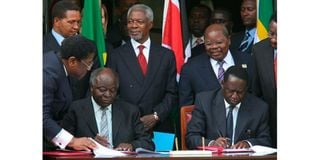
President Mwai Kibaki (left) and Raila Odinga sign a power sharing deal on February 28, 2008 in Nairobi as then Tanzania's President Jakaya Kikwete, chief mediator the late Kofi Annan and Tanzania's former president the late Benjamin Mkapa look on.
Out of diplomatic etiquette, Kikwete first telephoned Musikari Kombo, the leader of Ford Kenya, which was an affiliate party within the ruling PNU coalition and expressed to him his desire to visit Kenya to assess the situation.”Please ask President Kibaki whether he agrees with my offer to come?” he requested. “Moments later Kombo called back, telling me that Kibaki wanted me in Kenya as soon as possible.” But when he landed in Nairobi he was taken aback by the despondency he observed at the airport. “My host Kibaki, who had agreed to my visit, appeared gloomy,” Kikwete recalled. Along the way Foreign Affairs Minister Moses Wetangula, assuaged his anxiety by informing him that the dejection was because Kofi Annan the lead mediator had suspended the talks and everyone was worried.
Reach an agreement
Wetangula went on to plead with him to stay until Raila and Kibaki reached a deal, and also to talk to Koffi Annan not to leave Kenya. "I told Wetang’ula, talking to Koffi Annan not to leave Kenya is very simple. But me staying here until a solution is reached is impossible because l also have a country to run,” Kikwete recalled telling Wetangula.
In town, Kikwete first met Mkapa, who gave him the details of the talks and why they had stalled. He then met Koffi, Annan who also updated him on the progress of the talks and the reason why he had suspended the talks. He recalled Annan telling him:
"We have been trying to reach an agreement, but the problem is that the two parties reach an agreement in the morning. Coming back in the afternoon, they disown the same agreement. There's a certain female minister who has a very bad attitude, and she is causing us a lot of trouble. They are acting as if they are doing us a favour to be in this country. Because of this, l have decided to suspend the talks. "
He then asked Annan, "What should we do now?" and Annan replied," l'll wait until the day they'll be ready to talk. "
"One thing l realised was that the government's side really feared Raila. They thought that if Raila was to be given a prime minister position, he could end up being so powerful,” Kikwete observed.
"That night l met Raila who told me 'These guys have stolen my victory. But we can't continue this way because many people are dying and we must help our country to find peace. I am OK with the prime minister position, but it must have clear responsibilities. If it is just a premiership because of a name, then l am not ready. Another thing is that the other side wants the position not to be anchored in the constitution. If the position is not protected by the constitution, then l am not ready for it.'"
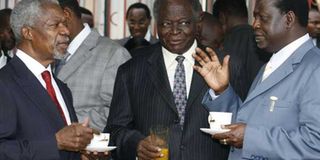
From left: Former UN Secretary-General Koffi Annan, President Mwai Kibaki and Prime Minister Raila Odinga. FILE PHOTO | NATION MEDIA GROUP.
Since Kikwete’s talks with Raila went late into the night, he couldn’t meet President Kibaki to share with him Raila’s demands. He met him the following day in the morning in the presence of vice president Kalonzo Musyoka and Prof George Saitoti. "They all agreed that the position of prime minister was necessary but it should just be like any other ministerial position. l then shared with them Tanzania's experience where the prime minister is responsible for the day to day running of government affairs and is also a "prefect" of all ministers.
Another point of disagreement was on the constitutionality of the office of the prime minister. Kikewete expressed fear that if the prime minister’s position was not embedded in the constitution, anyone could challenge it in court as an illegal office, but Kalonzo told him that no one could do that. “I made it clear to him that there are evil people who don't care whether Kenya burns or not.”
Kikwete later met Koffi Annan to update him on his separate meeting with Raila and Kibaki with their teams, after which they both agreed to organise a face to face meeting strictly between Raila and Kibaki in order to lock out their lieutenants who were sabotaging the talks. This meeting took place but the issue of the constitutionality of the prime minister’s position dominated the discussion. “We decided to summon Attorney General Amos Wako to share his thoughts with us. But Raila also insisted on the presence of his legal advisor, James Orengo. Kibaki said 'no problem', and James Orengo came,” kikwete revealed.
Constitutional powers
Wako advised that there was no problem at all in creating the office of the prime minister because the authority of the creation of such office was in the hands of the president and parliament. However, he pointed out that the president’s powerlessness to fire the prime minister as per the draft agreement would contravene the constitution because the president had constitutional powers to hire and fire. The only way out Wako constitutional amendments to adjust the presidential powers with regards to firing the prime minister.
"Annan then asked Kibaki what he thought about Wako's advice, and Kibaki replied,'So be it'. He had no problem at all. At long last there was light at the end of the tunnel. They agreed to break up for lunch and to return at 4.00 pm for the signing of the final agreement. But just before they broke up the Head of Public Service Francis Muthaura walked in and told President Kibaki that his team made up of Kalonzo Musyoka, George Saitoti and Martha Karua wanted to meet him before the official signing the agreement, but Kibaki dismissed him by telling him ' l'll meet them after signing the agreement."
Definitely if he had gone back to his team as requested by Muthaura, the whole draft agreement would have been dismantled. We went for lunch, came back, and went through the agreement for the last time. After everyone was satisfied, we went downstairs, and Raila and Kibaki signed the agreement. "
On February 29, just a day after the signing ceremony, UN Special Advisor on the Prevention of Genocide sent a report marked ‘confidential’ to the UN Secretary General in which he recommended actions to prevent recurrence of large scale violence.
For the short term he recommended an UN/AU police force that could be deployed to Kenya on short notice to support Kenya police. For the long term he recommended strengthening youth employment, constitutional and land reforms, and strengthening state institutions.
The writer is a London-based Kenyan researcher and journalist.