Long before Rigathi Gachagua discovered that a political retreat to his rural home could add value to his image, Jomo Kenyatta had found out the same about Gatundu, and Daniel arap Moi followed suit with Kabarak.
In Kenya, the politician’s home has never been merely a private residence. It can be turned into a shrine, a court, or a theatre of loyalty and resistance. That is why Wamunyoro matters in our reading of national politics. It is not simply Gachagua’s rural home in Nyeri, but his attempt to turn impeachment into grievance, and political humiliation into a second birth. Every delegation that arrives there is not merely visiting a former deputy president but participating in the construction of a myth.
But Gachagua did not invent this script. He is walking a path that Kenyan politicians have walked before. Our politics has repeatedly refused to remain inside Parliament, State House, party headquarters or public rallies. It keeps returning to the homestead, where power becomes personal, access becomes theatre, and citizens turn into delegations.
Before Gatundu became the shrine of presidential authority, there had been Maralal. The colonial government had moved Kenyatta to his restriction house there, hoping to reduce the political heat around him. Instead, Maralal became the first rehearsal of Kenyan political myth-making.
Kenyatta generated more heat from his Maralal house than Governor Patrick Renison had expected. There is a large file at the Kenya National Archives on delegations that sought to visit Mararal and the approvals sought from Nairobi. Politicians know how to take advantage of such sites and turn them into pilgrimage.
From Maralal, the aura travelled to Gatundu. Once Kenyatta entered power, Gatundu inherited the sanctity first manufactured in detention. The man who had received delegations under colonial surveillance now received them as president. Gatundu became more than an ancestral home. It became a theatre of loyalty, a place where political obedience was tested and where the republic quietly bent before the patriarch.
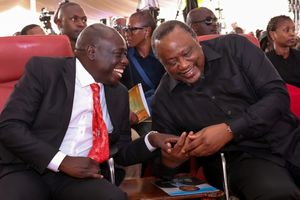
Former Deputy President Rigathi Gachagua receives a gift from PLP party leader Martha Karua at his Wamunyoro home in Nyeri County on May 4,2025.
Photo credit: Joseph Kanyi | Nation Media Group
In the troubled years after independence, especially after the assassination of Tom Mboya in 1969, Gatundu acquired a darker aura. It became associated with oathing, secrecy, ethnic consolidation and binding of political loyalty to the person of Kenyatta. Later, as the politics of succession sharpened and figures such as J.M. Kariuki exposed the moral contradictions of the post-colonial state, Gatundu remained the place where loyalty was performed and anxiety was managed.
While the State had Parliament, Cabinet and Kanu headquarters, the deeper rituals of obedience were imagined around the president’s home. To go to Gatundu was not simply to attend a meeting but to enter the patriarch’s compound. It was to be absorbed into a moral community where disagreement could be framed as betrayal of family, community, order and destiny.
That is the power of the political homestead, for it makes politics intimate. It removes power from the cold language of institutions and places it inside the warmth, fear and obedience of the compound.
Moi understood this grammar and perfected it at Kabarak. While Kabarak was not Gatundu, and did not carry the same oathing memory, Moi’s genius was different. He turned Kabarak into a court of access, patronage and political forgiveness. During the Kanu years, and even after he left office, politicians went to Kabarak to be received, blessed, rehabilitated or reminded of their smallness.
Kabarak, as Moi’s private State House, was the place where delegations arrived in humility. Choirs sang. Bishops prayed. Politicians laughed carefully. Moi listened, smiled, warned, blessed or withheld blessing. A politician could be revived by a visit to Kabarak. Another could be destroyed by being left outside its orbit.
At State House, Moi was president, but in Kabarak, the home gave his power a pastoral aura.
Before Ruto entered State House, Sugoi helped build the hustler story. It projected rural authenticity, simplicity, resilience and outsider ambition. Delegations to Sugoi dramatised the idea that power could be assembled away from the old dynastic centres. Sugoi told the story of the man from the village confronting the sons of privilege.
The Odinga homes have always played this role. Kang’o ka Jaramogi in Bondo has continued to play a role in myth-making. It held the story of Jaramogi Oginga Odinga: nationalist, vice-president, dissenter, detainee and opposition patriarch. Later, Raila Odinga’s Opoda Farm became a theatre of opposition pilgrimage, consultation, alliance-building and emotional renewal.
In the Odinga tradition, the homestead is archive, altar and battlefield. People go there not merely to meet a politician, but to touch a story: detention, betrayal, resistance, stolen victories, deferred justice and the refusal to disappear. The Odinga homes became a museum of injury and hope.
Once upon a time, there was Mululu: the home of powerful Kanu Secretary General Moses Substone Budamba Mudavadi, the father of current Prime Cabinet Secretary Musalia Mudavadi . Once christened the “King of Mululu”, Moses Mudavadi’s case is important because it shows that the political homestead was not only a presidential institution. It could also belong to a regional broker whose authority came from proximity to the president.
Mululu became Western Kenya’s mini-State House. Delegations went there not merely to greet Moses Mudavadi but to pass through him. They arrived with petitions, complaints, ambitions and anxieties, trusting that the man of Mululu could carry them to the man at Kabarak.
Before Kenneth Matiba entered politics, he opened his Embassy House in Kiharu to delegations. Embassy would later become the headquarters of defiance as Matiba fell out with Moi. Embassy House showed that private space could become a political institution not because the owner controlled the state, but because he had dared to confront it. In a country where many men went to Kabarak to be forgiven, Matiba made Kiharu a place from which refusal could speak.
Gachagua is trying to do from Wamunyoro what earlier politicians did from Maralal, Gatundu, Kabarak, Mululu, Embassy House, Opoda and Sugoi: manufacture meaning. But his case is unique. Wamunyoro is not the home of a sitting president. It is not the court of a ruler dispensing patronage. It is not merely the home of a regional broker. It is not yet a shrine of long opposition memory. It is the compound of a deposed deputy president attempting political resurrection.
That makes its myth fragile, but urgent.
Gachagua must narrate his fall before his enemies finish narrating it for him. He must turn impeachment from a parliamentary and legal defeat into a moral injury. He must persuade his supporters that what happened to him was not merely the removal of one man from office, but the humiliation of a constituency that had invested its hopes in him.
Kenyan political language
This is why the delegations matter, because in Kenyan political language, delegations are theatre. They show numbers and manufacture consent. They create images of inevitability and allow local elites to test political weather without making full public commitments. They tell rivals that the man still has visitors, witnesses and believers.
Every delegation to Wamunyoro performs three messages. To Gachagua, it says: you are not alone. To President William Ruto , it says: the mountain has not been pacified. To the rest of Kenya, it says: do not write this man off.
But myth-making is dangerous because it can liberate or imprison. The problem with Gatundu, and this has been pointed out before, is that it consolidated power but ethnicised loyalty. More so, Kabarak created access but reduced citizenship to supplication. Opoda sustained opposition memory but also turned suffering into inherited capital. Sugoi produced a national story, but that story is now being tested by the burdens of power.
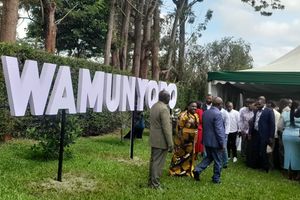
Former Deputy President Rigathi Gachagua (centre) with other political leaders when he hosted them at his Wamunyoro home in Nyeri County on May 4, 2025.
Photo credit: Joseph Kanyi | Nation Media Group
Wamunyoro faces the same danger. It can become a place of renewal, but it can also become a cage of grievance. It can help Gachagua rebuild, but it can also trap him inside the politics of injury. A politician can mobilise sympathy from a homestead, but to win national authority, he must eventually leave the compound and speak beyond the wounded faithful.
The question to be asked is whether Wamunyoro can produce a national doctrine, or will it remain a shrine of betrayal? Can it turn delegations into ideas? Can it move from the language of “what they did to us” to the language of what Kenya should become? Can it speak to youth unemployment, taxation, debt, corruption, police violence, agriculture, devolution and the cost of living? Or will it remain an echo chamber of mountain grievance?
While the 2010 Constitution was supposed to move Kenya away from this kind of personalised politics and gave us institutions, devolved governments, courts, commissions and public participation, our political imagination keeps returning to the homestead. We still seek power at the gate of the big man.
The road to Wamunyoro is, therefore, not just a road to Gachagua’s home. It is a road into Kenya’s political subconscious. It shows that our politics is still made through places that become myths, homes that become headquarters, compounds that become courts, and leaders who must turn private property into public destiny.
The question is whether Wamunyoro will become a footnote in Gachagua’s fall, or the birthplace of his second political life. Kenyan history suggests that such places matter. But it also teaches that a myth can take a politician only so far.
At some point, the shrine must produce a programme.
John Kamau is a PhD candidate in history, University of Toronto. Email: [email protected] ; On X: @johnkamau1