When, in October 2011, Kenya decided on an incursion into Somalia in pursuit of Al Qaeda-linked Al Shabaab insurgents who had been carrying out cross-border attacks, the Kenya Defence Forces (KDF) found an unlikely ally in one of the terror group’s founders and former members: Sheikh Ahmed Mohamed Islam, alias Ahmed Madobe.
Madobe is the leader of the Jubaland Security Force (JSF), previously known as the Ras Kamboni Brigade, without whom Operation Linda Nchi in Somalia would have been far more challenging.
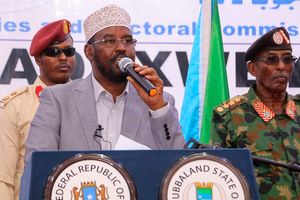
Ahmed Mohamed Islam, better known as “Ahmed Madobe”, speaks after his reelection as President of Jubbaland, a semi-autonomous state of Somalia, in Kismayo, on August 22, 2019.
Photo credit: Abdirazak Hussein Farah | AFP
So critical were the Jubaland Security Forces to Kenya’s quest to protect itself against Al Shabaab insurgency that it was reported Madobe’s fighters received facilitation from Nairobi.
The current Jubaland State President played a critical role in the establishment of the much-desired Jubaland buffer zone between Kenya and Somalia, serving as a shield against Al Shabaab’s cross-border attacks.
To the world then, Madobe offered a break in the cycle of hopelessness that Kenya and the wider region desperately needed.
Jubaland and its leader have, in recent weeks, been in the news following reports of fighters crossing into Mandera County and setting up base — something Kenyan security authorities have denied. The Jubaland forces have been engaged in battles against the Somalia National Army.
Mandera Governor Mohamed Adan Khalif and Senator Ali Ibrahim Roba have been among the most vocal in alleging that Jubaland troops crossed into Kenya and occupied Border Point One Primary School, where they allegedly conducted training that paralysed learning. However, during a visit this week, we did not witness the presence of any troops.
We found learning ongoing at the school, with local security and education officials affirming that there had been no interruption since schools reopened at the end of last month.
“There was fighting in Somalia’s Bulla Hawa border area in July, but it did not extend to Kenya, where security has been maintained with constant patrols by the Kenya Defence Forces (KDF) and other security agencies. During the fighting in Somalia, schools in Kenya were on holiday,” Mandera County Deputy Commissioner Solomon Chepoton said.
Madobe’s name will remain etched in Somalia’s history as the man who established and later turned against an insurgent group that continues to trouble the region.
He is among the few original members of Al Shabaab who have survived the relentless onslaught against the founders, many of whom faltered and turned against their own.
Madobe first began his journey with the Islamic Courts Union (ICU), which had taken over the ad hoc administration of the Lower Juba region following the collapse of warlord Farah Aideed’s control.
It should, however, not be forgotten that Madobe had family ties to Hassan Al Turki, the co-founder of Somalia’s jihadist organisation Al Ittihad Al Islamiya.
The ICU, whose youth wing became known as Al Shabaab, was ousted from administering the region by the US-supported Ethiopian National Defence Force for a time.
It was during this period that Madobe recalled, in a previous interview with this writer, being ambushed by drones in the Sufti area near the Kenya-Somalia border.
Of the nine ICU members with whom Madobe was fleeing from the Ethiopian onslaught, he was the sole survivor of a US drone strike. His accomplices, who had been using a satellite phone, were all killed. Madobe had excused himself to make a short call. He was later arrested by Ethiopian forces and detained in Addis Ababa.
Upon his release, Madobe established the Ras Kamboni Brigade, which began fighting Al Shabaab insurgents opposed to the Somalia Transitional Federal Government (TFG).
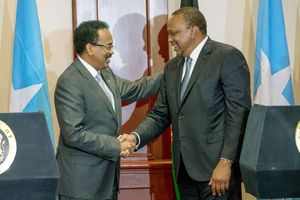
The leader of Jubbaland Sheikh Ahmed Madobe during a past press conference in Nairobi.
Photo credit: File | Nation Media Group
At the same time, top security officials in Nairobi were desperately seeking to create a buffer zone with Somalia, mainly to stop kidnappings by terrorists targeting foreigners, tourists, civil servants and NGO workers inside Kenya.
An idea to establish such a buffer zone under the name “Azania” was mooted in 2011 by interested parties, but the concept was short-lived.
The preferred leader of the proposed buffer zone had been Mohamed Abdi Mohamed, alias Professor Gandhi, a revolutionary academic later appointed Minister of Defence in President Sharif Sheikh Mohamed’s government.
It was at this point that Madobe’s Ras Kamboni Brigade, which was already fighting Al Shabaab in Ras Kamboni, became invaluable.
When the Kenyan government launched its incursion into Somalia under “Operation Linda Nchi”, Madobe, who had been struggling against Al Shabaab, became the ally of choice.
The battle-hardened Madobe readily joined KDF as a friendly force, and together they gradually liberated Dhobley, where KDF established an operational base, as well as Afmadow, Ras Kamboni, Biibi, Hosingow, Buale, Taabda, Jilib, Fafadun Oddo, Beles Quqani, Amuma, Dinsoor and Bardheere.
Despite frustration from Al Shabaab in his quest to carve out a territory for himself, Madobe’s Ras Kamboni Brigade eventually transitioned into the Jubaland Security Forces following the creation of the semi-autonomous state.
In 2012, KDF, alongside Madobe’s forces, marched towards Kismayu port, captured the city from Al Shabaab, and installed Madobe as interim president.
Having been part of the initial African Union Mission in Somalia (Amisom), the Ethiopian forces — who had vested interests in controlling Kismayu port — attempted to seize control but were resisted.
Madobe quickly established Kismayu as the headquarters of his Jubaland administration, consolidating his hold over a region that had previously been fragmented.
He was later formally elected President of Jubaland State. Madobe metamorphosed from a jungle-green, camouflage-clad militia leader with a henna-dyed beard to a grey-suited, statesmanlike figure as the newly elected head of state.
Long considered a most wanted terrorist, Madobe reportedly repented during his incarceration in Ethiopia, eventually turning against the very Al Shabaab movement of which he had once been a member.
Jubaland, which lies in Somalia’s far south bordering Kenya and Ethiopia, covers 110,000 square kilometres and has an approximate population of 1.3 million people. The ancient port of the legendary Ajuran Sultanate now boasts tarmacked roads, luxury houses and hotels, and a vibrant business community.
It is suspected, however, that the thriving Kismayu port import trade disproportionately benefits shrewd Kenyan businessmen and politically connected individuals.
Madobe, as head of the administration, wasted no time in amassing resources, acquiring weapons and building a war chest that has alarmed the Mogadishu-based federal government.
So concerned has the Somali government been about Madobe’s influence in Jubaland that it has made several unsuccessful attempts to oust him from power.
All three Jubaland presidential elections won by Madobe have been hotly contested, with the federal government consistently backing rival candidates.
From his fortified bunker overlooking desert dunes and surrounded by armoured vehicles and heavily armed fighters, Madobe has long been a thorn in the side of the federal government in Mogadishu.
However, Jubaland Security Forces have remained a friendly force to the Kenya Defence Forces and continue to coordinate operations aimed at annihilating the Al Shabaab insurgent group.