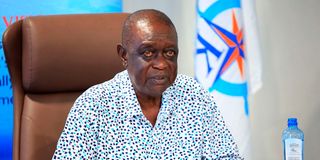
Oburu Oginga is one person who is easily ignored by those who believe politicians should be charismatic, maverick and controversial.
The new ODM party leader is the exact opposite of what most Kenyans perceive a good politician to be; he is soft-spoken, non-controversial, easy-going and down-to-earth.
In that seemingly naïve and harmless demeanour lies a steely, focused and purpose-driven intellectual. Unknown to many Kenyans, Oburu Oginga is a thoroughbred scholar and technocrat, with an earned PhD in econometrics and decades of practical experience as a senior government economist and planner.
Leveraging his background in a formidable political family, international exposure, and decades-long experience in government operations, Oburu has created dependable networks across the country and the world.
It should not be lost on critics that, for decades, the ODM leader worked tirelessly to steer his brother, Raila Odinga’s political boat. In this role, he reportedly helped negotiate coalitions and run confidential errands, while preferring to remain behind the scenes as Raila’s most trusted and loyal confidant.
Raila’s surprise death in October 2025 hit his ODM movement like a thunderbolt, instantly creating a void that has since separated two fiercely opposed factions: Linda Ground, led by Oburu, and Linda Mwananchi, associated with the party’s embattled Secretary-General, Senator Edwin Sifuna.
Strictly speaking, there does not seem to be clear ideological differences between the two ODM factions.
What is incontrovertible, however, is that the formation associated with Oburu is keen to go into a formal coalition with President William Ruto’s ruling UDA party ahead of the 2027 elections.
On its part, the Sifuna-led faction seems to prefer working with the opposition coalition. Pundits opine that such power struggles are not to be unexpected in situations where a “larger-than-life” figure of the stature of Raila leaves the scene after a long period of dominance over party affairs.
The argument is that, based on Raila’s unmatched political profile, everyone in the party viewed him as the natural titular leader.
In his absence, everyone now feels they have a chance to break out of the ODM nest and pursue their own political trajectory. That is why some people are overtly defying the party leadership.
Amid the furore, Oburu has coined a political clarion call, “We want power”, whose meaning, he claims, has been mischievously twisted by opponents for their own political ends. But what exactly does Oburu’s call for power mean? To do justice to this topic, one needs to appreciate the economic injustices that some regions of Kenya have had to endure for decades due to systematic marginalisation.
Since independence in 1963, Nyanza, Western, North Eastern, Eastern and Coast regions have suffered from systematic economic marginalisation rooted in post-colonial and political exclusion.
The primary driver of these injustices was “Sessional Paper No. 10 of 1965: African Socialism and Its Application to Planning in Kenya”. This blueprint directed national investments only to “high-potential” areas—primarily Central Kenya and parts of the Rift Valley—thereby neglecting other regions.
This skewed policy resulted in injustices and resentment among neglected communities, driving them towards opposition politics.
Some of the broad areas of shared injustices among the traditionally neglected regions are dilapidated infrastructure, poor social services, resource mismanagement and market exclusion. Deliberate under-investment in roads, electricity and clean water systems has left these regions poorly connected to local and national markets.
Inadequate funding for hospitals and schools has historically led to disease prevalence and lower literacy levels, respectively, compared to Central Kenya and parts of the Rift Valley.
Even when funds were allocated, corruption often saw resources stolen by the ruling elite and their cronies, diverted to favoured regions or simply not appropriated at all.
Government policies favoured cash crops like tea and coffee—found mainly in Central Kenya—while neglecting livestock in North Eastern and Eastern regions, or fisheries in Nyanza and Coast regions.
There have also been region-specific impacts of the systematic marginalisation. North Eastern has suffered extreme isolation, often treated as a “security zone” rather than an economic partner, leading to some of the highest poverty rates in the country.
Nyanza has consistently been a victim of intentional unfair resource distribution due to political friction between the State and the region’s leadership.
Consequently, vital industries like Kisumu Port, the sugar and cotton sectors, and the blue economy have either been under-resourced or sabotaged through imports of cheap sugar and second-hand clothing.
Western Kenya experiences some of the highest food poverty rates despite being an agricultural zone, due to a lack of investment in modern farming and market access. The Coast region has suffered severe land alienation and historical injustices, where local communities were displaced by wealthy individuals facilitated by political elites.
Besides, locals have cried foul over the lack of commensurate benefits from major national assets like the Port of Mombasa and other facilities and resources. The Eastern region largely comprises arid and semi-arid lands (ASALs), which were categorised as “low potential”, leading to persistent food insecurity and a lack of support for the livestock economy.
The 2010 Constitution attempted to rectify some of these injustices through devolution and the Equalisation Fund, which earmarks specific funds for these historically marginalised areas to catch up with more favoured parts of the country.
The real damage done to these unfavoured regions over the past six decades is just beginning to show, as funds are utilised to address basic needs that Central Kenya and parts of the Rift Valley dealt with in the 1970s and 1980s.
One hopes that Oburu’s call for “power” is not necessarily about individual ODM party members getting plum government jobs, but rather a deliberate policy to empower these regions that have traditionally been marginalised.
That way, the country will begin to see balanced regional development and a narrowing of economic disparities across the country. Consequently, inter-tribal suspicions will dissipate, making the country more cohesive and peaceful.
Prof Ongore is a Public Finance and Corporate Governance scholar based at the Technical University of Kenya.