A half-loaf cannot rescue universities
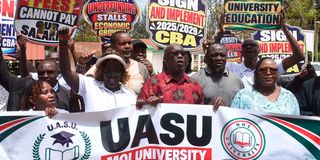
University Academic Staff Union officials protest to demand the signing and implementation of the 2025/2029 Collective Bargaining Agreement in Eldoret on October 02, 2026.
The announcement on Friday, October 30, 2026, that the public university strike had ended was met not with celebration but with exhaustion. For four weeks, universities had been paralysed. With the National Secretary-General of the Universities Academic Staff Union (UASU) signing the court-ordered return-to-work formula, lecturers are due back in class. The settlement leaves questions unresolved.
The settlement is a half-loaf. Unions secured a Sh20 billion funding framework, up from the Sh11 billion proposed by vice-chancellors, alongside new salary scales and an immediate five per cent adjustment from November 2026. Making the deal a court order gives the commitment legal backing.
However, union leaders accepted a 12-month deferment of salary arrears. With inflation and higher Pay As You Earn (PAYE) deductions eroding incomes, delayed payments will further diminish staff purchasing power.


The settlement leaves key non-financial grievances unresolved, including overcrowded classes, commuter allowance disparities and contested Public Service Commission human resource manuals. With the collective bargaining agreement on hold, the deal offers little more than a temporary reprieve.
Students and their families have borne the greatest cost. Parents have paid fees only to see lecture halls empty and academic calendars disrupted, while students remain uncertain when they will graduate. Their patience should not be mistaken for acceptance of recurring disruption. Universities cannot continue treating students’ futures as collateral in labour disputes. The strike exposed a more assertive university workforce. Lecturers are questioning government commitments, union leadership, university administration costs and the management of pension benefits. They want clear figures, enforceable commitments and accountability from the state and their representatives.
The country must move beyond a cycle in which strikes become the routine means of securing overdue pay adjustments. One option is to link basic salary scales to the Kenya National Bureau of Statistics’ Consumer Price Index, allowing wages to respond to changes in the cost of living. Parliament should also review the Universities Act and establish a reliable funding framework for public universities.
That requires scrutiny of university payrolls, administrative spending and public funds, alongside safeguards against inflation. Without such reforms, the Sh20 billion agreement may prove only a temporary reprieve. Lecturers return to the lecture halls on Monday, but the issues that brought them out remain. The strike is over; the demand for structural change is not.
Follow our WhatsApp channel for breaking news updates and more stories like this.
Dr Ogutu Keroboto B. Za’Ngoti is a lecturer in the Department of Mathematics and Physical Sciences at Dedan Kimathi University of Technology (DeKUT). Email: [email protected] / [email protected]