Alarm every hour: The 19-year-old living with rare condition that never lets her sleep
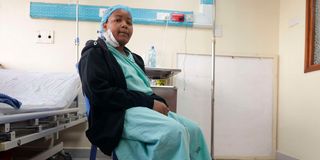
Rahab Nyambura, who is battling a rare condition known as nesidioblastosis, at Kenyatta National Hospital on October 5,2026

What you need to know:
Rahabd was diagnosed with nesidioblastosis, a condition affecting fewer than 10 people in Kenya.
On most mornings, Rahab Nyambura is already showered and dressed by the time her doctor arrives at her private ward at Kenyatta National Hospital (KNH). Her hair is done, and she is waiting. On the mornings after a good night, her smile is a litmus test for her medical team.
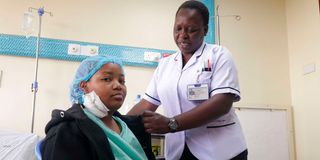
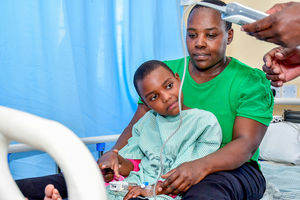
Rahab Nyambura(left) is attended to by nurse Jacqueline Nduta at Kenyatta National Hospital in Nairobi on October 5.
Rahab is 19. She has spent the last two and a half years in a hospital bed and sat her Kenya Certificate of Secondary Education exams from a corner of the ward that staff set up as a desk. She has celebrated three birthdays here. Along the way, she learned to crochet, contemplated writing a book, and picked a university course. Her body, meanwhile, cannot be trusted to keep its own blood sugar steady.
Also read: Nine years, three tumours, two transplants: One family's fight against a cancer that keeps returning
It began in 2023 with swollen legs, headaches, and constant vomiting. At Kikuyu Hospital, she was told she had diabetes and was started on insulin.
“But after a few months, my sugar started dropping. We thought I was using excess insulin, so the hospital reduced it. But my sugars continued dropping,” she says.
She was referred to KNH, where doctors admitted her because her sugars kept crashing. Then came a puzzle. Her blood tests showed her body was flooding itself with insulin. Yet every scan came back clean.
“My CT scan was normal, my ultrasound was normal, and my MRI scan was normal. The doctors didn’t know what was happening.”
Her doctors suspected what the blood work pointed to. In a patient with no diabetes and dangerously low sugar, they suspected an insulinoma, a growth in the pancreas that makes the body overproduce insulin, a hormone produced by the pancreas that acts like a key to unlock cell doors, allowing glucose (sugar) from the blood to enter cells and provide energy. It meant that any time she ate, the body overcompensated with a lot of insulin, and then her sugars went low.
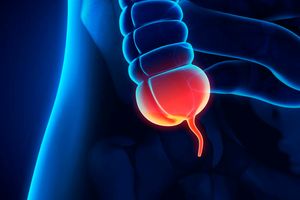
But there was no growth to see. The team had considered sending Rahab to India for a specialised scan. Then MP Shah Hospital in Nairobi acquired the technology, and the scan was done locally. It revealed the cause: a rare condition called nesidioblastosis, in which insulin-producing beta cells multiply across the entire pancreas. It is a non-cancerous lesion and a diffuse growth of the beta cells, where one cannot tell where the growth starts and where it ends.
Dr Prisca Mungla, physician endocrinologist at KNH and the lead doctor guiding Rahab’s treatment, notes that the determination of the nature of the growth ruled out surgery as the obvious solution.
“Surgery works when the problem is in one place. Removing the whole pancreas would have traded one illness for another, pushing a teenager into diabetes and leaving her short of other digestive hormones the organ also makes. This would have also reduced her quality of life,” notes Dr Mungla.
The team chose conservative management, a long campaign of medicines that included octreotide, steroids and diazoxide. The treatment kept Rahab alive, but it carried a price.
“When you take a lot of steroids, you become big. They cause weight gain, making your body hold onto water and shifting where fat is stored. I got a moon face due to the water retention,” recalls Rahab.
“Diazoxide made my legs swell, so it was stopped. Repeated emergency doses of concentrated glucose through my veins scarred the lines that carried them. The result was infections and blood clots. I have scars everywhere from the doctors and nurses looking for IV access,” says Rahab.
Her life is never the same again.
At night, her alarm goes off after each hour of sleep. Rahab gets up, checks her blood sugar sensor, and eats a snack. Then she lies back down, and an hour later it starts again. She must do this every day for the rest of her life.
“Every night, I set hourly alarms so I can wake up, check my sugar levels, and have a small snack: a biscuit, samosa, a slice of bread, or a few sips of soda. It’s a daily routine I have to follow; otherwise, I risk my blood sugar dropping. It’s harder for me to tell when my sugar drops at night because I’m asleep, whereas during the day, it rarely drops at all,” says Rahab.
For the nurses, the worst hours were the night ones when she developed hypoglycemia. When a low strike occurred, the signs were hard to miss. She would sweat, develop chills, become weak and lightheaded, be unable to communicate, and at times be confused. Ward staff turned the problem into a routine, providing hourly snacks, including biscuits, bread, samosas, and beverages to push the blood sugar levels back up.
Rahab’s illness did not stop her education, although it often tried to. When she was admitted, she was in Form Three, just a year away from her KCSE examinations. Some mornings she woke and could not walk. On other days, an infection, a seizure or a clot made studying impossible.
“One day I would wake up feeling fine; the next few days, I would be ill. I knew I had an exam, but I couldn’t study on days that I wasn’t feeling well. So, I would study on the days that I was okay. My class teacher sent past papers to my phone. I would complete them alone and send them back. When it was time for KCSE, I sat for it on a desk set up in my room by staff. Midway through the exams, I developed an infection that would not respond to antibiotics. I finished the papers anyway and then went into isolation,” she says.
“I did well and was offered an opportunity at Mount Kenya University to study psychology. We have since processed a transfer to Daystar University to study cybersecurity so that I am close to the hospital for care and home with my family. Because of the hospital stay, I missed this academic year and will start in January,” says Rahab.
Dr Mungla explains that during Rahab’s stay, the long admission period was a concern to doctors, who worried about her mental wellbeing in hospital.
“The prolonged stay has had an impact on quality of life because you can imagine being away from your family for two years. Two years is a long time, and mentally it takes a toll on you. It’s almost like being in prison, but you’re not in prison, for lack of a better word. Counsellors are available at the hospital, though Rahab has rarely needed one. But her support has been the best. Her auntie, her grandma, anything we’ve always wanted, be it a test or medication, we’ve always got them,” says Dr Mungla.
“When we first saw her in the clinic, she was getting at least two hypoglycemic attacks in a night. The team changed the rule. She would sleep for one hour at a time, wake and eat something, then sleep again, without waiting for the blood sugar sensor to sound,” Dr Mungla says.
“I know the hourly wakes mean interrupted poor quality sleep. Nights are riskier partly because the body’s cortisol levels fall, weakening the hormones that normally push sugar back up. During the day, even a nap is fine.”
By September 2, over two years after Rahab was admitted, the team felt it was time to try. She was discharged. They taught her aunt and grandmother to recognise the signs of hypoglycemia and what to do about it. Rahab was given a continuous glucose monitor, a sensor worn on the arm that tracks blood sugar around the clock. A feeding tube was placed in her stomach so that relatives could push glucose directly if she could not swallow. But three and a half weeks later, Rahab was back.
“The feeding tube had become infected. I readmitted her to treat the infection. The team will now need to go back to the drawing board to figure out how her blood sugar levels can be resuscitated at home, when she cannot swallow, without risking an infection,” says Dr Mungla.
“This condition is one of those rare endocrine disorders. We are unable to tell how many numbers are in Kenya because the country has no registry for such cases. I have personally managed three, but I doubt that the number across the country exceeds 10. The cost and complexity of the tests mean some patients may never get a final diagnosis,” she explains.
She notes that for most patients, there is no long-term cure, only management. “Patients who have surgery tend to have fewer low-sugar episodes, but for a diffuse case like Rahab’s, that option is closed. That is why I want the condition to be talked about. It’s the rare diseases that people really suffer from because they wouldn’t know where to seek help.
KNH has an endocrine unit for adults and children, with four endocrinologists. Anyone with an unexplained hormonal disorder can always refer to us,” says Dr Mungla.
Jacqueline Andal, a principal nursing officer who joined Rahab’s medical team partway through her stay, says her team made deliberate efforts to keep the teenager from feeling like a case file.
“Rahab got a side room for privacy. A hairdresser sometimes came to do her hair and nails so that she feels loved and seen. Friends from a support group visited and took her outside for sunshine, and nurses sang happy birthday and merry Christmas,” says Andal.
“ Rahab spent so much time with us, chatting at the nursing station that other patients wondered whether she was staff. We treated her like our little sister, checking on her unprovokedly and keeping extra watch over her at night,” Andal says.
The kindness did not remove the strain on her family. “They were always like, when is she going to come back home? Is she ever going to come back home?” Rahab says. But she insists she never felt the full weight of missing occasions because the ward marked them. “Even when you’re sick, you can still celebrate it. So it was normal.”
A stay of two and a half years generates a vast bill, and Rahab’s was “really huge,” according to Dr Mungla. A hospital credit committee reviewed her case after a social worker assessed her family’s circumstances. The bill was waived, not erased, meaning that Rahab could leave while a guarantor and a payment plan took care of what remained.
Psychologist Arthur Gichuru of Serenimind Wellness says that while Rahab’s cheerfulness is real, it is not the full picture.
“Prolonged hospitalisation is not only a medical experience; it can also become a significant psychological and social experience. When an individual remains in hospital for an extended period without discharge, the uncertainty surrounding recovery, finances, family, work and the future can gradually affect emotional wellbeing,” he says.
He notes that studies on adult hospitalisation show that it can negatively affect patients’ ability to cope and adjust, with increased experiences of anxiety and depression. The studies also show that the length of stay, the hospital environment and the patient’s interaction with healthcare providers may influence the psychological experience of hospitalisation.
For patients whose discharge is delayed, several psychological effects may emerge. Not knowing when they will leave hospital or what their future holds can create persistent worry and helplessness, and extended separation from normal life, family, work and social roles may contribute to sadness, loss of motivation and feelings of hopelessness. Dependence on healthcare workers and family members for basic needs can also affect a person’s sense of independence and self-worth, while prolonged hospitalisation can reduce meaningful contact with family, friends, colleagues and the community.
Beyond the emotional toll, an extended admission may create concerns about medical bills, loss of income, employment, and the welfare of dependents. Over time, patients may begin to see themselves primarily as “patients” rather than as parents, professionals, providers or active members of society. Watching other patients become critically ill, or going through repeated procedures, can further heighten fear and emotional distress.
“For long-stay patients, psychological support should therefore be viewed as part of holistic patient care, rather than an optional service. Regular psychological check-ins, emotional support, family engagement, social-work intervention, recreational activities, communication about discharge plans and early identification of anxiety or depression can help preserve dignity, hope and a sense of control,” says Gichuru.
“Ultimately, a patient may be medically stable but psychologically exhausted. Supporting their mental and emotional wellbeing during prolonged hospitalization can contribute to a more humane healthcare experience and potentially improve recovery, functioning and reintegration into family and community life,” Gichuru adds. Asked what university will look like, Rahab is hopeful of living a normal student life.
“When you look at me superficially, it’s hard for you to notice that I’m sick. As long as I’m taking my medication the way I’m supposed to take it, and I’m eating regularly, it’s going to be as normal.”
Her birthday was celebrated this month at the hospital surrounded by her medical team that has become her second family.