Every time a building collapses in Nairobi, the sequence is grimly familiar. There is outrage, official visits to the rubble, pledges of investigations and suspensions announced with urgency. Then, slowly, attention drifts with the construction cranes returning to contested sites and court cases stall.
A review of major building collapses over the past decade — from informal settlements to middle-class neighbourhoods — reveals a pattern of regulatory failure that residents’ associations now say has become structural, not accidental.
Despite repeated warnings, audits and even criminal prosecutions, unsafe buildings continue to rise, often with official approval or silent acquiescence.
On October 20, 2024, a seven-storey building partially collapsed in Kahawa West, Nairobi, injuring one person. The structure had been constructed without approval from the Nairobi County Government. According to the National Construction Authority (NCA), the building had already been condemned by a Multi-Sectoral Agency Consultative Committee.
“The building had been condemned and an enforcement order was issued for immediate evacuation,” NCA Director Maurice Akech said at the time.
Residents said the danger had been visible long before the collapse. Instead of evacuating tenants, they alleged, the developer reinforced visible cracks at the ground floor and allowed people to remain inside. “The cracks were visible and even after the county issued a notice, instead of asking people to vacate, he started doing renovations from the ground floor,” a witness said.
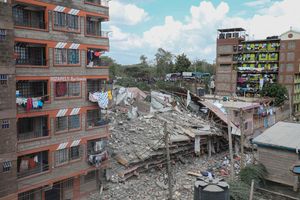
A seven-storey building that collapsed in Kahawa West, Nairobi County on October 20, 2024.
Photo credit: Dennis Onsongo | Nation Media Group
County Chief Officer for Disaster Management Bramwell Simiyu at the time said investigations would be conducted to establish why the illegal building was allowed to stand. No public findings have followed.
Just months earlier, on May 7, 2024, a five-storey building collapsed in Uthiru, injuring at least 10 people. The then Roads and Transport Cabinet Secretary Kipchumba Murkomen said engineers who supervised such projects must be held personally liable, directing the NCA to take action. Again, enforcement stalled.
The pattern has been the same in recent years. On November 15, 2022, a seven-storey building collapsed in Kasarani, killing three people. The developer had ignored multiple non-compliance notices, including one issued on the morning of the collapse. Construction continued despite the site being formally closed by the NCA that same day.
Nairobi Governor Johnson Sakaja responded by suspending three county officers — Michael Agoya, Catherine Wairimu and Beatrice Kimathi — and reconstituting the Urban Planning Technical Committee. The reforms were presented as decisive. Residents associations say they were cosmetic.
Two days later, on November 17, 2022, a five-storey building collapsed in Ruaka, Kiambu County, killing two people. The owner was arrested at Jomo Kenyatta International Airport while attempting to flee the country. On November 21, 2022, another five-storey building collapsed in Ruiru. Tenants had been evacuated just hours earlier after authorities condemned the structure for poor workmanship and lack of approval.
Earlier tragedies dot the timeline: three people killed in Mamboleo, Kisumu, on September 13, 2021; six deaths in Roysambu in April 2015; 52 people killed in Huruma in April 2016 when a six-storey building collapsed during heavy rains; and eight pupils crushed to death at Precious Talent Academy in Dagoretti on September 23, 2019.
Across these cases, investigations repeatedly cite the same causes: poor workmanship, shallow foundations on unsuitable soil, substandard materials, falsified reports and absent supervision. Yet punishment remains elusive.
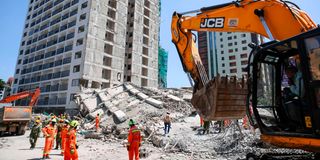
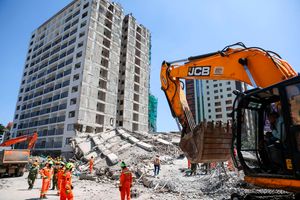
Bulldozers comb through the rubble of the collapsed multi-storey building in South C, Nairobi on January 3,2025.
Photo credit: Billy Ogada | Nation Media Group
At least five building owners and 10 government officials have been charged over collapses that killed more than 100 people. Most of those cases have dragged on in court for more than five years. Some defendants have been acquitted. Others remain on trial with no end in sight.
Among pending cases is that of Moses Ndirangu, the owner of Precious Talent Academy, charged with manslaughter in February 2020. The trial, involving eight Nairobi county officials, is still ongoing at the Kibera Chief Magistrate’s Court.
In Huruma, the owner of a six-storey building that collapsed in 2016, killing 52 people, was charged alongside county officials and an NCA officer. The court heard that the building had been declared unfit for habitation, yet more than 100 rooms were occupied.
Experts say failure is political as much as technical. Patrick Adolwa, a fellow of the Kenya Institute of Planners, argues that residents cannot entirely absolve themselves.
“There are people with the mandate,” he said on NTV’s Fixing the Nation . “You elect officials. These are the people who make regulations and come up with a plan for the county government. They decide how an area should look like, how many people should live in Kilimani.”
Inside the County Assembly, some legislators are pushing reforms they say could restore accountability. Kileleshwa MCA Robert Alai wants the revival of a public register of building approvals.
“Previously at City Hall, there was a register for all approvals,” Mr Alai said. “You would see the building, its location, number of floors and even the minutes of approval.”
The seven-storey building that collapsed in Kahawa West, Nairobi, on October 20, 2024
Photo credit: Dennis Onsongo | Nation Media Group
Elsewhere, accountability has failed altogether. In Kiambu, the owner of a five-storey building that collapsed in 2009, killing 13 people, was acquitted after prosecutors failed to prove their case. No one was held responsible.
Earlier audits paint an even starker picture. A 2018 probe found that of nearly 15,000 buildings inspected in Nairobi, only 2,194 were deemed safe. Huruma alone had 388 buildings under imminent threat.
Despite this history, county governments, the NCA and other regulators continue to watch as unsafe structures rise, particularly in high-value neighbourhoods where political and commercial pressure is intense.
In 2025, residents of Kileleshwa, Kilimani, Westlands, Parklands and South C filed a detailed petition before the Nairobi City County Assembly, accusing City Hall of turning zoning laws into dead letters. The petition alleged that high-rise developments were being approved in areas governed by the Nairobi Integrated Urban Development Master Plan without lawful rezoning, public participation or regard for infrastructure capacity.
The residents named Sky Valley Ventures Kenya Co. Ltd, Blissful Residences Investment Ltd and Ameey Homes Ltd as among developers benefiting from irregular approvals. They accused the county government, the National Environment Management Authority and the NCA of collusion, allowing projects to proceed despite violations of height limits, density controls and environmental safeguards.
“We have witnessed massive and unabated spring up of Skyscrapers that are posing health hazard to the residents such as lack of natural lighting, insufficient airflow, noise pollution whereas owners of these apartments currently under construction have not conducted public Participation and where done, not adequately done since no notice given to residents and are shambolic with hired goons,” read the petition.
They warned that unchecked construction posed serious public safety risks, eroded access to light and air, strained sewerage systems and overwhelmed narrow residential roads. They asked the County Assembly to cancel approvals, revoke licences and discipline both developers and public officials.
Kenya Red Cross team at the site of the Pangani building under construction whose scaffolding collapsed on December 2, 2023.
Photo credit: Bonface Bogita | Nation Media Group
A County Assembly committee established to investigate irregular approvals collapsed amid claims of intimidation and missing records.
“We requested minutes of meetings approving buildings and files for developments approved over two years,” said Nasra Nanda, the MCA who chaired the probe. “A file was sent from the executive — but it disappeared. We were threatened. We could not complete our mandate.”
He also blamed the widespread use of acting officials for eroding responsibility. “When officers are in acting capacity, they escape accountability,” he said.
South B MCA Waithera Chege linked recent collapses to illegal approvals, weak inspections and corruption that shields unsafe developments. She is pushing for digitised approvals, independent structural audits and automatic suspension of officers implicated in irregularities.
“Anyone who has built beyond the required floors, I will be demanding through the assembly that you bring down the building,” she said.