Greatest monument ‘Baba’ deserves is a peaceful 2027
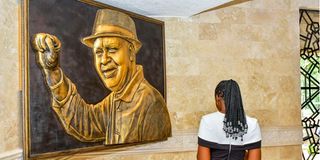
Historical photographs documenting the political journey of the late former Prime Minister Raila Odinga adorn the walls inside his mausoleum at Kang’o ka Jaramogi in Bondo on October 11, 2026. The displays chronicle his decades-long contribution to Kenya’s political and democratic development.
In 1994, I was a pupil at Highlands Primary School in Kericho. That year, Jaramogi Oginga Odinga died, and our school allowed us to view his body. I barely understood death, let alone politics or democracy. Yet that moment planted a seed of curiosity and, without my knowing it, of political consciousness. The name Odinga never left my mind.
The 2007/2008 post-election crisis gave that seed clarity. For the first time, I saw Raila Amolo Odinga not as a name but as a force. When Baba spoke, the masses listened. When he said “Haya!”, a whole nation paused. Years later, working in peace and cohesion, I came to understand what he carried for this country.
Thirty-one years after I stood before his father’s body, I watched the son make the same final journey home. Raila died on 15 October 2025 in Kerala, India, aged 80. That night, a nation stayed awake. Kenyans at home and abroad watched a small aircraft creep across a dark map. At one point, 58,000 people followed that single plane. When it entered Kenyan airspace and its name changed to RAO001, a country that had argued with itself for decades wept as one. Baba was home.


He was laid to rest at Kang’o Ka Jaramogi in Bondo, beside his own father. For one week, Kenya was not 42 communities. It was a single household gathered around a fallen father. The story that began for me in a school line in Kericho had come full circle.
History being written
The RAO2026 Memorial Conference started with a phone call. I called my classmate, William Dekker, and asked a simple question. How do we document Baba’s last homecoming? As communication scholars, we had watched history being written in real time, on phones, in songs and in the streets. It felt wrong to let it pass unrecorded.
We set out to write a paper, which we now present at the conference: Baba Home: An Afrocentric Analysis of Symbolic Communication and Communal Restoration in Kenya Airways’ RAO001 Tribute to Raila Amolo Odinga. Our classmates Eucabeth, Millicent and Mercy soon joined us. Professor Levi Obonyo gladly came on board and challenged us to grow the paper into a conference.
The Daystar University Vice Chancellor, Professor Laban Ayiro, not only blessed the idea but also fine-tuned the theme: Future-Proofing Democracy. We visited Professor Anyang’ Nyong’o, Governor of Kisumu County, who was excited by the idea and granted us his blessings. Mama H.E. Ida Odinga graciously blessed it too and accepted to be our Patron. A phone call had become a paper. The paper had become a conference.
This week, from 8 to 9 October, scholars gather at Daystar University. As Chair of the Organising Committee, I carry this conference as an act of memory and of duty. The child who once filed past Jaramogi’s body now helps a nation remember his son.
What a life it was. A young engineer, he chose struggle over comfort. He endured detention without trial, betrayal and five presidential defeats, yet he never wavered. When critics grumbled, he answered with a proverb from home: “Kuot Ogwal ok mon dhiang’ modho pi.” The grumbling of a frog does not stop a cow from drinking water. As Prime Minister after the violence of 2007 and 2008, he helped stitch the country back together. Many see his fingerprints on the 2010 Constitution.
Brink of division
He was also selfless. On 9 March 2018, he shook hands with President Uhuru Kenyatta, choosing peace over power. On 7 March 2025, he did it again with President William Ruto, backing a broad-based government when the country stood on the brink of division. Each time, he placed Kenya above himself.
A year on, we still say “Baba says” before we catch ourselves. The silence where his voice used to be is the loudest thing in Kenyan politics today.
His vision was never tribal. He belongs to the boda boda rider who still believes his vote matters, and to the widow in Turkana who walks for hours to a polling station. He belongs to every Kenyan who was told to sit down and stood up anyway.
So the question this anniversary asks is not how we will mourn him, but how we will live him. We live his legacy when we refuse to hate a neighbour for the language he speaks at home. We live it when we choose dialogue over violence. We live it when we demand accountability from every leader, including the ones we love.
As another election approaches, let us not allow the man who gave his life to unite Kenya to become one more reason to divide it. The greatest monument we can build for him is not made of stone. It is a peaceful 2027.
Go well, Baba. Go well, Jowi. Rest in power, Rwoth. Your voice may be silent, but your legacy never will be.
Follow our WhatsApp channel for breaking news updates and more stories like this.
Ms Metet is a Peace and Communication Expert and Teamleader, RAO2026 Memorial Conference Organising Committee.


