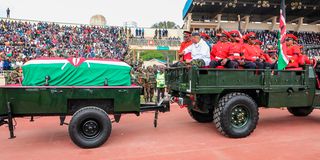
When the casket bearing Raila Amolo Odinga’s body was lifted onto a gun carriage from Lee Funeral Home headed for Parliament early morning on Friday, the air in Nairobi grew still. The national flag fluttered half-mast across the city, and thousands stood in silence as the Kenya Defence Forces band played a slow, mournful hymn.
A police chopper hovered above the Parliament severally, almost in a ceremonial fly-past, the same sky where Odinga had, for decades, stood to address jubilant crowds calling for change. This was not just a farewell. It was a state funeral with full military honours, a spectacle reserved for only a handful of Kenyans in the country’s history.
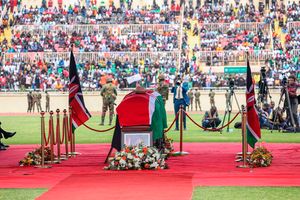
On Friday morning, Odinga’s body lay in state at Parliament Buildings, guarded round the clock by uniformed officers. Legislators and dignitaries were led by President William Ruto to pay their last respects to the octogenarian whose stints in politics painted every corner of the country.
The body of former Prime Minister Raila Odinga at Nyayo National Stadium in Nairobi for the state funeral service on October 17, 2025.
Photo credit: Lucy Wanjiru | Nation Media Group
From Parliament Buildings, the solemn procession carrying the former Prime Minister’s body began its slow journey to Nyayo Stadium, a final march steeped in ceremony and emotion. The gun carriage, draped in the national flag, glistened under the morning light as soldiers from the Kenya Defence Forces matched its pace with military precision.
Once at the intended venue where thousands had gathered, the casket was lifted gently from the gun carriage and borne by pallbearers into the arena. The choir’s harmonies mingled with the echo of drums, filling the air with reverence.
The lying-in-state, a practice borrowed from Commonwealth traditions, is both symbolic and democratic, allowing citizens to share in the final farewell of one of the nation’s most consequential figures. It is often a moment of closure and unity, a fitting farewell to a man who has, for decades, divided and defined Kenya in equal measure.
State funerals in Kenya are not routine events; they are rare, deeply symbolic ceremonies reserved for individuals whose lives have left a mark on the nation’s conscience.
The tradition began in 1978, following the death of the country’s founding father, Mzee Jomo Kenyatta. His funeral set the blueprint for all others that followed. After his sudden death in Mombasa, the body was flown to Nairobi and placed in state at Parliament Buildings. For ten days, Kenyans from every corner of the republic filed past his glass-topped coffin. It was a solemn and emotional spectacle, the young nation’s first experience with collective mourning.
August 31, 1978: A gun carriage with Mzee Jomo Kenyatta's flag-draped coffin is drawn through the streets of Nairobi for the funeral.
Photo credit: File | Nation Media Group
When the day of burial arrived, the Kenya Army led a grand procession. The casket was mounted on a gun carriage pulled by naval officers, escorted by senior military officials. A 19-gun salute was fired, followed by the haunting notes of “The Last Post.” Fighter jets soared overhead in perfect formation. It was the first time Kenya had witnessed such a ceremony, a combination of state protocol and military pageantry that announced to the world that a founding father had departed.
For the next 25 years, the grandeur of Kenyatta’s farewell would not be replicated. It was not until 2003, with the passing of Vice President Michael Kijana Wamalwa, that the country once again held a state funeral. Wamalwa’s death, just months into his tenure in the NARC government, stunned the nation. His body lay in state at Parliament, the first time a vice president was accorded such an honour.
Yet Wamalwa’s funeral, while solemn and state-funded, did not include full military honours. There was no gun carriage or salute, a sign that while the government recognised his stature, the final farewell remained largely civilian.
Prof Wangari Maathai’s funeral
The same could be said of Prof Wangari Maathai’s funeral in 2011. The Nobel laureate, environmentalist, and human rights champion was given a state funeral by President Mwai Kibaki’s government, the first woman in Kenya’s history to receive such recognition.
Her coffin, made from water hyacinth and bamboo, was carried by Kenya Defence Forces pallbearers. The military’s presence added ceremonial weight, but there were no gun salutes or fly-pasts. Instead, her farewell was filled with song, poetry, and green tributes to her life’s work.
In 2016, the passing of former First Lady Lucy Kibaki saw another state funeral, a relatively understated one. Held in Othaya, the service was officiated by clergy but included uniformed officers and government protocol. It was dignified yet subdued, lacking the grand military pageantry seen in the burials of presidents.
Father Dominic Wamugunda blesses the coffin bearing the remains of former First Lady Lucy Kibaki after a mass at JKIA on May 01, 2016.
Photo credit: File | Nation Media Group
That would change in 2020, when Kenya’s longest-serving president, Daniel arap Moi, died at age 95. Moi’s coffin lay in state for three days at Parliament, draped in the national flag, as Kenyans filed past in long, winding queues.
On the morning of his burial, the sound of gunfire echoed across Nairobi as the Kenya Army fired a 19-gun salute. His casket was drawn on a gun carriage to Nyayo Stadium, escorted by a full military parade.
The cortege of former President Daniel Moi leaves State House, Nairobi, for the State memorial Service at Nyayo National Stadium on February 11, 2020.
Photo credit: PSCU
Fighter jets painted the sky above, and buglers from the Defence Forces played “The Last Post”, a song to its soldiers that it was time to stand down for the day.
When Mwai Kibaki died in April 2022, Kenya once again turned to the familiar rituals of state mourning. The government declared three days of national mourning, and the former president’s body lay in state at Parliament for public viewing.
On the day of the state funeral service at Nyayo Stadium, the Kenya Defence Forces executed the ceremony with military precision. A gun carriage bore Kibaki’s coffin, the flag fluttering gently over the casket.
Family and friends stand near the flag drapped coffin of former Kenyan President Mwai Kibaki during the memorial service at the Nyayo National Stadium in Nairobi on April 29, 2022.
Photo credit: File | AFP
As the national anthem played, a 19-gun salute broke the morning silence, each volley a symbol of the country’s final respect to a leader remembered for economic reform and quiet integrity. Kibaki thus joined an elite club of three, after Kenyatta and Moi, to receive full military honours at burial.
In 2023, another notable state funeral took place, that of Mukami Kimathi, the widow of the Mau Mau freedom fighter Dedan Kimathi. Her burial in Nyandarua County was both historical and symbolic. The government declared a day of national mourning, and military officers formed part of the procession. Though not accorded a gun salute, Mukami’s funeral carried the weight of a nation finally paying its debt to the freedom generation.
A casket bearing the remains of the late Kelvin Kiptum, the world marathon record holder, during prayers and viewing of the body at Kapkenda Girls High School in Keiyo South, Elgeyo Marakwet County on February 22 2024.
Photo credit: Jared Nyataya | Nation Media Group
Two months later, the country again stood still for a different kind of hero. Marathon world record holder Kelvin Kiptum, who died in a car crash at just 24, was given a state funeral, a rare honour for a sportsman. His coffin was draped in the national flag. It was a gesture of state recognition, celebrating his record-breaking achievements and the pride he brought to Kenya.
Highest state and military traditions
Then came the sombre burial of General Francis Omondi Ogolla, the Chief of Defence Forces, in April 2024. His death in a helicopter crash alongside nine officers was a devastating blow to the Kenya Defence Forces.
General Francis Ogolla's memorial service at the Ulinzi Sports Complex on April 20, 2024.
Photo credit: Wilfred Nyangaresi | Nation Media Group
His send-off in Siaya combined the highest state and military traditions. A gun carriage bore his coffin, the national flag folded with precision by fellow officers. The 19-gun salute thundered through the hills of Ngi’ya, as military jets soared overhead. It was perhaps the most complete display of military ceremony Kenya had witnessed since independence.
While Kenyans often use the term “military honours” loosely, the Defence Forces follow a strict protocol. Full military honours typically include a flag-draped casket to signify a state burial, military pallbearers, a gun salute, and the playing of “The Last Post.”
According to the Defence Forces Standing Orders, the persons entitled to state burials are serving and retired presidents, serving and retired prime ministers (who act as Head of State or government), serving and retired vice or deputy presidents, and general officers up to the rank of brigadier. The Standing Orders further stipulate that serving presidents are accorded a 21-gun salute, retired presidents, sitting prime ministers, and serving generals receive a 19-gun salute, while retired prime ministers are honoured with a 17-gun salute.
Kenya’s state funerals are rare precisely because they are meant to unite the nation beyond politics. They are moments when flags, anthems, and uniforms merge into a collective act of remembrance. The military presence, its discipline, order, and solemnity, offers a visual metaphor for continuity.
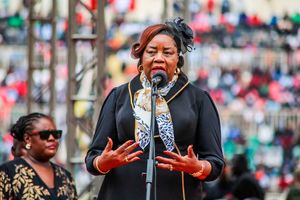
Bishop of the Anglican Diocese of Bondo, the Right Reverend Professor David Hellington Kodia, during the state service of Former Prime Minister Raila Odinga at Nyayo National Stadium on October 17, 2025.
Photo credit: Lucy Wanjiru | Nation Media Group
From the solemn march at Kenyatta’s funeral to the thundering salutes at Raila Odinga’s send-off, each moment has reminded Kenyans that their nation still knows how to honour service, sacrifice, and leadership.
And as Raila’s coffin continues to rest under tight military guard ahead of his final journey to Bondo, the bugler’s note still hangs in the air, both an ending and a beginning, the closing of one era and the quiet assurance that, in Kenya, some legacies are immortalised not by power, but by the way a nation chooses to say goodbye.
Jomo Kenyatta (1978) – State funeral with military honours Michael Kijana Wamalwa (2003) – State funeral without military honours Wangari Maathai (2011) – State funeral without military honours Lucy Kibaki (2016) – State funeral without military honours Daniel Toroitich arap Moi (2020) – State funeral with military honours Mwai Kibaki (2022) – State funeral with military honours Mukami Kimathi (2023) – State funeral without military honours Kelvin Kiptum (2024) – State funeral without military honours Francis Ogolla (2024) – State funeral with military honours Raila Odinga (2025) – State funeral with military honours