A mere suggestion.That is what the plan by the National State Funeral Committee, which is coordinating the final journey of former Prime Minister Raila Odinga, was reduced to as crowds undid virtually everything that had been scheduled.
When the committee addressed the media on Wednesday evening, it gave a plan that appeared workable. However, when the real execution began, plans had to be changed at the drop of a hat. The huge crowds presented a logistical nightmare.
Mr Odinga’s body was to arrive at the Jomo Kenyatta International Airport (JKIA) by 8:30am (this was moved forward by an hour), then be received by President William Ruto (which did not happen, as the surging crowds overran the airport’s defences and poured into the landing area).
Mourners gather to receive the body of former Prime Minister Raila Odinga at the Jomo Kenyatta International Airport on October 16, 2025.
Photo credit: PCS
From the airport, the body was to be transported to Lee Funeral Home (a plan that was abandoned altogether, as the movement was too slow) and then taken to Parliament Buildings at noon (which was also cancelled).
At Parliament, public viewing was scheduled to happen from 2pm to 5pm. However, the venue was changed to the Moi International Sports Centre, Kasarani, where viewing started at about 20 minutes to five.
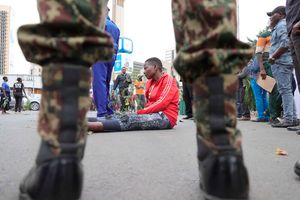
The relocation to Kasarani was not without incident. Before the viewing began, after the convoy had manoeuvred its way through the crowds, police opened fire while dispersing the crowds that had filled the stands and the pitch. A man was shot in the head and was feared dead, with initial reports indicating multiple deaths and numerous injuries.
In the Wednesday briefing, Prof Kithure Kindiki announced that Mr Odinga’s State funeral on Friday would happen at Nyayo Stadium. The venue was changed from Nyayo to Kasarani, as Friday was also gazetted as a public holiday.
After the State funeral, the body was to be moved to the former ODM leader’s Karen home, where it was expected to remain on Friday night.
“On Saturday, the body will leave Nairobi for Kisumu early in the morning, and there shall be public viewing of the body of the late Prime Minister at Moi Stadium in Kisumu City between 9am and 3pm,” said Prof Kindiki.
A helicopter hovers over mourners who were escorting the remains of former Prime Minister Raila Odinga from the Jomo Kenyatta International Airport in Nairobi on October 16, 2025.
Photo credit: Reuters
“After that, the body will travel by road from Kisumu City to Bondo for an overnight stay,” he added, noting that the burial would happen on Sunday.
By Thursday evening, the venue of the Kisumu viewing had been changed to Jomo Kenyatta Stadium, which is bigger and situated on the outskirts of the city, compared to the initial Moi Stadium that is located in the heart of one of Mr Odinga’s strongholds.
The reason for the tight timelines, Prof Kindiki explained, was that Mr Odinga had wished to be buried “as soon as possible” after his death, and his family had capped the duration at 72 hours. However, some people wished this was reconsidered.
“Baba Raila Odinga is too big to fit into a three-day mourning period,” political analyst Herman Manyora posted on X as it became clear that the programme had been derailed. “Let’s negotiate with his spirit for an extended funeral period.”
At JKIA, Mr Odinga’s remains arrived aboard a Kenya Airways plane whose flight code was changed from KQ203 to RAO001 as it entered Kenyan airspace. As it landed, security forces had a difficult time controlling the crowds, who soon breached the perimeter wall.
A member of the Kenya Defence Forces along with band members stand atop a military vehicle carrying the body of former Kenyan Prime Minister Raila Odinga in Nairobi on October 16, 2025.
Photo credit: Reuters
So massive was the crowd that, for the first time in JKIA’s history, they breached the tight security protocols and marched to the airport’s landing area.
“Baba! Baba!” they shouted, using one of Raila’s most famous nicknames meaning “father.”
One telling moment was when Chief of Defence Forces Charles Kahariri was seen pleading with the crowds to hold their horses, but his words seemed to have little effect. At some point, a daring mourner even hugged General Kahariri while crying. The man who commands the armed forces of the entire country could only stand there, calm though a little surprised.
JKIA was besieged for hours, with the Kenya Civil Aviation Authority (KCAA) temporarily halting all its operations.
“KCAA informs the public that operations at JKIA have been temporarily suspended due to an ongoing security situation following the arrival of the remains of the late Rt Hon Raila Odinga,” the authority said in an X post at 11am.
“The security situation that prompted the precautionary closure has been resolved,” it said in a statement.
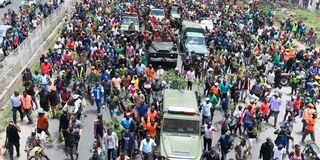
By that time, the convoy of military vehicles carrying Mr Odinga’s body was moving at a snail’s pace as crowds filled the roads right from the airport.
They intended to walk alongside the body to Lee Funeral Home. Two hours later, the procession had barely moved two kilometres.
Mourners escort a military vehicle carrying the body of former Prime Minister Raila Odinga at the Jomo Kenyatta International Airport in Nairobi on October 16, 2025.
Photo credit: Reuters
As this was happening, the security cordons placed on Parliament Road were overrun by hundreds of mourners. Before long, Parliament Buildings were besieged, with hundreds of youth threatening to bring down the gate.
Despite pleas by National Assembly Speaker Moses Wetang’ula and his Senate counterparts, the youth climbed up the gate and clung there, chanting slogans in praise of Mr Odinga.
Efforts by Embakasi East MP Babu Owino, Rarieda MP Otiende Amollo and Narok North Senator Ledama Olekina to calm the youth failed, forcing Mr Owino – who had joined the youth at the top of the gate – to abandon his mission.
The mourners, who were largely peaceful, became charged when they learnt that the public viewing venue had been changed to Kasarani.
Threats by the mourners to invade Parliament forced the military personnel to quickly remove the catafalque where Mr Odinga’s body was to be placed. The parliamentary choir, which was singing dirges around the catafalque, was also forced to leave. Several personalities, including Makueni Governor Mutula Kilonzo Jr, also left Parliament in a huff as the threats of invasion grew.
After the youth were convinced that the venue for public viewing of Mr Odinga’s body had changed to Kasarani, some commandeered a police vehicle full of officers while others protested.
A government dispatch stated: “The government wishes to inform members of the public of a change in venue for the public viewing of the body of the late Raila Odinga. The viewing will now be held at Kasarani Stadium and not at Parliament Buildings as earlier announced.”
A senior police officer told the Nation that the move to change the body-viewing venue was meant to avert the possibility of security apparatus being overrun by the huge number of people already thronging Parliament and Lee Funeral Home.
“Raila was a very influential man. The influence was massive and is evidently seen across the country, ranging from Siaya, Kisumu and Nairobi. The diversion is to allow more people to attend the viewing at a place where we can control the masses more easily,” he said.
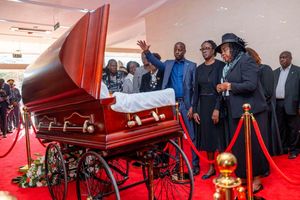
A section of thousands of mourners who thronged Moi International Sports Centre, Kasarani in Nairobi for the public viewing of the body of former Prime Minister Raila Odinga on October 16, 2025.
Photo credit: Sila Kiplagat | Nation Media Group
A widely circulated observation on social media as mobs of frenzied supporters changed the course of the programme was: “The only person who can calm down the crowds is in the casket.”
Lawyer Wahome Thuku, in a Facebook post, stated: “When Raila Odinga kept saying that he has a 10-million-man following, he meant those people... If anyone intended to ignore that group in the funeral protocols, you are in for a rude shock.”
On Wednesday, Nairobi Region Police Commander George Sedah told the Nation that security agencies had heightened their vigilance and mapped out potential flashpoints across the city.
“We have upped our security antennae and are on the lookout for any mischief that might arise during the mourning,” he said.
“These areas include Mathare, Baba Dogo and Kibra, as well as additional officers stationed along Ngong Road and in Karen,” he said.
He, however, said that the police would not interfere with peaceful mourners.
In Eldoret, one such screen was set up at the Eldoret Sports Club, courtesy of Kapseret MP Oscar Sudi.
The team had foreseen crowd troubles, and Dr Kindiki said they were banking on ODM party to help bring order.
“We are requesting the ODM party, which is represented in this committee and also at the grassroots, to support and work together with our security agencies in the normal party manner to make sure there is order and dignified mourning to ensure that we do not have any incident that could disrupt this very important moment in the history of our country,” said Dr Kindiki.
That, however, backfired spectacularly.
Reporting by Elvis Ondieki, Edwin Mutai, David Mwere, Steve Otieno, Hilary Kimuyu, Kevin Cheruiyot and Titus Ominde