Matiang’i victory hinges on Gachagua, Kalonzo alliance
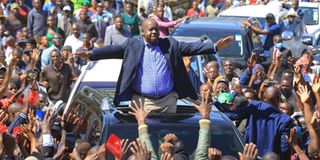
Former Interior Cabinet Secretary Fred Matiang'i acknowledges greetings from members of the public in Borabu Constituency, Nyamira County on May 02, 2025.

The battle for the presidency in 2027 is already simmering, igniting fervent discussions in the nation’s political arena. This election promises to be one of the most intricate and pivotal in recent memory.
Dr Fred Matiang'i, the former influential Interior Cabinet Secretary often seen as a leading contender, faces a challenging journey to State House. Despite possessing undeniable strengths, his candidacy must navigate a complex political landscape shaped by ethnic dynamics, entrenched regional strongholds, and a fragmented opposition. The stakes are high, and the coming months will reveal whether he can rise above the formidable obstacles ahead.
The administration of President William Ruto, which ascended to power in 2022 polls, has, in the view of many, exacerbated economic hardships, perpetuated systemic corruption, and deepened political divisions.


But still, to successfully challenge an incumbent government with the vast resources and machinery of the State at its disposal, a divided opposition is a luxury the nation can no longer afford. Kenya desperately needs a united, coherent and strategic opposition to present a viable alternative and unseat President Ruto from power.
The sheer arithmetic of Kenyan politics necessitates unity. The 2022 election results revealed a nation almost perfectly split down the middle. President Ruto secured 50.5 per cent of the vote, a margin that underscores how a consolidated opposition front could have altered the outcome.
A fragile opposition, with competing manifestos and leaders, is easily picked off, co-opted, or simply drowned out by the State’s narrative. A united front can pool resources, coordinate a coherent national message and present a singular counterweight to the government’s propaganda.
Dr Matiang’i’s strategy for success is to forge a strategic coalition with former Deputy President Rigathi Gachagua and Wiper party leader Kalonzo Musyoka. This alliance, though seemingly unconventional, represents a masterstroke of political pragmatism that could unite a critical mass of the Kenyan electorate.
Bureaucratic incompetence
Dr Matiang’i’s primary asset is his reputation as a no-nonsense, efficient and results-driven administrator. His tenure at the Interior Ministry cemented his image as a firm leader capable of delivering stability and order. These are qualities highly valued by a populace weary of insecurity and bureaucratic incompetence.
However, his Achilles' heel is his perceived lack of a deep, independent ethnic voting bloc. While he enjoys massive support from within the Gusii community and respect nationwide, history has shown that Kenyan presidential politics often require a strong ethnic base as a launching pad. This is where Mr Gachagua becomes indispensable.
As the former DP from the vote-rich Mt Kenya region, Mr Gachagua holds the keys to Kenya’s largest voting bloc. An alliance with him would guarantee Dr Matiang’i a huge share of the Central Kenya vote, a foundation upon which any successful presidential bid is built. For Mr Gachagua, partnering with Dr Matiang’i would secure a powerful position for himself and his region in a new administration, given that issues around his political participation are still in court.
Mr Musyoka completes the trinity. He is a veteran politician with a steadfast support base in the Lower Eastern region, the Ukambani bloc. His political brand, built over decades, commands the loyalty of millions of voters. By bringing Mr Musyoka into the fold, a Matiang’i-led ticket would effectively neutralise the ruling coalition.
Kalonzo brings crucial “soft power” to the ticket. He is often seen as a calming, moderate and diplomatic figure, which could balance Dr Matiang’i’s tough, administrative persona and assuage voters who might be wary of a purely “strongman” image. His involvement would lend the coalition a sense of national breadth and experienced statesmanship, appealing to undecided voters across the country.
Economic drivers
Beyond individual strengths, the prevailing political context makes this alliance necessary. Of course, such an alliance would face challenges. Negotiating the hierarchy of the ticket would be a delicate affair requiring compromise. There would also be the task of crafting a cohesive policy platform that appeals to their diverse constituencies, from the economic drivers of Mt Kenya to the agricultural communities of Ukambani and Kisii.
Critics would inevitably label it a marriage of convenience devoid of ideology. However, Kenyan politics has repeatedly shown that voters often prioritise shared economic interests and the tangible benefits of power over rigid ideological purity.
The cold, hard arithmetic of Kenyan presidential politics dictates that Dr Matiang’i’s ambition cannot be realised alone. His path to victory in 2027 is a narrow one that requires stitching together a mosaic of regions and communities. A strategic coalition with Gachagua and Kalonzo is the most astute way to achieve this.
This alliance would create a formidable, cross-regional juggernaut capable of dismantling the existing political order. For Dr Matiang’i, the choice is clear: build a bridge with Gachagua and Kalonzo, or risk watching the presidency stay out of reach.
Mr Gachahi is a former public health officer in Kenya and now a businessman in Washington, US. [email protected].