Ol Kalou’s bitter aftertaste: Democracy under threat
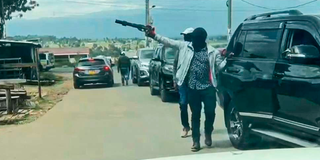
A screengrab of a video shows hooded men brandishing guns and hurling tear gas canisters at residents and journalists during the Ol Kalou by-elections on July 16, 2026.

The Ol Kalou by-election should have been a routine democratic exercise: citizens casting their ballots, candidates accepting the verdict, and the country moving on.
Instead, what many Kenyans will remember are scenes of chaos, intimidation, masked men carrying weapons, assaulted journalists, and a growing political culture in which disagreement is increasingly treated as a form of betrayal.
That should worry all of us, regardless of our political loyalties.


First, the attacks on journalists must be condemned without qualification. Reports that journalists were assaulted while covering developments during the by-election, with some having equipment confiscated and others allegedly threatened or physically attacked, represent a direct assault on press freedom.
A journalist is not a political operative. A cameraman is not a party agent. Reporters do not attend elections as participants but as witnesses on behalf of the public.
When journalists are assaulted, intimidated, robbed of equipment or prevented from documenting events, the victim is not merely an individual reporter. The true victim is the public's right to know what is happening in its own democracy.
Kenya's Constitution guarantees media freedom for a reason. Elections cannot be credible if those attempting to observe and document them are treated as enemies. Whether the victims work for Nation Media Group, The Star, Radio Africa, Standard Group or any other outlet is beside the point. An attack on one journalist is an attack on all journalists. More importantly, it is an attack on the public itself.
Equally disturbing were the reports and images of armed men wearing balaclavas and operating around polling stations. If these individuals were State agents, Kenyans should be deeply concerned.
The State possesses a lawful monopoly on force. That force must be exercised openly, professionally and accountably. Police officers are public servants, not shadowy figures in a low-budget political thriller. Citizens have a right to know who is exercising authority over them. They have a right to identify officers. They have a right to expect accountability when force is used.
Masked men carrying AK-47s have no place near polling stations in a constitutional democracy.
If those individuals were State agents, then the authorities owe the country an explanation. Why were they masked? Under whose command were they deployed? What legal authority governed their operations? Why was their identity concealed from the very citizens they were supposedly protecting?
And if they were not State agents, then an even more serious question emerges: how did armed men come to operate around polling stations at all?
There should be no ambiguity here. Elections are not military operations. Polling stations are not battlefields. The presence of anonymous armed men creates fear, invites suspicion and undermines confidence in the electoral process.
No government committed to democratic principles should tolerate such scenes. Indeed, State agents should not appear anywhere near a polling station with concealed identities unless there exists an extraordinary and clearly articulated legal justification. Otherwise, the government risks creating the impression that it is less interested in securing elections than in intimidating citizens. A constitutional government must never allow itself to resemble an organisation of goons.
Yet democratic intolerance is not confined to those who wield State power. In the aftermath of the by-election, social media clips circulated showing what appeared to be members of the public harassing a UDA MCA. The apparent logic was simple: because he is associated with the government, he is undeserving of respect, engagement or even ordinary civility. That mentality is every bit as dangerous as the intimidation directed at opposition supporters.
One does not defend democracy by persecuting one's political opponents. Far too many Kenyans appear to be adopting a view of politics in which those who disagree with them are not merely mistaken but illegitimate. Political affiliation is becoming a test of moral worth. If someone supports the government, they are treated as collaborators. If they support the opposition, they are treated as enemies. If they refuse to choose a side, they are regarded with suspicion by both camps.
This is not healthy political engagement. It is a breakdown of democratic culture.
Citizens must be free to support UDA, DCP, ODM, Jubilee or any other political formation. They must be free to praise the government or criticise it. They must be free to change their minds. They must be free to cross political lines. Politicians defect all the time; ordinary citizens must enjoy the same freedom. Loyalty freely given is democratic. Loyalty demanded is not.
More importantly, people must be free to walk away from politics altogether. Voting is a constitutional right, not a compulsory declaration of loyalty. Some citizens will vote enthusiastically in 2027. Others will reluctantly choose what they regard as the least objectionable candidate. Others may spoil their ballots. Others may decide not to vote at all.
All these choices are legitimate. No citizen should be harassed for voting for the government. No citizen should be harassed for voting against it. No citizen should be harassed for changing sides. No citizen should be harassed for abstaining. Democracy includes the right to participate and the right not to participate.
The real lesson of Ol Kalou is therefore not about who won or lost. It is about the fragility of democratic culture. Violence against opposition supporters is wrong. Harassment of government supporters is wrong. Assaulting journalists is wrong. Deploying unidentified armed men around polling stations is unacceptable. Political intimidation, regardless of who practises it, corrodes the foundations of constitutional government.
A mature democracy is not measured by how we treat those who agree with us but by how we treat those who do not. The rights we defend for our allies today are the same rights that must protect our opponents tomorrow. Once political affiliation becomes a test of who deserves dignity, security or freedom of expression, democracy ceases to be a contest of ideas and becomes a struggle for domination.
Democracy cannot flourish where fear walks around in a balaclava, nor where political conformity is enforced by an angry crowd. Kenya deserves better than masked men with rifles and citizens policing one another's political choices. It deserves a republic confident enough to tolerate disagreement, respect dissent, and allow every citizen to vote, campaign, switch sides, abstain, or stay at home without fear.
Ol Kalou reminds us just how much work remains to be done.
Follow our WhatsApp channel for breaking news updates and more stories like this.
The writer is a professor of English and comparative literature at Northwestern University, U.S., where he is also the Melville J. Herskovits Professor of African Affairs. [email protected]


