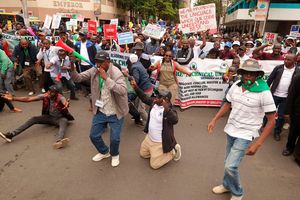
Kenya’s candidate Raila Amollo Odinga (RAO) lost the race to be the African Union Commission (AU) Chairperson in February 2025 in an epic electoral battle that was a surprise outcome to his supporters.
Even more unsettling, however, was that, the renowned ‘enigma of Kenya’s politics’ had lost to the then, much lesser known, Mahmoud Ali Youssouf, former Foreign Affairs Minister of the French speaking Somali enclave, Djibouti.
A little earlier in 2017, Kenya had similarly lost the quest for the same AU Commission Chairperson seat, when President Uhuru Kenyatta nominated my former boss at the Ministry of Foreign Affairs, Ambassador Amina Mohammed.
History repeated itself when, in 2021, the same Kenyan candidate, Amina Mohammed, lost to Nigeria’s Dr Ngozi Okonjo-Iweala in the race for the Director General of the World Trade Organisation (WTO).
Let me add to this list, the startling case in which President Kenyatta again, proceeded to nominate Monica Juma as the country’s candidate for Secretary General for the Commonwealth in 2021 at a time when we already had another Kenyan serving as the Deputy Secretary General. In spite of the AU’s rather interesting adoption of that candidature, the embarrassment was so glaring that Kenya quietly withdrew from the race by May 2022.
And there is more: the current nomination by Kenya, of two candidates at the same time, to the two highest international courts — the International Court of Justice (ICJ) and, the International Criminal Court (ICC) — speaks volumes about a possible diplomatic imbroglio. As it is now, there are eight other African countries, including neighbouring Uganda and Tanzania, who have nominated candidates for the ICC December 2026 judges’ elections. Others are Ghana, Senegal, the Gambia, DRC Congo and Malawi.
In the meantime, just a month before the ICC elections, the ICJ full-term judge elections will be held and Kenya has already presented quite a formidable candidate, Prof Phoebe Okowa. Sierra Leone, Ghana and even Liberia would be correct in expecting Kenya to support their candidate for the ICC, in return for their support to Kenya’s ICJ candidate. In the absence of this critical diplomatic understanding, the likely intense competition between these African countries pitted against each other, makes it obvious that we are preparing to lose rather than to win.
To be fair and a little more magnanimous to our great country, I have to also testify that I have witnessed a better-coordinated campaign and lobbying for Kenya to join the UN Security Council, albeit, as a non-permanent member, as per the strict UN Charter provisions. I was in New York when Ambassador Macharia Kamau, then Principal Secretary at the Ministry of Foreign Affairs took Kenya’s seat at the UN Security Council with quite some pomp. As it turned out, it was actually a double victory because on the same day we launched then brand new Blue Economy: Research Perspectives before the newly sworn-in cohort of UN Permanent Representatives.
This signalled Kenya’s Blue Economy policy consistency and leadership after successfully hosting the first ever Global Blue Economy Conference in 2018. I recall that Kenya’s strategic approach to getting the support of other nation-states in a multilateral diplomatic environment, was to ensure that we had to promise the other countries support in reciprocation, when their time came to vie for a position in the system.
Reciprocity is such an important ingredient in multilateral diplomatic practice, such that if Tanzania had, for example, supported our quest to be the AUC Chairperson, we were obligated to reciprocate by supporting them when they vie for a position at some point in time.
Going back to when Kenya lost in its bid for the AUC Chairperson, I was one of few Kenyan professionals to have had previous experience of the AUC Chairperson’s Office. While there, I had come face to face with the real bogey of ‘working in silos.’ This is the one phenomenon many people talk about glibly, yet I had to take on this UN-backed assignment at the AU so as to appreciate its complex magnitude.
Regionalism, and the embedded contest between Francophone and Anglophone blocks; not to mention the ever present possibility of a swing vote by the Lusophones, was part of the reality in AUC elective positions. In an institution where Directorates often did their things almost independently while the top watched from above, it was never going to be easy to disrupt that establishment without risking future votes. Former President Olusegun Obasanjo of Nigeria may tell you that his High Level report on alternative sources of financing for the AU may still be gathering dust almost twelve years later.
In the Kenya’s Raila Odinga vs the Djibouti candidature case, I had tried to reach out to share my experience and offer some free advice, primarily, that the AUC Chairperson quest was not going to be an easy shot if we didn’t review our strategic alliances. Remember, that my job at the AU was specifically to craft a strategy to help bridge the communication gaps between and among the various AUC institutions, in preparation for its 50th Anniversary that birthed the now famous ‘AGENDA 2063’. I had no doubt, that I had some legitimate insider information but unfortunately, Kenya’s political decision-making structures and processes often override even the most basic common sense.
One other thing I have learned from the Kenyan debacles that I have outlined above is that candidates nominated to the multi-lateral jobs should always be presented as governmental rather than as an individual’s personal candidate. In which case, a good test criterion is the formal processes that are invoked before a nomination is made.
A direct nomination by a Head of State can be both a plus and an undoing, especially if it turns out that one may not even be able to do the job. There are countless such instances that can be traced to nomination processes influenced by personal preferences yet the specific institutions -especially the judicial category, required an unequivocal demonstration of independence.
The final thing I must mention on reflection, is that, a little over-statement in a candidate’s CV can be one’s Waterloo. Those who love using the prefix of ‘Dr’ or ‘Prof’ and other far-fetched, imaginary accolades, when they actually know that they never attained them, had better be very careful. You might want to read ‘the Makgoba Affair’ and what damage ‘sexed’ up CVs can do to an otherwise novel career.
Prof G. Odera-Outa is an interdisciplinary scholar currently based at the Technical University of Kenya. He has previously served as an advisor and technical expert for various government and UN programmes.