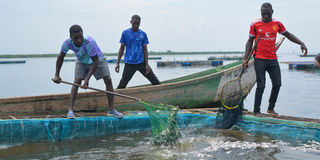
The loss of 10 tons of fish in cages at Dunga beach in late September 2025 is not an isolated tragedy—it is a flashing red alarm that Kenya's water pollution crisis has reached catastrophic levels.
The Kenya Marine and Fisheries Research Institute (KMFRI) has confirmed that reduced dissolved oxygen levels in Lake Victoria caused the massive caged fish deaths at Dunga Beach, resulting in financial losses estimated at Sh9.6 million, including fish stock, feed, and labour.
This is not the first time Dunga has witnessed such devastation, similar incidents occurred in 2023, signaling a chronic problem that authorities continue to ignore.
The Root Cause: Untreated Effluent Flowing Unchecked
The Kibos River, which drains into Lake Victoria at Dunga beach, carries industrial effluents, raw sewage, and agricultural runoff that deplete oxygen levels critical for aquatic survival. When organic pollutants enter water bodies, bacteria consume oxygen to break them down—a process measured as Biological Oxygen Demand (BOD). Research on Lake Victoria indicates that the accumulation of organic material increases benthic BOD to levels exceeding 10 mg/g, a sensitive indicator of ecological damage from pollution. High BOD means less oxygen for fish, leading to mass deaths like those at Dunga.
Yet despite clear environmental laws, enforcement remains virtually non-existent. The Environmental Management and Coordination Act (EMCA) and NEMA's Water Quality Regulations explicitly prohibit the discharge of pollutants into water resources without pre-treatment. Counties across Kenya—particularly Kisumu County—routinely discharge raw sewage directly into Lake Victoria, driven by a toxic combination of inadequate infrastructure, budget constraints, and regulatory apathy.
The Wetlands Solution: Nature's Free Treatment Plant
Wetlands are among the most cost-effective and sustainable solutions to this crisis. These natural ecosystems act as biological filters, trapping sediments, absorbing excess nutrients like nitrogen and phosphorus, and breaking down organic pollutants before water reaches lakes and rivers.
Unlike engineered treatment plants that require millions in capital investment and ongoing operational costs, wetlands provide continuous filtration with minimal maintenance once established.
Industries and factories with available land should be mandated, not merely encouraged, to construct artificial wetlands for effluent pre-treatment before discharge.
Riparian zones along rivers like the Kibos must be restored with native vegetation, including bamboo species that absorb heavy metals and excess nutrients while stabilising riverbanks.
Learning from Ruai and Demanding Better
The Nairobi Water and Sewerage Company's treatment works in Ruai demonstrate that proper wastewater management is achievable in Kenya.
The facility uses aerobic and anaerobic lagoons where bacterial action treats sewage before releasing it into the Athi River.
Fish populations in the final maturation pond serve as biological indicators—their survival confirms safe BOD levels; their death triggers immediate investigation.
However, even Ruai is compromised by sewer bursts and illegal discharges upstream. This highlights a critical gap: Kenya needs both engineered treatment infrastructure AND natural buffer systems like wetlands to handle the inevitable failures of ageing pipes and inadequate enforcement.
County governments bear direct responsibility for municipal waste management. Kisumu County, whose economy depends heavily on Lake Victoria, cannot continue treating the lake as a free dumping ground. The county must:
Immediately halt all raw sewage discharge into Lake Victoria and its tributariesInvest in decentralised sewage treatment plants with budgets allocated in the next fiscal yearEstablish mandatory wetland buffers between industrial zones and water bodies, with penalties for non-complianceConduct quarterly water quality audits with results made public to ensure accountability
The National Environment Management Authority (NEMA) must revoke operating licenses for industries violating effluent discharge standards and impose punitive fines sufficient to fund wetland restoration projects.
The Dunga tragedy is not about 10 tons of fish; it is about the systematic destruction of an ecosystem through negligence and impunity. Every day authorities delay action, oxygen levels drop further, algae blooms spread, and more fishermen lose their investments.
The technology exists. The laws exist. What is missing is political will. If we fail to act now, Dunga's dead fish will be remembered not as a warning, but as the moment we chose profit over survival, and sealed Lake Victoria's fate as a toxic graveyard.