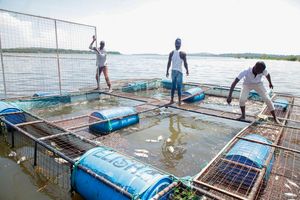
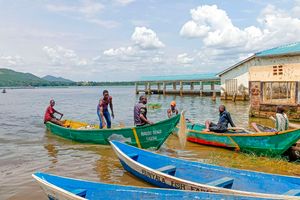
The Kenya Marine and Fisheries Research Institute (KMFRI) has attributed the recent fish deaths at Kisumu’s Dunga Beach to pollution from the river upstream and the discharge of untreated water into Lake Victoria.
According to the report, the strong, pungent smell coming from the river mouth may have depleted the oxygen levels in the fish cages, resulting in the deaths of large numbers of fish.
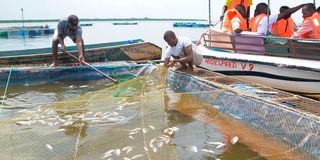
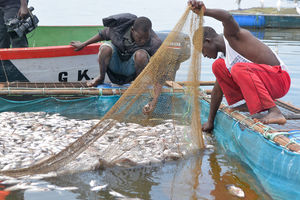
On Sunday, residents of Dunga woke up to find thousands of tilapia floating in the lake. Approximately 12 cages out of 100 were affected.
Within two days, cage farmers had lost 10 tonnes of tilapia, worth approximately Sh10 million.
Dead fish retrieved from the cages at Dunga Beach, Kisumu County on September 29, 2025.
Photo credit: Alex Odhiambo | Nation
The report by the institute’s Freshwater Systems Research Director, Dr Christopher Aura, said that the discolouration of the water indicated possible water discharge, runoff, and siltation activities.
“The levels of dissolved oxygen were low at the river mouth compared to other areas of the lake. This is an indication of high oxygen demand, attributed to industrial or domestic discharges and the deposition of nutrients into the lake,” it said.
In the report, Dr Aura explained that both oxygen depletion and a high concentration of organic matter are harmful to aquatic organisms such as fish.
“Such an environment creates an anoxic condition that causes fish to suffocate, leading to mass deaths,” he said.
Mr Godfrey Ochieng, a cage farmer in Dunga, said that the cages closest to the river mouth, where River Kibos discharges into Lake Victoria, were the most affected.
“The cages farthest from the shore were untouched by the upwelling, which occurs when oxygen-deficient water from the bottom is pushed to the top. If the wetlands around Dunga were not interfered with, we might not suffer these losses,” he said.
He added that wetlands play a crucial role in filtering and purifying river water before it flows into the lake.
“But due to population pressure, human activities, and pollution, nature and wetlands have been disrupted. Residents of Kapuothe, for example, recently complained of frequent floods, prompting the erection of dykes that now allow free flow of river water directly into the lake,” Mr Ochieng said.
In Seme Sub-county, however, farmers at Ogal Beach have not been affected. “So far, I only know of Dunga Beach being hit, but for us, we are monitoring oxygen levels and remain safe,” said cage farmer Shalton Omollo.
Floating fish on the shores of Lake Victoria in Dunga Beach, Kisumu County on September 29, 2025.
Photo credit: Alex Odhiambo | Nation
However, he suggested that relocating cages to deeper waters would reduce the risk of fish kills. “Although moving to deeper waters requires more fuel to reach the cages, it is worth it. Security concerns are another reason farmers prefer keeping their cages close to the shores,” Mr Omollo added.
The Lake Victoria Aquaculture (LVA) Association said the crisis reflects a deeper problem—systemic failure.
“At the heart of this problem is regulatory paralysis. Nine months since the High Court suspended the Fisheries Management and Development (Aquaculture) Regulations, the government has failed to provide an alternative framework. This complacency has left the sector in limbo, undermining food security, investments, and livelihoods,” said Ochieng’ Mbeo, the chairperson of the LVA Board.
The contested aquaculture regulations were suspended in December 2024 after the association petitioned the court, arguing that the rules were punitive and exclusionary.
Earlier this year, a task force appointed by the Cabinet Secretary for Fisheries, Ali Hassan Joho, submitted its recommendations, with Joho pledging to introduce new, more inclusive laws. However, none of these recommendations have been enacted.
For cage farmers, the costs are immediate and devastating.
“Every time there is a fish kill, we suffer huge financial losses with no support. We feel abandoned. Farmers need both protection and predictability that only effective regulation can provide,” said Mr Albert Altena, a cage fish farmer in Siaya County.
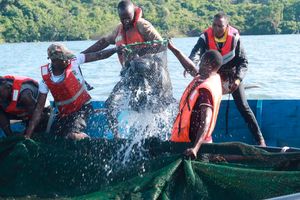
Fish farmers retrieve dead tilapia from cages at Dunga Beach, Kisumu County on September 29, 2025.
Photo credit: Alex Odhiambo | Nation
But the damages damage stretches far beyond cages. At Dunga Beach, fishmongers sit idle by empty tables as customers flee.
“People think we are selling the same fish that died in cages, but those were taken away for disposal. Yet customers have cancelled orders, some saying they’ll wait three months before buying again,” said Franciscar Odhiambo, a trader of more than 20 years.
For Pamela Ogwayo, another fishmonger, the collapse has been devastating.
On Tuesday, she did not sell a single fish and the hotels around her had fewer customers.
The ripple effects extend well beyond market stalls. Boda-boda riders along the lake shore complain of empty days and shrinking wallets.
Brian Omondi, for example, used to earn enough to fuel his motorcycle and still save some money.
“Now I can go the whole day with only two trips. Sometimes I return home with less than Sh300. It is discouraging because this motorcycle is my only hope for survival,” he said.
Authorities have since advised farmers to relocate their cages into deeper, more suitable waters.