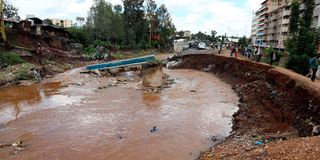
On the evening of Friday, 6 March, Nairobi flooded and reckoned with decades of decisions it had been quietly deferring.
Within hours of the Nairobi River bursting its banks, major transport routes including Mombasa Road and Uhuru Highway were submerged, vehicles were swept away, and flights at Jomo Kenyatta International Airport were diverted to Mombasa.
Our city of five million people was brought to its knees by a single night of rain. The police confirmed 49 deaths and 2,624 families displaced and we know this number may still be rising.
The instinct, which is totally understandable, is to point to the drains choked with plastic, the buildings thrown up on riparian land, the concrete replacing the soil that once absorbed rainfall. But these are all symptoms. The diagnosis is older and harder.
Nairobi’s flooding problem was generations in the making and will likely take decades to reverse. Some data from the Technical University of Kenya estimates that between 2000 and 2019 alone, the city lost about 6,600 hectares of forest cover (roughly 11 per cent). And that’s six years ago. Meanwhile, glass towers and apartment blocks have mushroomed everywhere.
We also have a large proportion of our urban population in Nairobi that lives in informal settlements lacking adequate drainage infrastructure, meaning almost all storm rainfall is translated into rapid and sometimes catastrophic flooding. Finally, we know that drainage infrastructure in our city has simply not kept pace with the growth of the city which had twice as many people as it did in 1986.
President William Ruto himself acknowledged that “these floods once again highlight the urgent need for lasting solutions to the perennial challenge of flooding in our urban areas.”
Once again. Those two words are the most important in his statement. Because this crisis has been building, neighbourhood by neighbourhood, drain by drain, for 30 years. So, the question is not merely how to grieve, but whether we have the courage to finally stop it.
Stopping it means we address a deeper, more serious reality and that is the dismantling of the irreplaceable natural systems, like Karura, Ololua, and Ngong forest, and the wetlands of Nairobi National Park, the riparian corridors of the Nairobi and Gitathuru rivers. There should be no ambiguity about their full protection.
The city’s natural systems were ignored and have systematically been destroyed. What has not changed is the memory of water, which still remembers its route and now more than ever as we are confronting a climate crisis, it remembers its route with devastating violence.
Any department involved in city planning must consider both green and grey infrastructure. This includes wetlands restoration, floodplain reconnection and riparian buffers to enhance management and reduce flood risks. There is one intervention that costs nothing but political will and that must precede every shovel, every permit or every master-plan for development in Nairobi: the Environmental Impact Assessment (EIA).
Every EIA, properly conducted and honestly enforced, should produce precisely the flood risk data that Nairobi has been building without for decades: where the water flows, where it pools, what it will destroy when the drains are blocked and the rivers rise.
No era of development has the right to build as though the rivers do not exist. With technology, flood risk can be mapped and predicted. These approaches harness the capacity of ecosystems to absorb, retain and slow flood waters while providing benefits such as water purification, habitat conservation and recreational opportunities.
Once the assessment is clear then action to restore and build adaptive capacity must be resolute. The approaches that work do not fight water. They work with it, restoring ecosystems to absorb and slow floods while returning to communities clean water, living habitat, and green space. But knowledge without resolve is just data. The action that follows must be fearless which is why clearing of Karura to establish a tree nursery is so disturbing.
The example of Kigali here is worth noting. Rwanda’s capital faced a near-identical trajectory a few years ago. A city expanding faster than its infrastructure, wetlands surrendering to concrete, and flood risk compounding with every construction permit signed in ignorance of hydrology. In one generation Kigali’s rivers are beginning, slowly, to forgive.
Between 2013 and 2019 alone, Kigali’s wetlands shrank from 100 square kilometres to just 72, a loss of nearly a third of the city’s natural flood buffer in six years, even as the population surged from under half a million to more than 1.3 million people.
The flooding that followed was not a surprise. But Rwanda made a different choice. In 2016, the Rwanda Environment Management Authority (REMA) launched a plan to rehabilitate the degraded Nyandungu wetland, a $5 million investment that cleared industrial pollution, restored a native fig forest, and employed 150 Kigali residents to plant over 17,000 trees and plants from 55 indigenous species. The wetland, once a liability, became a proof of concept.
In 2024, Kigali broke ground on the rehabilitation of five further wetlands spanning nearly 500 hectares. This is evidence-based urban development. For Nairobi, where heavy rains frequently lead to destructive flooding, Kigali’s experience offers several lessons.
Ms Mathai is MD for Africa & Global Partnerships at the World Resources Institute and Chair of the Wangari Maathai Foundation.