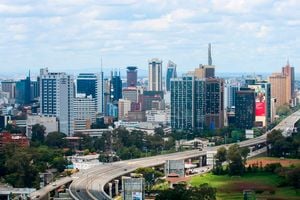
On a sunny Monday in Nairobi, September 4, 2023—the opening day of the inaugural Africa Climate Summit—the President of the Republic of Kenya stood before the world and declared with pride: ‘Nairobi is the only city in the world that has a national wildlife park at one end and a closed-canopy forest on the other... our credentials as Africa’s Green City in the Sun are well established.’”
I could not have agreed more. I have always believed it. But today I am angry.
What is happening at Karura Forest today is both an environmental outrage and a political contradiction of the highest order, and we must name it as such. The plan to establish National Youth Service barracks inside Karura Forest, allegedly without community consultation, without an environmental impact assessment, and with trees already felled, cannot possibly be a bureaucratic error. It is a symptom of something far more troubling. How can we possibly speak the language of climate leadership on the world stage while quietly, and with stunning impunity, dismantling the very evidence and ecosystems that give that language meaning?
As many Kenyans have lamented, I fear we’re acquiescing to these actions because they’ve become routine—namely, the proposed golf course and hotel in Ngong Forest. A highway has been carved through Aberdare Forest. A hotel water and sanitation pipeline that threatens another green space. The proposed degazettement of over 17,300 acres across Mt Elgon, Nandi and Kakamega. In a country that is already two-thirds arid or semi-arid, it is hard to understand how this seems acceptable.
Let us be clear about what science tells us. One hectare of mature forest absorbs 153 cubic metres more water during a storm than a paved surface. Nairobi already floods. Just yesterday, we were drowning. The forests that ring this city are crucial green infrastructure to cushion us in times like these. They are our life-support systems, as critical as any road or hospital. When we replace forest canopy with concrete, we are inviting catastrophe for ourselves, our children and their children.
Kenya has committed to planting 15 billion trees. We have told the world, and the world has listened, that Africa can lead the green transition. But climate leadership must go beyond the speech. It is the daily, unglamorous, legally-bound work of protecting what we already have. You cannot plant 15 billion trees with one hand and fell Karura with the other and then hope we don’t notice. Our Constitution is unambiguous. The Forest Conservation and Management Act of 2016 is unambiguous. Public participation has never been a courtesy. It is a constitutional mandate. And when governments consistently violate the rule of law, they erode the public’s faith in institutions, destabilise society, and increase the likelihood of the very conflict and unrest they seek to avoid.
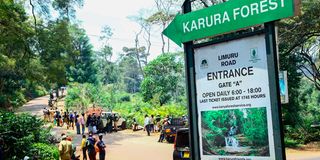
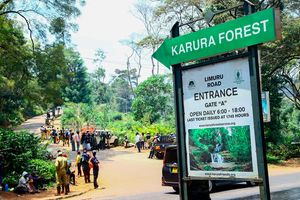
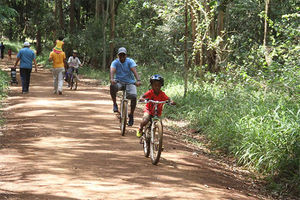
The footpath near the Mau Mau caves leads up the Karura River to the waterfalls. Karura Forest, Nairobi.
Photo credit: File | Nation Media Group
My mother, Wangari Maathai, was beaten in Karura Forest in the 1990s defending it against encroachers of the Moi regime. She bled for those trees. She understood and always reminded us of something that power often forgets: that the state of a country’s environment is a direct reflection of the state of its governance. You cannot have a healthy democracy and a decimated forest. The contempt shown to our ecosystems is the same contempt shown to us as citizens, to science, to law, to the painstaking community participation that transformed Karura from an unsafe, degraded space into a beloved urban forest receiving up to 80,000 visitors a month. Can this just stop!
What we are fighting for is not the Karura of the past. It is the Karura of the future. A Karura Forest that will cushion our children and their children against the worst impacts of a changing climate. Every inch we surrender today is borrowed against their future. We insist on transparency. We insist on consultation. We insist on respect for the law. We call for an immediate halt to any further destruction, and for the full restoration of what has already been lost.
Despite the sad and unfortunate developments in Karura, the past few weeks have been wonderfully full as we celebrated Wangari Maathai Day. It deepened my conviction about why this fight matters. We hosted three Nobel Peace Laureates in Nairobi: Shirin Ebadi (2003), Leymah Gbowee (2011), and Olexsandra Matviivhuk (2022), and it turned into one of those rare weeks that remind you why the work we all do matters so deeply.
The Wangari Maathai Foundation, which I chair in honour of my mother’s legacy, co-hosted the visit alongside the Nobel Women’s Initiative (NWI) founded in Nairobi in 2005. They were here to celebrate 20 years of NWI and to gather in solidarity with 80 women's activities from around the world including Kenya. The experience was truly extraordinary.
Having the laureates with us as events continue around the world in all our continents was beyond words. Their presence here in Kenya created a powerful bridge between struggles for justice across continents.
One moment felt particularly poignant during our visit with Chief Justice Martha Koome. At a time when the rule of law is under pressure in many parts of the world, standing together in the Supreme Court felt like a quiet but resolute affirmation of what must be defended: justice, accountability, and democratic institutions.
Moments like these remind us that solidarity is lived, shared, and strengthened when courageous voices come together. Our forests are asking for exactly that kind of solidarity now. They cannot speak. So we must.
Ms Mathai is the MD for Africa & Global Partnerships at the World Resources Institute and Chair of the Wangari Maathai Foundation.