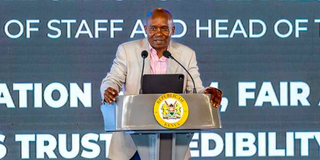
Recently, we convened at the South Eastern Kenya University in Kitui County for the Third Annual Regulatory Authorities and Agencies Conference, bringing together principal secretaries, chairpersons of boards, chief executive officers of regulators, policy experts and senior public officers from across Government.
The conference was officially opened by the Deputy President, Prof Kithure Kindiki, who reaffirmed the critical role of regulators in strengthening governance, protecting citizens and advancing national transformation.
The gathering was not merely another Government conference. It formed part of a deliberate reform process that my office has been undertaking over the last three years to revitalise and re-energise regulatory authorities and agencies.
This reform agenda is anchored on a simple but important reality: wananchi experience Government primarily through regulators.
Many citizens may never interact directly with senior officials, but every day they encounter Government through institutions that inspect buildings, test medicines, regulate fuel, oversee transport safety, monitor environmental compliance, supervise communications systems and protect consumers from exploitation.
When a mother purchases medicine for her child, she trusts that Government regulators have verified its safety. When a family enters an apartment building, they assume inspections have been properly conducted. When wananchi board aircraft, consume food products, use mobile money services or purchase fuel, they are placing confidence in the vigilance and integrity of regulatory institutions.
In many respects therefore, regulators constitute the everyday face of Government.
Where regulation is firm, fair and effective, citizens experience Government as organised, responsive and trustworthy. But where regulation is weak, inconsistent or compromised, wananchi quickly lose confidence in institutions and begin questioning the seriousness of Government itself.
For many years, sections of the regulatory environment suffered from fragmented mandates, weak coordination, duplication of roles and excessive bureaucracy. In some cases, institutions became overly focused on internal procedures while losing sight of the actual experiences of citizens on the ground.
Citizens judge government through lived experience. They judge us through safe buildings, orderly towns, fair markets, efficient services, clean water, reliable systems and the ability of institutions to respond decisively whenever public interest is threatened.
The theme of this year’s conference, “Consistent Measurement and Evaluation of Real Regulatory Impact on the Ground”, reflects the direction we must now take as a public service. It is no longer enough for institutions to merely report activities undertaken or programmes implemented. The true measure of government is whether wananchi can genuinely see, feel and experience positive change in their daily lives.
Citizen centred questions
Increasingly, therefore, regulators must ask more practical and citizen centred questions. Are buildings becoming safer? Are dangerous products being removed from markets? Are environmental standards being enforced properly? Are approvals becoming faster and more transparent? Are citizens receiving better services? Are public complaints being addressed effectively?
Encouragingly, meaningful progress is already emerging across several sectors.
More institutions are embracing digital transformation, integrated oversight systems and inter agency coordination. Increasingly, regulators are recognising that regulation is not simply about enforcement. It is also about supporting economic growth, strengthening investor confidence, protecting public health and ensuring fairness within society.
At the conference, several agencies showcased reforms already underway. In the environmental sector for instance, digital systems are streamlining licensing processes, reducing delays and improving transparency. New frameworks governing climate action, carbon markets and environmental compliance are similarly helping Kenya respond to emerging national and global realities while safeguarding public interest.
Equally important has been the growing institutionalisation of Monitoring, Evaluation, Accountability and Learning frameworks across the regulatory space. Through this approach, we are cultivating a public service culture where institutions increasingly measure outcomes, rely on evidence and continuously improve performance.
Advancement of public good
This represents an important departure from a culture where institutions focused heavily on procedure without sufficiently interrogating whether citizens were actually benefiting from Government action.
Going forward, regulators must increasingly demonstrate, through credible evidence, that their interventions are reducing risks, improving efficiency, strengthening compliance, lowering the cost of doing business and improving the daily experiences of wananchi.
But beyond systems and frameworks, there is also a deeper responsibility that rests upon every regulator and every public officer.
The powers granted to regulators exist for the protection of citizens and the advancement of public good. They must, therefore, be exercised lawfully, courageously and fairly. Whenever regulators become negligent, complacent or compromised, the consequences are often severe.
When unsafe buildings collapse, lives are lost. When counterfeit products enter markets, families suffer. When environmental degradation goes unchecked, entire communities are affected. When standards are ignored, public confidence erodes. And when institutions fail to act decisively against wrongdoing, wananchi begin to feel abandoned by the very Government meant to protect them.
This is why regulatory authorities and agencies must now rise fully to the demands of the moment before us.