Climate change: Classrooms must connect dots
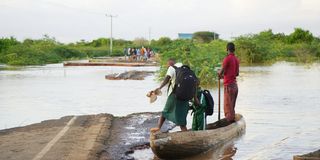
Students disembark from a canoe to school at Watta Hamesa village, Tana River County on Monday May 13.

Communities across the country are watching the weather closely as forecasts point to the possibility of heavy rains in some areas. Such weather extremes can disrupt agriculture, livelihoods, infrastructure, and learning. Yet our classrooms remain stuck in academic silos.
In the real world, environmental crises do not arrive neatly labelled as Geography, Biology, Physics, or Economics. A drought can trigger crop failure, spike food prices, threaten public health and force children out of school. Heavy rains can bring flooding, soil erosion, damaged roads and water contamination. If our learners are expected to navigate such interconnected challenges, our education system must help them connect knowledge across disciplines.
Kenya is not starting from scratch. The Education for Sustainable Development Policy calls for learning that fosters critical, systemic thinking and collaborative action. The goal, therefore, is not to burden an already crowded curriculum with another standalone subject called “Climate Change”. Instead, we must transform how existing subjects interact to turn classroom knowledge into practical community action.


Rather than teaching climate concepts in isolation, educators can anchor learning around a single, real-world challenge: How can our school become climate resilient? The value of this approach is that learners learn to use knowledge, skills and values together.
Responsible citizenship
Climate change provides a natural context for this because its effects require scientific understanding as well as economic reasoning, responsible citizenship, communication, innovation and practical decision-making.
Consider a school facing chronic water shortages. Mathematics students can calculate potential rainwater harvesting yields from classroom roofs and estimate storage costs. Physics students can design simple gravity-fed flow systems. Geography learners can map runoff patterns to prevent soil erosion, while Agriculture classes utilise harvested water to maintain a school food garden. Meanwhile, Technology students can leverage digital tools such as artificial Intelligence to analyse climate data, conduct research and model solutions.
The same project can extend beyond the classroom. Students can measure rainfall, estimate the school’s daily water demand, investigate how water scarcity affects families, examine the health consequences of unsafe water, and compare the costs of different conservation options. Language Arts students can synthesise these findings to pitch practical climate solutions to parents, local authorities, and community leaders.
Climate challenge
In this way, a single climate challenge becomes a living laboratory where learners connect classroom knowledge to decisions affecting their own community. This problem-solving approach also fulfils the promise of competency-based education. Assessment shifts from asking students what they can memorise to evaluating how effectively they investigate problems, analyse evidence, collaborate, communicate and execute workable solutions.
To achieve this, teachers need structured opportunities and incentives to co-plan across departments, utilise local environmental data and facilitate project-based learning. Teacher training must move beyond preparing educators to deliver isolated subject lessons toward empowering them as designers of integrated learning experiences.
If climate change is interconnected in the real world, our classrooms must be interconnected too.
Follow our WhatsApp channel for breaking news updates and more stories like this.
Baraka Mumo Kilonzo, Kiambani Senior School


