“Lock up the babies, politicians are coming” is a slogan synonymous with elections in many countries for as long as politics has existed. It was a way for politicians fooling the electorate that they had a softer side after all. Which is telling of the gap that politicians try to reduce during campaigns after creating it between them and the electorate as soon as they get elected.
“Lock up the babies, politicians are coming” has now been overtaken by anti-migrant rhetoric of “go back where you came from.” The latter has gained as much traction in the recent past as COVID-19. I can’t think of a continent that is not reeling from the effects of anti-migration. It is worse in Europe, USA and the Middle East. South Africa has taken the top spot in its anti-migrant stance in Africa.
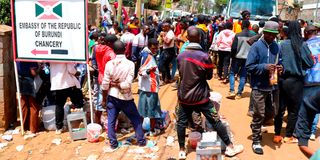
Kenya has now followed suit and targeted some migrants from certain African countries, especially Burundi, and asked them to leave. Although the time has been extended for their departure, it does not take away from the fact that the initial order at short notice was deliberate and meant to cause panic.
The stance Kenya has taken recently to ask Burundians specifically to leave was not only discriminatory but contradictory. Many migrants from across Africa chose to move to Kenya since President William Ruto opened the country to all Africans on a “visa-free entry”.
I was sceptical then about such a roadside policy on a matter that could prove a threat to national security. Since the declaration of visa-free entry for all Africans, Kenya saw a spike in migration to the country from Burundi, Nigeria, Somalia, Congo, Ethiopia, Tanzania, Uganda, Rwanda, to name just a few. This is why singling out Burundians to leave the country left many unanswered questions.
Over time, Burundians became the people who did the “jobs that no Kenyan wanted”, which is a problem to have if one has choices. This means many Kenyans had a choice at home to choose not to hawk tea in flasks and mandazi to make ends meet.
Burundians had no such choice in a foreign country where opportunities for them were limited and perhaps better than the situation they left back home. No one would wish to move to foreign countries except for seeking greener pastures, something millions of Kenyans are already doing in many other countries.
Ironically, some Kenyans are, in fact, doing the dirty jobs abroad that locals do not want to do, such as sweeping the roads, working in care, factories and cleaning toilets. This is when Kenya should have been careful before throwing a stone in a glass house.
Parliament has now been cajoled to enact laws to stop foreigners from running small and micro-enterprises such as those used to be done by Burundians. This is a policy that should have been thought of before opening the country to all and sundry. The timing before the next election is suspect for one simple reason: It is being brought forth to appease the small Kenyan traders who have been ignored for yonks. It was mama mboga in the limelight in the last campaign, and now she is being replaced by micro-traders of every shade. This is not about helping Kenyans but about votes. You do not open the country to everyone when there are limited economic opportunities for the citizens in the first place.
Unemployment has been a challenge for Kenya for many years now, and little has been done to reduce the number. Therefore, many Kenyans opted for self-employment, but that was undermined by flooding the country with cheap labour from other African countries.
Kenyans have lamented that imported cheap labour undercuts their wages. Those who work in the construction industries have been impacted the most by the low wages that migrants were willing to accept. Why has nothing been done all this time to address the concerns raised by construction workers?
Kenya has only fallen into the trap many countries have fallen into, where their politicians are using anti-migration rhetoric to win votes from the people they neglected in the first place. Any politician worth his/her salt now, from across the world just needs some kind of anti-migrant slogan to win. Anti-migration has become a sure way of being elected.
Meantime, little is done to address the challenges local communities face that are caused by illegal migration and flooding countries with cheap labour. Concerns by locals are often ignored as politicians turn to migration as a tactic of winning votes.
They appease those against migration or poor citizens brainwashed to believe all their problems are caused by migrants and not their incompetent and insular governments.
Kenya has been a host country to millions of bona fide refugees for decades. A role it played to great acclaim until the recent xenophobic move by the State against a few African countries for its own political survival. Anti-migration and politics should never mix!