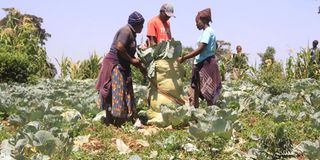
Communities farming in public forests have lost an estimated Sh240 million in annual income over the past five years, as the government raced to increase the national forest cover.
New data shows that between 2019 and 2024, Kenya’s forest cover grew from 3.47 million hectares to 3.59 million hectares, largely due to afforestation and restoration initiatives.
Over the same period, the size of forest land used by adjacent communities to grow food crops fell from 8,410 hectares to 3,636 hectares, a report by the Kenya National Bureau of Statistics (KNBS) shows.
And while the size of land under forests grew by 124,003 hectares over the five years, incomes to farmers who grow food in public forests dropped by more than half.
The farmers’ annual income dropped from Sh421 million in 2019 to Sh182 million between 2022 and 2024, the KNBS report said.
“Kenya’s public forests contribute to food security through the Plantation Establishment and Livelihood Improvement Scheme (PELIS). PELIS is a community-based forest management programme implemented by the Kenya Forest Service (KFS) that integrates food production with forest restoration efforts,” KNBS says.
Under the programme, forest-adjacent communities, typically organised into community forest associations (CFAs), are granted temporary rights to cultivate small plots within young plantation forests, as they plant and nurture tree seedlings.
This has offered a lifeline for thousands of Kenyans living near public forests, who have for years gained access to food and income, as they protect forests.
“Common crops grown under PELIS include maize, beans, potatoes and vegetables, providing direct nutritional and economic benefits to households that often have limited access to arable land,” KNBS states.
Forest land under food cultivation shrank over the period, with land under maize production reducing from 3,814 hectares in 2019 to 1,427 hectares annually since 2022.
This occasioned an annual Sh120 million loss of income to farmers who grew maize in the public forests, half of the entire loss of income from food farming in the forests.
Potato farmers lost Sh47 million in annual income, the same as those farming cabbages and sukuma wiki, while pea farmers lost Sh24 million annually.
For decades, Kenya’s forests had suffered decline due to a mix of factors, including forest excisions, agricultural expansion, illegal logging and urbanisation, causing the forest cover to shrink by about 460,000 hectares over a 30-year period to 2019.
“However, a gradual recovery has been observed since 2019, with forest area increasing to 3.59 million hectares (6.07 per cent) by 2024, representing a net gain of approximately 124,003 hectares over the five-year period,” KNBS says.
The report shows that over the five years to 2024, there was an afforestation of 342,427 hectares of forest land in the country, countering the deforestation of 218,424 hectares.
Under the PELIS system, farmers grow food crops just after harvesting mature forests and as new tree seedlings are planted, benefiting from the forest land until trees start maturing and the canopy closes.
“Through this approach, Kenya’s public forests act as both a restoration area and a source of food resources, contributing an estimated Sh182 – 420 million annually to domestic incomes,” KNBS says.
The statistics body observes that Kenyans could be earning far more than the estimate from public forests, since its estimate excludes additional forest-derived foods such as traditional vegetables, insects and other non-timber forest products.