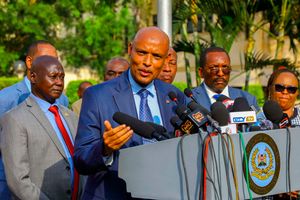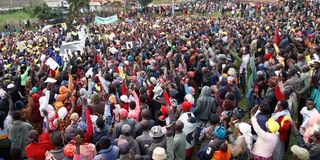
A political rally.
Kenya is closer than ever to achieving the economic transformation it has pursued since independence. Growth is steady, innovation is thriving, and the country’s young population is ready to drive the next chapter of development.
Yet this progress is overshadowed by a political climate that is becoming increasingly polarised. If Kenya does not address these divisions head-on, the country’s path to high-income status will remain turbulent.
Today, Kenya stands at a rare moment when economic momentum, demographic energy, and technological ingenuity are aligned, yet the window to convert that momentum into a historic leap is narrowing fast.
For the first time since independence, Kenya is within reach of upper middle-income status, close enough to taste a different future. But the real test is whether the nation can move with speed, unity, and strategic discipline, while still holding together a vibrant democracy and a society shaped by deep diversity.
You can feel the tension in ordinary places where citizens argue about politics with the kind of fatigue that comes from repeating the same disappointments. In Nairobi, a young graduate with a laptop and big ideas jokes that Kenya has start-ups, but our politics runs like a power outage, always interrupting momentum. These are the everyday signals of a country that wants to move forward, but keeps being pulled back into a cycle of suspicion and grievance.
Political division is not only a problem of emotions but a substantive economic risk. When elections feel like existential contests rather than choices, investors price in uncertainty. When political competition maps too easily onto identity, national debates harden into regional positions that are difficult to negotiate. Yet development requires continuity, the steady, boring work of building systems over years, sometimes decades.
Fertile regions
Kenya has seen this movie before. Sessional Paper No. 10 of 1965 pushed a logic of concentrating resources where returns were highest, in fertile regions such as Central Kenya, Rift Valley and parts of Western Kenya. It delivered early growth, but it also planted seeds of disparity that still shape our politics today. Vision 2030 tried to correct that imbalance by insisting that every region must be part of the national transformation. The lesson is that the next development leap must lift the whole nation, not just the counties with the loudest political voice.
This is where infrastructure becomes more than concrete and steel but the architecture of national possibility. It determines how fast goods move, how widely opportunity spreads, how competitive firms become, and how confidently investors bet on the future. But in a diverse democracy, infrastructure does something even more important, it becomes physical proof that the state works for everyone. A road in Turkana is a message that the nation remembers its edges. A port in Lamu is a statement that the coast belongs to the national story, not just the tourism brochure. They cool political temperatures by showing that development is not a zero-sum game.
That is why the creation of the National Infrastructure Fund is the clearest signal that Kenya is trying to build a dedicated engine for long term financing so that infrastructure is not held hostage by volatile budget cycles or unsustainable borrowing. The goal is to pool resources from government, pension schemes, private investors, and development partners, then use it to unlock stalled projects and accelerate new ones. If it works as intended, it gives Kenya the financial muscle to build at the pace required for global competitiveness, and it creates a more predictable pipeline that planners and investors can trust.
But the Fund will not save Kenya if the politics around it becomes another contest. A financing vehicle can be well designed on paper, yet still fail if citizens suspect it is a corridor for insider deals. That is why governance matters. The rules must be clear, project selection transparent, and procurement must be disciplined, and backed by routine reporting to the public. The point is to persuade Kenyans that the numbers will translate into roads, ports, power, water and jobs that serve everyone.
Kenya’s current pipeline of flagship projects shows a country preparing for a more competitive future. Major highways, an expanded airport system, stronger special economic zones, modernised ports, and wider renewable energy capacity can become symbols of inclusion if they are planned and delivered with fairness.
Digital learning
Still, physical infrastructure alone is not enough. To reach high income status, Kenya must also build the systems that multiply human capital. Primary healthcare that reduces disease burden and raises productivity. Modern schools and digital learning that prepare youth for a competitive global economy. Water and sanitation that protect public health and support urban growth. County industrial parks that bring jobs closer to where people live. Digital infrastructure that makes it easier to build services, trade online, and scale innovation. These are the foundations of a modern economy.
But here is the core truth we avoid. No infrastructure fund, no economic blueprint, and no flagship project can succeed in a climate of persistent political polarisation. Countries that made the leap built political compacts that outlived elections and created shared national agendas, strengthened institutions that could survive leadership transitions, and invested in civic trust. They were not free of division but simply refused to let division define their future.
Kenya can do the same, but it must be deliberate. Leaders across the political divide should agree on a small set of national priorities that will not be rewritten after every election.
Kenya’s path to high income status will not be built by one project or one administration. It will be built by a national commitment to long term, cross party, cross county investment in the systems that power opportunity. In a democracy, that commitment is the glue that holds the country together.
When development is planned openly, financed sustainably, and distributed equitably, it becomes the one arena where politics can compete without tearing the nation apart.
Follow our WhatsApp channel for breaking news updates and more stories like this.
Osewe is a development finance expert, who has held senior positions at the World Bank and Asian Development Bank