First Olympic gold: Another big win receives lukewarm coverage at home
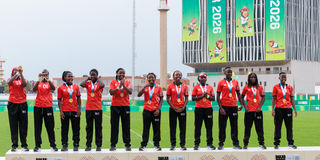
Kenya’s Rising Lionesses celebrate with their gold medals after beating Australia 17-12 in the girls’ rugby sevens final at the Dakar Youth Olympic Games on November 3, 2026.

A beautifully written story. Fast-paced, action-packed and taking the reader to Dakar’s Complexe Iba Mar Diop, it not only announced Kenya’s historic win at the Rugby Youth Olympics, but also pointed out what must be done for a repeat. The irony in the strap line, Dakar 2026 Youth Olympics: Success highlights the stark contrast with the country’s long-neglected team sports, was, however, hard to miss. The historic win contrasted as starkly with the lukewarm treatment accorded this story — a puff on the front page, the main article relegated to the back page. NTV did not fare any better.
We’ve been here before. When Sebastian Sawe became the first man in history to run a marathon under normal conditions in less than two hours, we called out the Nation for failing to give him his day in the sun.
As noted in the story, the Rising Lionesses didn’t just win the gold; they shattered a decades-old ceiling to become the first-ever Kenyan team to win an Olympic gold (whether Winter, Summer or Youth).


“Since 1954 (Tokyo), only athletics has produced gold medals at the Olympics, save for 1998 when Robert Wangila (now deceased) won gold in boxing at the Seoul, South Korea Games,” former Nation Media Group Sports Managing Editor Elias Makori said in response to this win. It is also the first time Kenya has won gold in a team sport on the world stage.
In any other country, this would call for a national celebration; perhaps even a national holiday. Life would come to a standstill, TV would interrupt normal broadcasting to announce the win, and newspapers and digital platforms would run pages of stories, pictures and videos.
Unfortunately, the celebration has been left to families, communities, churches, clubs and schools who acknowledge the sheer magnitude of the success. A school took to social media to celebrate its student for making history as its first-ever Olympic gold medalist. When the media gives such a euphoric moment lukewarm treatment, it alienates these communities and sends them away to spaces where they feel more valued. If the media wants to win over youthful audiences, it must make their achievements count and their voices heard.
At a time when Kenyans are yearning for good news to distract them from the toxic politics, the gloom of catastrophic road accidents that have claimed many lives in the last two weeks, and the tragedy of the collapsed building in Nairobi, giving prominence to this uplifting story would have been welcome.
Unfortunately, owing to our training and history, we journalists seem to be good pathologists, always seeking what went wrong or the dark backstory. Death, tragedy, crime and the never-ending political drama preoccupy us. We need to exorcise this trauma that is choking newsmaking in Kenya.
Celebrating success and being critical should not be mutually exclusive. We should, can and ought to do both simultaneously. These girls’ victory was one such moment to look at what is working and where we can do better as a country. To show evidence that the country’s youth, given the opportunity and right support, can conquer. It is about hope in a time of bad news from everywhere. But instead of celebrating, the media’s pathological eye turns away.
This is not a crisis from the blue; it is a symptom of the problem underpinning newsmaking in Kenya.
Another problem is that, while the media rarely celebrates success outside politics, financial and corporate achievement, it also tends to undervalue women’s achievements. In politics, business and more prominently in sports, women’s achievements are treated as an occasional win, which is tolerated in both the breadth and width of coverage.
Kenya’s women volleyballers are celebrated for conquering Africa, but rarely do we read their individual stories. When the Starlets made it to the World Cup, it was another case of tokenistic reporting. What is worrying is that the problem persists across sectors, desks, and media houses, reflecting a systemic bias against any achievement that is not masculine.
When Eliud Kipchoge wins a marathon, we should all stop and admire his individual effort. And when Kipchoge’s daughters match this excellence with an Olympic win, the political and corporate goes mute. It is treated as a fluke. In fact, on social media, many people expressed disbelief at this news, suspecting it to be false. Our deserving winners like Kipchoge have shown us that hard work pays, but it is fulfilling when it is celebrated as a national achievement.
In many countries, sport is an important unifying factor as citizens rally to support their national teams. It drives economies and can be a crucial revenue stream for media houses.
But perhaps the question to ask of NMG editors is: Does the Sports Desk have a seat at the Editorial decision-making table? Is the Desk’s contribution taken seriously?
A recent letter from former Nation sports writer Zoeb Tayebjee, raises the same issue of downplaying sports.
The journalist writes: “The international cricket tournament, under the World cricket body (ICC) ended in Nairobi last Saturday. Contestants were New Jersey, Denmark, Kuwait, Qatar, Papua New Guinea and Kenya. The Nation completely ignored coverage of this high-profile international event.
Participants received good coverage in their respective countries, except the host Kenya. No previews, no scores of matches played. A complete blackout. Only one half-hearted story appeared in the Nation.
On Monday, The Nation’s editorial found a good reason to demean Kenya. Here, I won’t argue as Kenya finished at the bottom of the table and was kicked out of the next year’s World Cup.”
Follow ourWhatsApp channel for breaking news updates and more stories like this.
Contact the Public Editor to raise ethical concerns or request a review of published material. Reach out: Email: [email protected]. Mobile number: 0741978786.