The world is fracturing into competing spheres of influence. While the US has declared its own moral law to be supreme, China is building an alternative financial architecture.
The West, once united, splinters over trade and security. In this multipolar disorder, Kenya has been handed an unusual opportunity in co-organising the Africa Forward Summit.
Today, French Minister Delegate Éléonore Caroït arrives at the University of Nairobi (UoN) with PS Korir Sing’oei to prepare for that summit.
Three months from now, Emmanuel Macron follows for the first institutional France-Africa gathering since 2017.
One month after Nairobi, France chairs the G7 in Évian. The Nairobi Declaration becomes how rich economies engage Africa. Kenya is shaping the conversation when international order faces existential questions.
France hasn’t been absent from Africa by accident. The 2021 Montpellier France-Africa summit invited only civil society, deliberately excluding heads of state. Many traditional governmental partners felt alienated. Since then, France has been partly rejected from its traditional sphere of influence. Macron’s strategy has been to redirect toward Anglophone Africa. He's focused on Ghana, South Africa, Rwanda, and Nigeria. Nairobi continues this strategic pivot.
The substance looks serious. France is committing about Sh5.4 billion (€35 million) to build a science and engineering complex at the UoN, modelled after Saclay, France's premier innovation ecosystem that clusters elite engineering schools, research institutes, and tech companies. The summit tackles AI, health systems, blue economy development, international financial architecture reform, energy transition, and green industrialisation. India and the EU will participate fully as partners.
France's "Transformational Agenda" promises strengthening civil society relationships, mobilising diaspora, reducing military footprint, examining shared colonial history, and advocating for African representation in global governance, including permanent African seats on the UN Security Council. Day one brings business and youth forums. Day two convenes heads of state for policy negotiations.
The Nairobi Declaration feeds into June's G7 discussions when Africa's Security Council representation, financial architecture reform, and climate financing tools all hang in the balance. This matters because, as multipolarity accelerates, the question of who speaks for Africa at these tables becomes crucial in determining whether reformed multilateralism will emerge, or if the great powers will simply impose their will.
Yet a gap remains between partnership ambitions and enabling infrastructure. However, mobility issues should be discussed at bilateral meetings rather than at the multilateral summit. The summit's six themes all require people moving between countries to collaborate effectively. Research partnerships need scientists exchanging between labs. Health cooperation requires medical professionals training in each other's systems. Business forums connecting entrepreneurs depend on reliable travel access.
The asymmetry is instructive. French passport holders access nearly all African countries visa-free or with visa-on-arrival. African applicants to France face 30 per cent rejection rates compared to 17.5 per cent globally. Kenyan applications surged by 45 per cent in 2025, which France cites as evidence of growing engagement.
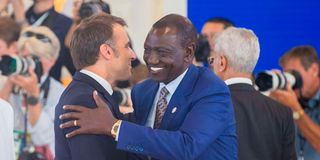
French President Emmanuel Macron (left) shakes hands with Kenyan President William Ruto as he leaves after their meeting at the Elysee Palace, amid the New Global Financial Pact Summit in Paris on June 23, 2023.
Photo credit: AFP
France has also adjusted student policies. A 2025 budget law eliminated housing assistance for non-EU foreign students without scholarships while increasing enrolment fees. These changes create financial barriers alongside visa uncertainties.
India offers a comparative model. France extended five-year multi-entry Schengen visas to any Indian who studied one semester in France. Indian graduates receive 24 months to find work. India will participate in Nairobi as a guest with mobility arrangements that exceed what Kenya currently has as co-host.
Kenya holds significant cards at a pivotal moment. France needs this summit to succeed because it provides legitimacy for the African position that France presents at the G7. Questions of Security Council reform, financial architecture, and climate financing get shaped in these conversations. Kenya co-organises the agenda and provides the platform.
The conversation must start somewhere. Kenya should propose concrete arrangements: electronic visas for Kenyan nationals, or visa-free access for specific categories such as researchers, students, and business travellers. Even a phased approach starting with 90-day electronic visas would signal genuine partnership. France manages to extend such arrangements to strategic partners such as India. Kenya, as summit co-host shaping Africa's G7 position, qualifies as strategic.
The Nairobi Declaration establishes African precedent when rules of international engagement are rewritten. Kenya should articulate clear expectations: mobility frameworks with measurable benchmarks, scholarship commitments and investment guarantees in specific sectors, technology transfer ensuring graduates access French facilities.
France is making real investments. The engineering complex is a tangible asset. Thematic partnerships address development priorities. The question is whether the mobility infrastructure matches the ambitions of these partnerships. In a multipolar world, where partnerships determine positioning, Kenya must take its place at the table as a co-architect, not a supplicant. The summit’s success depends on substance beyond declarations. Kenya has the leverage.
The writer is a whistleblower, strategy consultant and start-up mentor. www.nelsonamenya.com