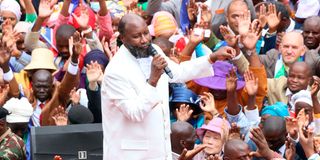
On November 15, 2024, a video circulated online: Prophet David Owuor's hand firmly pressed against Venezuelan President Nicolás Maduro's head at Miraflores Palace in Caracas. The self-proclaimed man of God was praying fervently, decreeing protection for Maduro.
“I decree with my prophetic tongue today that you protect the president of this nation,” Owuor declared, his voice heavy with certainty. “The enemy will not come near, and this nation will rise. I decree victory, victory, victory—victory three times in the mighty name of Jesus.”
Less than two months later, on January 3, 2026, American special forces breached Maduro’s fortified compound at 2:01am, used blowtorches to cut through steel doors, and dragged the Venezuelan leader and his wife from their bedroom. Maduro is now in a New York jail cell awaiting trial. So much for prophetic protection.
This spectacle might seem like distant theater, but it reflects a dangerous pattern much closer to home. Just before Kenya’s August 2022 elections, both William Ruto and Raila Odinga allegedly made separate pilgrimages to Prophet Owuor’s palatial mansion in Runda, seeking his prayers and presumably his blessing. Sources close to Owuor confirm both meetings occurred privately. The prophet, hedging his bets, prayed for both candidates. Yet privately, he believed Raila would win. Raila lost. The prophecy failed, just as it would fail again in Venezuela.
Calculated political theater
Here lies the fundamental problem: Politicians don’t campaign on competence anymore; they campaign on which prophet has decreed their victory. Congregants, vulnerable and earnest in their faith, interpret a politician’s appearance at the pulpit as a sign from God rather than a calculated political theater. We end up electing leaders not because they can manage water systems or fix our roads, but because some cleric in flowing robes suggested God chose them.
Before 1905, the Catholic Church in France owned 10 per cent of the country’s land, collected its own taxes through tithes, controlled education and healthcare, and filled its upper ranks exclusively with nobility. The Church and the absolute monarchy were so intertwined that France was known as “the eldest daughter of the Church.”
Kings claimed to rule by divine right, their authority supposedly flowing directly from God, validated and reinforced by clerical blessing. The formula was simple: the Church legitimised royal power, and the monarchy protected Church privilege. Meanwhile, ordinary French people suffered under a system where competence mattered less than divine endorsement and noble birth.
The French Revolution violently challenged this arrangement, but it took until December 9, 1905, for France to finally enact complete separation of Church and State. The law established that the Republic neither recognises, funds, nor subsidises any religion. It guaranteed freedom of worship while drawing clear boundaries: the State stays out of Church affairs, and the Church stays out of State governance. The principle, known as laïcité, remains enshrined in France's constitution today. Leadership would now be based on merit and democratic choice, not prophetic decree.
Rwanda offers an even more sobering lesson. Before the 1994 genocide, the Catholic Church was deeply entangled with State power. The Archbishop of Kigali sat on the ruling party's central committee for over a decade, implementing discriminatory policies that would eventually enable mass murder. Church leaders were closely tied to President Habyarimana's regime through personal friendship and blood relations.
Churches as campaign grounds
When the genocide erupted, more people died inside churches than anywhere else. Priests directed death squads to hiding places, nuns handed over Tutsis seeking refuge, and one priest even ordered bulldozers to crush two thousand people sheltering in his church. International tribunals convicted multiple clergy members of genocide and crimes against humanity.
Today, Rwanda's government refuses to allow churches any political power.
Some will argue that faith matters in leadership, that we need God-fearing people in office. But consider China—officially atheist leadership, yet they’ve lifted 800 million people out of poverty and built the world’s second-largest economy.
No one asks if Xi Jinping has a prophet’s blessing. They measure results: infrastructure, economic growth, technological advancement. Meanwhile, Kenya’s deeply religious “Christian” leaders have presided over looted coffers, collapsed infrastructure, and scandals from NYS to Arror and Kimwarer dams. Faith didn’t stop the theft. Prophetic endorsement didn’t build a single kilometer of functioning BRT.
Competent management matters more than divine endorsement. Singapore’s Lee Kuan Yew wasn’t chosen by prophets; he was chosen for his vision and capability. South Korea's economic miracle wasn't prophesied; it was planned and executed. When we prioritise prophetic theater over demonstrable competence, we get leaders who excel at performance but fail at governance.
Kenya needs structural barriers, not just gentlemen's agreements. We should bar politicians from using churches as campaign grounds during electioneering periods. Places of worship should be sanctuaries for spiritual matters, not venues for political validation. Religious leaders who endorse candidates should face consequences, just as churches that become political machinery should lose any tax privileges they enjoy.
The writer is a whistleblower, Strategy consultant, and a Startup Mentor, www.nelsonamenya.com