US Vice President JD Vance is coming to Kenya at the end of November, which is something of a big deal. Marco Rubio, the Secretary of State, cancelled an earlier visit to Kenya and President Donald Trump has made his disapproval known at the expenditure of American treasure to police East Africa, particularly protecting it against Al-Shabaab. He makes the rather reasonable case that the primary job of the US military is to protect the American homeland, not police far-flung African badlands.
Mr Vance’s visit will be framed as intended to reassure Kenya of its strategic importance to the security of the US. Well, for me, an important US official will not wake up in the morning and wear his trousers to come to Africa to smooth feathers.
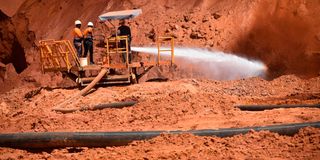
They used to come for oil, steel and timber, which built the old economy. The new economy of AI, green mobility and smart warfare is being built with a different category of minerals called rare earth minerals. Kenya has no oil but it has rare earth minerals. The US and China consider access to rare earths a matter of national and economic security.
These are 17 metallic elements used in the green economy – batteries, wind turbines, solar panels – advanced electronics (laptops, mobile phones, screens and LED lighting, lasers used for medical purposes and fibre optics) and the defence industry (missile guidance systems, night vision equipment, aircraft engines and frames, among others). This is the stuff with which the future economy is being built.
Rare earth mineral deposits
China and the US are engaged in a high-stakes geopolitical rivalry. China stole a march by allowing small miners to find rare earths, dig them out and process them without too much government or environmental regulation. Once they had found the metals, the government quietly kicked them out and consolidated the mining under a handful of giant government-tied enterprises. By subsidising the mining and not being too fussy about the environment, China pumped cheap rare earths into the global market, drove out US producers and controls supply of 90 per cent of refined rare earths and magnets. And it quickly flexed muscle: it cut supply to Japan over a maritime tiff, it tightened export controls, creating a shortage in response to US tariffs, disrupting Western defence projects and EV production.
Today, China dominates the supply chain so much so that even American ore is shipped to China for processing. Now the US is scrambling to build a separate supply chain, sometimes seeking to work with allies such as Australia. It is also doing deals with, or arm-twisting, countries to gain access and stockpile the minerals it needs to keep its technology and defence industries winning. Rare earths have no substitute; any country that wishes to leverage clean energy technology, advanced electronics for AI and build a world-beating military must have them.
Kenya has significant rare earth mineral deposits, particularly at Mrima Hill in Kwale, where Cortec in 2013 found deposits of neodymium, praseodymium, cerium and dysprosium, critical for high-tech products. There are also major deposits of niobium, used in the aerospace industry, pipelines and automotive parts. Kenya’s rare earth deposits at Mrima are valued at between $62.4 billion and $7 trillion, depending on whether your estimate is from Cortec, Rare Earth Exchanges or Dennis Itumbi. In 2024, Salim Mvurya, who was then Mining Cabinet Secretary, announced the discovery of coltan, another valuable mineral, in six counties. That has since gone quiet.
First, we should pledge our minerals to neither the Americans nor the Chinese. This is a trade negotiation; the outcome is dependent on what we are getting. The negotiations should take place in open, transparent mechanisms, not in the State House closet. Secondly, the negotiations should be open to all comers: the Europeans, Japan, South Korea, India, Brazil – everyone with money. We should accept the deal that promises the best returns for our country.
Thirdly, the negotiations should be conducted by experienced trade experts, not by some smart-Alec, Danube-of-thought cowboys who think they are very clever, but who in actual fact don’t.
Fourth, we should be very nice to the Americans, play them like the nyatiti – gentle, fine, delicate but deep strokes to make the melody sensual and hauntingly memorable. We should let them know how much we like them, how grateful we are to them for fighting with us when our country is under attack and our people being slaughtered by terrorists who kill us by night and spend the day pretending to be friends; we should be uneconomical with our expressions of admiration for President Trump and his efforts to reform not just the US, but the entire global diplomatic and economic system. Let them know that we are negotiating because this is a matter of business, otherwise we’d simply throw in our lot with them.
Fifth, demonstrate that we mean business – no corruption, no nonsense; the local community should be involved and benefit without the disruption of the whole project by a litany of unrealistic village expectations; environmental regulations should be strong and enforced.
Sixth, we should never ever agree to a deal that involves the export of dirt. All minerals must be locally processed and exported in a refined state, and all fair taxes paid. This is a strategic opportunity. God has put a fat morsel in front of us. Let us eat it.