Raila sometimes made bad political deals, but he was one of the good guys.
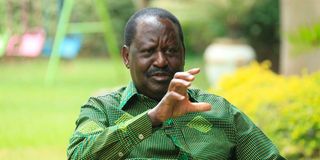
Just before the election, I went to see Raila Odinga. I wanted, among many other things, to ventilate about heavy handed regulation and commercial interference in the media, its gradual decline and the threat it posed to democracy. As I launched into my indignant professorial rant, I saw his eye-lids grow heavy and by the time I brought my monologue to a close, his eyes were completely shut. I never missed a beat, this is not the first big man I had bored to sleep. Part of the job.
But he sprang awake and gave me a lecture of his own on digital progress and its impact on old media. I didn’t disagree, I just thought it was besides the point. The media could handle digital disruption - eventually. What it couldn’t handle was a system that believed that advertising was a reward for good coverage. Media do not owe government good coverage, they owe government, and everyone else, fair coverage. A system that did not know the difference was a disaster for the media and the country. I was experienced enough to know that there are interests bigger than having the last word, so I didn’t press my case.
Tinga knew I had not done a good job of convincing him, I could see from the hint of amusement on his lower lip, a sly shadow of a smile. He was in command of the basic facts and arguments, it was going to take some time to bring him on board.
I had had another policy encounter with him when the board of the Kenya Copyrights Board paid him a visit at Capitol Hill organized by Mr Juma Odemba, a board member and he of the Kayamba Africa fame. Tinga had brought along SK Macharia, a clever move. Mr Macharia, and his Royal Media empire were copyright consumers and our relationship was professionally not convivial. But Mr Macharia is brilliant; he has a very practical grasp of complex technical and policy issues.
While I was idealistic and dreamy, I found Mr Macharia brass tacks brilliant. He had very real-world solutions to what we had set as our objective: to digitise and automate copyright management end-to-end and remove once and for all the thieving CMOs. My own personal crusade was to hold to account the CMO fat-cats over which I had seen the Director of Public Prosecutions, Director of Criminal Investigations and Executive Director of the Ethics and Anti-Corruption Commission and an investigation of some sort was started. But the system ran down the clock and rings around me, our term expired, we left. I suppose CMOS are still talking about scientific and general distribution, paying our best artists two cents for their brilliant creativity.
Tinga was a good policy guy. He was genuinely bright, big memory, widely knowledgeable, fully formed views about things and not too worried when there are things he didn’t know. He often would know someone who does and would introduce them into the dynamic. I played on the edges of his circle for a short while and I think he would have made a great President.
He reminded me of the men from my father’s generation, the ones who had taken up pangas and home-made guns against the mightiest empire on earth. The same pride in our imperfect little nation, the same fount of patriotism and commitment to freedom at all costs, the same courage in the face of repression. It is because of him and people like him that we have a modicum of democracy in this country. Everyone understood that Tinga has a big, fanatical following; if he was set against you, there is little you could do. You could jail him, of course, as Moi did, but he survived and did not stop opposing Moi on account of it. You could do whatever you wanted with him, he would not stop. Perhaps you could rent him, but you were never too sure for how long. The one thing you could be sure of was that it was never permanent.
Leaders on this continent were amazed with Tinga’s pragmatism and easy ability to make political deals with his worst rivals. He was a great mobiliser but not a good organiser: He would mobilise the folks to vote for him, but he wasn’t organised enough to stop his rivals from stealing his votes.
They also demonised him to their people, made him out to be the great Satan, but he never nursed grudges. He would still do political deals with them.
He had become an integral part of the architecture of the Kenyan nation, the guarantor of its stability, the moderator of power and the people’s champion.
As a journalist, I’m not really used to people being kind to me, but in recent years he was quite thoughtful. He had gathered around him a bunch of bright giants , which meant that his decisions were always carefully thought through.
He was also served by many unassuming but brilliant people, key among them his press secretary Dennis Onyango, whose longevity of committed service is often overlooked. Kenya has suffered a terrible loss but Raila leaves behind a lot to celebrate and emulate.