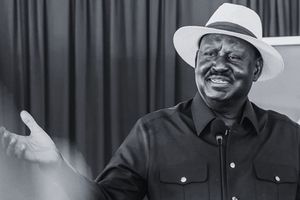
In political terms, former Prime Minister Raila Odinga was like a giant, African bull buffalo which provided a home for pests on the long hairs of its head, its ears, its belly, and every inch of its hard-to-reach hide.
So long as it was well-fed and healthy, the parasites were welcome to its warmth and perhaps even a little bit of blood.
With his demise, many politicians and technocrats who owed their careers to Mr Odinga and those who don’t have a strong standing in Nyanza and in ODM will struggle.
The “experts” in government will be hard-pressed to negotiate largesse and elbow room from the system. Previously, they could walk the Savannah with confidence and nibble on sweet grass under the protection of the giant horns of the big buffalo. Today they are but scattered browsers, fully exposed to wild dogs, hyenas and the odd lion. It is just a matter of time before something eats them.
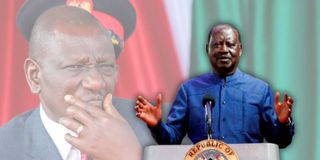
But my thinking is that the obvious orphan-in-chief is President William Ruto . To provide some context, in 2018 I took a market tour of Nyanza. A market tour in the news business used to be sitting around bus stops, restaurants, bars and in town halls, listening to your customers.
The Kisumu bus park is a unique place; folks read and discuss the newspapers and politics in general. Every journalist who comes calling visits the bus park to listen to the sound of the river.
It was shortly after Mr Odinga had shaken hands with then President Uhuru Kenyatta on the steps at Harambee House, Nairobi. I looked at the circle of “Luopean” faces, grinning mischievously at me. “Uhuru is no longer the enemy,” one of the men told me. So who is? I asked. “It is Ruto,” he told me. The other guys laughed and enthusiastically agreed. Just like he changed perceptions about Mr Kenyatta after the handshake, Mr Odinga rehabilitated Mr Ruto’s political image in Nyanza and many other parts of Kenya, such as Western and the Coast. Just by shaking hands.
Mr Odinga gave Ruto’s government the final coat of legitimacy when he agreed to recognise and join it – of course, by “sending experts”. Mr Odinga was President Ruto’s opponent in the election; he was also the complainant in the election petition at the Supreme Court. When he recognised the Kenya Kwanza government, the last vestiges of resistance against the government collapsed.
Those who had been saying “not my President, not my government” suddenly found themselves without a leg to stand on. If the man who lost to the President had embraced him, who are you, a mere bystander to continue holding off? The Broad-Based Government was a strong legitimising factor for Kenya Kwanza and one of its bigger political victories.
For more than 30 years, Mr Odinga was the king of the streets. He represented a slum constituency for the longest time; he had networks in every poor neighbourhood, and he commanded the political champions of those spaces. He had an almost direct control of the youth from these poorer neighbourhoods and they followed him into political battle with courage and no questions.
After the 2017 election, I watched him personally lead wave after wave of youths into the Nairobi central business district to protest what they said was theft of the election. Mr Odinga had tremendous personal courage and political audacity. Because of that he owned the streets of Nairobi and was a formidable political opponent.
Conversely, it is very difficult to have protests in the streets of Nairobi without the involvement of the Odinga political system in the city, which is what the Gen Zs tried to do. By committing to the other side, Mr Odinga’s system cleared the streets for the regime. Hardened youths from the slums with experience in street combat and love for action not only faced the less experienced university students, but they contaminated the protests with “false flag” crime, especially attacks on businesses, clashes with the police and generally creating conditions that justified a tough crackdown by the regime – not that much encouragement was needed for that. In that way, in my opinion, the Odinga system in the city has kept the streets clear for the Kenya Kwanza government and kept it safe from the wrath of a population that is sometimes quite dissatisfied with regime policy and actions.
In Parliament, theoretically, Kenya Kwanza has the support of 179 MPs and Azimio 158. But this is a misleading, helicopter view. Up close, ODM’s 89 members support the government, but Jubilee’s and wiper’s combined 56, do not. Similarly, there are many MPs, especially from the Mt Kenya region, who are in government in name only; their souls are in DCP.
Theoretically, if ODM were to leave the government, then maybe Kenya Kwanza could experience a mathematical risk of a confidence vote, but with the kind of MPs there are, it is just wishful thinking: this is the President’s Parliament, it will not sack him.
Finally, Mr Odinga and Mr Ruto were some of the most talented and hardened campaigners in Kenyan politics today.
Together they might have delivered a second term for Mr Ruto by winning the majority of the votes in the Rift Valley, North Eastern, Nyanza, Western, the Coast region and a considerable number in Nairobi. Without Mr Odinga, the President faces a grim re-election battle. And it will take a tremendous amount of police violence to keep the streets clear.