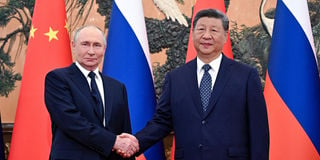
Gathering of China, India, Russia and the rogue state North Korea in Beijing in the last couple of days, capped by a military parade and bromance between Kim Jong Un, Vladimir Putin, Narendra Modi and their host, Xi Jinping, is an event of consequence for global affairs.
It is a direct challenge to the tremendous technological, economic and military power that the US has wielded — and which peaked in the 1990s— likely to come under pressure from hostile Eurasian coalition.
To understand why this meeting is interesting, one must go back to the late 1980s and early 1990s to unbundle one of the biggest events that created a unipolar globe with the US with rarely challenged influence and revisit the ideas of Zbigniew Brzezinski, former National Security Advisor, thinker, and foreign policy guru.
When the Soviet Union dramatically imploded in December 1991, the vast Soviet empire covering Eastern Europe and Central Asia splintered into component republics: Russia, Ukraine, Belarus, Moldova, Estonia, Latvia, Lithuania, Georgia, Armenia, Azerbaijan, Kazakhstan, Uzbekistan, Turkmenistan, Kyrgyzstan and Tajikistan. Georgia and Armenia had gone much earlier.
Mikhail Gorbachev quit as the Soviet President on December 25, 1991, the following morning the Soviet Union was no more. Its flag came down at the Kremlin, the imperial seat of power, and its military, economy and bureaucracy scattered.
The Soviet had tightly controlled the Eastern Bloc, but from 1989, countries started asserting independence and in 1989, Poland, East Germany, Czechoslovakia, Hungary, Bulgaria, and Romania broke free.
After the death of the Soviet Union in 1991, the Warsaw Pact, the military alliance that held together Soviet Union allies, was dissolved. Germany had reunited in 1990.
The Soviet economy collapsed, countries such as Russia were hit by hyperinflation, industrial decline, mass unemployment, and widespread poverty.
There were wars and territorial disputes canvassed as a result of the collapse, some which continue in one form or another, such as the current war in Ukraine and others such as Chechnya, which fought Russia for independence, Nagorno-Karabakh, pitting Armenia against Azerbaijan, Abkhazia and South Ossetia in Georgia and the civil war in Tajikistan.
US became the world’s only superpower, NATO, its military alliance with Western Europe, grew eastwards, gobbling up some previous members of the Warsaw Pact and taking Western power right to the doorstep of Russia.
Brzezinski’s 1997 book, “Grand Chessboard: American Primacy and Its Geostrategic Imperatives”, is a blueprint for American power in a world without the Soviet Union. The strategy is based on nine key ideas, which we summarise here.
First is the idea that Eurasia, the combined landmass of Europe and Asia, “is the central arena of global power” because “it contains most of the world’s population, natural resources, and economic output” and therefore who controls it runs the world.
In his view, the US needed to maintain control of the affairs of that region to ensure that a new Eurasian power does not emerge.
The second is the cautionary idea that American power is fragile if it loses its grip on Eurasia or if it allows “hostile coalitions” to arise in Eurasia. He advised America to use its power wisely, forge alliances and finesse international organisations to stay on top longer.
Thirdly, and related to this is his advice that the central focus of US foreign policy should be to prevent the rise of such a “hostile coalition” in Eurasia. The nightmare scenario is the creation of an axis incorporating Russia, China, Iran or India.
Four, he identifies countries which he says are “pivot states” because they can decisively change the global balance of power depending on which side they choose: Ukraine, Azerbaijan, South Korea and Turkey. Ukraine is described as a “linchpin” which must never fall to Russian control: if Russia regained control of Ukraine, it would regain imperial strength and threaten Europe.
Five, to prevent a Russian comeback, he advocated the expansion of NATO and the European Union eastward, bringing Central and Eastern Europe into the Western column.
The sixth idea was how to manage Russia. In his view, the West should not isolate Russia but at the same time should never allow it to regain control of the former Soviet republics.
He counsels finessing Russia to become a friendly democratic country while at the same time entrenching the independence of the other regions of the former Soviet Union.
Point number seven, he foresaw the rise of China and counsels maintaining a strong alliance with Japan, South Korea and South East Asia to balance it, but also says that relations should be constructive with the aim of domesticating China by integrating it in global institutions which can moderate its behaviour.
If the grins and grips are genuine and longstanding, then we are seeing the emergence of a hostile Eurasian coalition, the nightmare scenario.