Taifa Leo holds a special place in the Nation Media Group stable. It was the group’s first publication and only newspaper until the Nation’s launch in 1960. It has survived the test of time and remains the only Kiswahili national newspaper in Kenya.
Over the last few years, the newspaper has distinguished itself with its witty headlines that accurately capture the country's mood. Headlines such as “Kuliendaje?”, “Aisha Aisha”, “Hasla feki, Joshua bandia 2022?”.
If there ever were a global competition for the best headlines, Taifa would take all the gongs.
Besides the headlines, Taifa serves the large population of Kiswahili speakers with credible content.
Daily, the editors do a superb job, producing and publishing content that connects and resonates with the newspaper’s readers. Its language is beautiful.
Additionally, Taifa Leo is a valued education platform. It has attracted subscriptions from thousands of primary and secondary schools, whose teachers use the newspaper to teach Kiswahili. Examination results have shown a marked improvement in performance in Kiswahili for schools that subscribe to Taifa Leo under NMG’s Newspapers in Education (NiE) programme.
However, a regular feature in Taifa Leo risks tainting its reputation. A letter from Kigwiri Njuru drew the public editor’s attention to the feature.
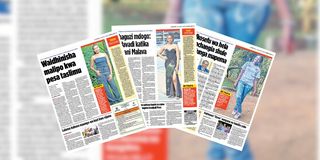
Njuru raises concern about the Bi Taifa feature in Taifa Leo, which regularly profiles young women — showing their photos, names, ages, professions and hobbies.
He states that, while this is a commendable effort in celebrating women, it is notable that there is no equivalent platform for young men.
“This gender imbalance suggests that men’s stories are less worthy of such visibility, which is neither fair nor reflective of our diverse society. For the sake of equity and inclusivity, I urge Taifa Leo to consider either expanding the slot by introducing a similar column for men. Maybe Bwana Taifa,” he adds.
Mr Njuru’s letter, calling for “fairness and balance”, prompted the public editor to look at the Bi Taifa more keenly. Does the feature have any news value? What needs of the reader does it serve?
The Bi Taifa slot, which occupies a substantial part of Page Three, features full-body photographs of mostly young women and girls who have willingly posed and granted permission for them to be published in the newspaper.
Our research found that Taifa has preserved this feature, copied from tabloids in the West, for decades, only changing its name and position. In 1996, the slot was on Page 13 under the name Changamka (cheer up). In 2000, it was renamed Leta Raha (entertain or bring fun). Then in 2005, its name was changed to Mgeni Wetu (our guest). In 2007, the slot was moved to Page 3 under the name Bi Taifa (Miss Taifa).
The historical names make no pretense of the feature’s intention. The women’s photographs are a piece of entertainment.
Current editors argue that the current name (Bi Taifa) dignifies the women. Yet, even this name is problematic as it is fashioned from the titles for beauty pageants and other contests where the winner is crowned as Miss or Mr this and that. Taifa has not run any such competitions before crowning the individuals who appear on its Page Three.
The editors argue that the photographs used depict decently dressed women who benefit from the exposure. In other words, Taifa provides space for women to “advertise” themselves. How does the exposure help the young women?
The argument that the women send their pictures of their own volution, or pose to be photographed only adds decorum to aggression. With the countless digital platforms, both men and women have unlimited possibilities for exposure, socially and professionally. Taifa should not be competing with sleazy social media platforms.
Bi Taifa belongs to the 60s, 70s and 80s, when profiling women as objects of entertainment was the norm.
It is a poster of passive objectification, feeding the narrative of women as objects to be ogled. The passive objectification is even more harmful than indecent content, which repulses readers. This is because it normalises the vice and makes it difficult to fight.
Bi Taifa’s objectification of women bodes ill for a newspaper that is at the forefront of shaping the Kenyan society. It undermines the newspaper’s credibility.
Taifa can be entertaining without being an album for women. It can, and should, publish pictures of women inspiring readers with their achievements, skills, values and competencies.
Readers are more nuanced and want to read about women making change and contributing to societal growth, not simply showing off their appearance.
Ironically, even the tabloids from which Taifa borrowed this feature have since discarded it following pressure from the women’s rights movement. Taifa risks becoming the last bastion for gender misogyny globally.
It is time the NMG ethos of gender equity and inclusivity is dispatched to the Taifa Leo Desk. Rest Bi Taifa, for good.
Contact the Public Editor to raise ethical concerns or request a review of published material. Reach out: Email: [email protected] . Mobile Number: 0741978786. Twitter and linkedin: PublicEditorNMG