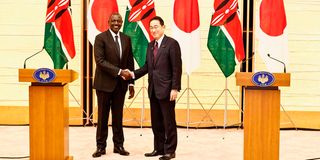
When President William Ruto returned from his Japan visit and asked “why not Kenya? ” while reflecting on their development, many Kenyans had a ready answer.
My response, which went viral, was as blunt as it was accurate: “Japan doesn’t budget for corruption. Their leaders don’t take a cut from road projects or pay MPs to impeach enemies.”
Just this week, we got a perfect illustration of why not Kenya. President Ruto and Mr Raila Odinga joined forces to save Nairobi Governor Johnson Sakaja from impeachment on allegations of corruption and gross incompetence.
The same President who wonders why we can’t be like Japan actively undermined the very institutional processes that could make us like Japan.
Mr President, since you asked the question publicly, allow me to provide the data-driven answer. The gap between Kenya and Japan isn’t about geography, resources, or colonial history.
It’s about leaders like you who systematically destroy the institutions needed for development while asking why we can’t develop. Here are the numbers that answer your question.
Japan ranks 20th globally in corruption perception with a score of 71/100, while Kenya sits at 121st with just 32/100. That’s a devastating 101-position gap that reflects decisions, not destiny.
When Japan privatises public assets, it creates efficiency and accountability. When our leaders approach infrastructure, we get scandals like the Standard Gauge Railway where auditors found Sh777 billion in potential overpayments on a project budgeted at Sh407 billion.
Japan ranks 14th globally in rule of law while Kenya sits at 102nd. This isn’t about intentions or vision statements—it’s about building systems that work regardless of who’s in charge. But you can’t build those systems while simultaneously tearing them down.
Japan’s civil service operates on merit-based recruitment through competitive examinations unchanged since 1887. Meanwhile, politicians in Kenya auction employment letters from institutions like the Teachers Service Commission.
When merit dies, nations die with it. Your recent intervention to save Governor Sakaja perfectly illustrates the problem.
Here was an opportunity for institutional accountability—the county assembly investigating corruption allegations and gross misconduct. Instead of letting institutions work, you mobilised political machinery to subvert them. This is exactly why Kenya can’t be Japan.
Consider what we’ve normalised under your leadership. Kenya recorded 61 killed and 73 abducted during 2024’s protests, with international observers documenting systematic extrajudicial killings by security forces. Japan doesn’t murder citizens who demand accountability. We do, and call it maintaining order.
You revealed that senators received Sh150 million to influence impeachment votes, with some getting up to Sh10 million individually.
In Japan, such revelations would trigger immediate resignations and criminal investigations. In Kenya, they’re just Tuesday’s headlines while you continue the same practices.
What makes this even more tragic is that Kenya has everything needed for transformation except political will.
We have one of Africa’s most educated, motivated and skilled young populations. Our youth demonstrated remarkable organisation, discipline and vision during the recent protests, showing exactly the kind of civic engagement that drives successful nations. They’re tech-savvy, globally connected and hungry for change.
They have already created world-class innovations in mobile money, renewable energy and other solutions that other countries now copy. They’re ready to take this country to unprecedented heights.
But instead of harnessing this incredible human capital, leaders like you suppress it with violence and then wonder why we can’t develop like Japan.
Japan’s post-war miracle was built on exactly this kind of motivated, skilled population working within functional institutions. The difference is their leaders created systems that rewarded merit and innovation rather than crushing them.
Recent scandals show how leadership choices compound over generations. The Arror and Kimwarer dams scandal saw Sh63 billion disappear.
Meanwhile, Japan’s 1960s infrastructure investments still generate economic returns today because their leaders chose development over extraction. Singapore went from a corruption-plagued port to global financial centre through unwavering political will and institutional independence.
You could implement similar reforms immediately, Mr President. Establish truly independent anti-corruption institutions.
Stop interfering in accountability processes like impeachments. But this week’s Sakaja intervention proves you won’t. You’d rather maintain a system where political loyalty trumps institutional accountability.
Your question—”why not Kenya?”—was answered perfectly by your own actions this week. Japan became a First World because their leaders chose institutional integrity over political convenience. You chose the opposite when you saved a governor accused of corruption . Kenya fails because leaders like you systematically dismantle the very institutions needed for development.
The question isn’t “why not Kenya?”, it is whether you’ll stop being the reason why not Kenya. Your actions this week suggest the answer is no. Japan became Japan by choosing competence over corruption for seventy years.
Will you finally make that choice for Kenya, or will you keep asking rhetorical questions while providing the answer through your own destructive behaviour?
The writer is a whistleblower, strategy consultant, and a startup mentor. www.nelsonamenya.com.