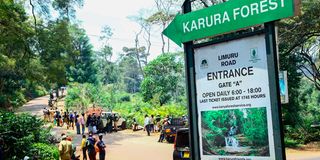
Karura Forest survived the political era of Daniel arap Moi. It survived a time when public land was treated as a political reward, when allocation letters could turn forests into private property, and when people who stood between bulldozers and trees were beaten, mocked, and called enemies of development.
Karura survived because ordinary Kenyans decided that the forest mattered. People showed up. They planted trees. They walked inside that forest knowing they were walking into a space where power was once wanted gone.
It would be a bitter historical irony if Karura, the forest that survived authoritarian land politics, began shrinking under a generation that speaks loudly about environmental protection.
Many Kenyans are not reacting to the recent clearing inside Karura because of one construction project alone. The fear is deeper. It is the fear that a forest defended through protest, community courage, and sacrifice could slowly be weakened through administrative language, national campaigns, and reassurances that everything is under control.
Karura is one of the last places in Nairobi where the city still feels human. It is where the heat softens under thick tree cover. It is where children run ahead of their parents along gravel paths. It is where people sit without phones sometimes, just listening to the wind moving through leaves they cannot name but feel comforted by anyway. Karura is not a luxury park. It is a survival space inside a growing and increasingly crowded city.
The forest protects water catchment systems that serve surrounding communities. It supports wildlife that would otherwise disappear under urban expansion. It gives ordinary people access to nature in a city where green spaces are slowly becoming expensive experiences rather than shared rights.
Nairobi is expanding. Buildings are getting taller. Concrete is spreading. Without forests such as Karura, the city risks becoming a heat trap where the poor and vulnerable suffer first.
The controversy around construction linked to NYS housing inside the forest has raised questions that go beyond technical explanations. The Kenya Forest Service says the work is inside an existing headquarters zone and that no indigenous trees were cut. But public anxiety is not only about this single project. It is about history, about memory, and about a pattern many Kenyans are watching across different parts of the country.
Move across Kenya and you will notice something worrying. Mature forests are shrinking in some areas while environmental campaigns promise future restoration. Large tree-planting drives are announced with optimism, but citizens can still walk through places where the established canopy has been cleared. Planting trees is good. But replacing living forests with symbolic planting exercises creates a dangerous illusion that environmental protection is being achieved when the reality on the ground looks different.
A forest is not a nursery project that can be rebuilt quickly. It is a living system that develops slowly over decades. Soil organisms, water retention layers, wildlife habitats, and biodiversity relationships form over time. When those systems are broken, recovery takes generations. You cannot cut down mature indigenous trees today and expect young seedlings planted during public campaigns to immediately replace what was lost.
Karura’s strength has always come from people. Citizens helped fence it when it was once a dangerous and neglected space. Volunteers worked to restore damaged areas. People pay entrance fees that are reinvested into security and maintenance. Families treat Karura as a shared national inheritance rather than something owned only by the state.
That community stewardship is what made the forest survive past threats. Any decision that changes that balance should involve the public in a real and meaningful way. Karura matters because it helps Nairobi breathe. It absorbs carbon in a city that keeps growing outward and upward. It protects water systems feeding parts of the urban population.
It offers mental and physical relief in a society where life is becoming faster and more stressful. When forests are fragmented, recovery is slow.
When the idea that protected land can be adjusted for administrative convenience becomes normal, similar decisions become easier to repeat.
It is painful to imagine how Wangari Maathai would react to seeing mature forests cleared while national campaigns celebrate tree-planting targets. She understood that conservation was not about posters or speeches. It was about whether trees actually survive on the ground. Environmental protection must be visible in the survival of ecosystems, not only in announcements or policy statements.
The real danger is not sudden destruction. It is a slow acceptance. Public outrage may rise quickly online and then fade while changes continue unnoticed. Forests are rarely lost through one dramatic action. They are lost through small decisions that feel reasonable individually but become permanent when added together.
If Karura falls, it will not be because citizens were powerless. It will be because we became comfortable with small losses until those losses stopped feeling important. It will be because administrative explanations replaced public accountability. It will be because we convinced ourselves that planting trees somewhere else can compensate for cutting mature forests today.
Karura is public inheritance. It belongs to the people who fought for it, to the children who will grow up in Nairobi, and to future generations who deserve cleaner air and cooler cities. Protecting it requires more than campaigns or reassurances. It requires people to stay alert, ask questions, and refuse to treat the slow erosion of public natural spaces as normal.
Because if Karura is allowed to shrink, it will not just be a forest that disappears. It will be a country choosing, step by step, to trade away its conscience. And that is a future Kenya should never accept.