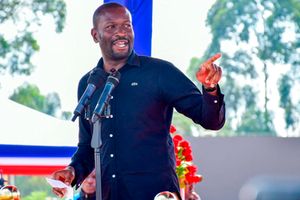
During a speech on September 18, at the ground-breaking ceremony for a $300 million fuel storage terminal outside of Kampala, President Yoweri Museveni threw a cat among Kenya’s pigeons.
Museveni seemed to criticise Kenya’s government-to-government (G-to-G) fuel deal, saying that Uganda had been buying fuel at inflated prices from intermediaries, and that when it abandoned that arrangement for direct purchases through the Uganda National Oil Company (UNOC), costs fell sharply: diesel from $118 to $83 per metric tonne, petrol from $97.50 to $61.50, and jet fuel from $114.25 to $79.25.
The remarks would have gone unnoticed without the social media storm in Kenya. Nairobi’s Ministry of Energy and other officials pushed back defensively, and the Motorists Association of Kenya demanded a probe into the G-to-G deal.
On September 21, Museveni emerged with a fire extinguisher. He said his comments referred to corrupt intermediaries exposed in 2019, before President William Ruto took office, via the late “former Senator” Cyrus Jirongo. He complimented Ruto for overruling internal opposition to grant Uganda direct access to Kenya’s oil pipeline, and naturally accused the media of misrepresenting his original remarks.
It was surprising that Museveni tempered his barbs, because they are the most East African thing. On November 9, 2025, he caused an even bigger uproar when he declared that landlocked Uganda is entitled to access the Indian Ocean, comparing coastal nations such as Kenya to residents of a shared apartment block whose ground-floor occupants cannot claim the compound belongs only to them.
“In future, we are going to have wars. How can you say that you are in a block of flats, that the compound belongs to only the flats on the ground floor? The compound belongs to the whole block... My ocean is the Indian Ocean, I’m on the top floor of the block, then you say the compound belongs only to the ones on the ground floor, this is madness,” Museveni said.
Many in Kenya took it as a declaration of war. Museveni quickly explained that his comments were not a direct threat but an argument for an East African political federation.
Museveni is not the only sinner. In March 2023, Tanzania’s President Samia Suluhu was believed to be mocking Kenya when she spoke of a neighbour that had run to Dodoma (or more likely Dar es Salaam) to beg for dollars to tide it over, only to be rebuffed.
Kenyan social media, at a time when the country’s currency was under stress, made a feast of it. The government said nothing.
President Ruto himself is not innocent in these matters. As the head of East Africa’s largest economy, nearly the size of all other East African Community economies combined, he frequently belittles and puts them down.
During a Sunday service at the Africa Gospel Church in Karen, Nairobi, he unleashed an epic boast. Defending Kenya’s higher fuel costs, partly driven by a road levy, he said it was because Kenya, as a middle-income economy, had a considerably larger road network to maintain. He claimed its 20,000 kilometres of paved roads exceeded those of Tanzania, Uganda, Rwanda, DR Congo, and South Sudan combined.
Then he twisted the knife, saying Kenya should not be compared to its ka-little “least developed” neighbours, but to other middle-income peers elsewhere with similar infrastructure burdens.
To many, these are signs of a dysfunctional East African Community. But they are missing the real thing. This is the way East Africa works. Countries need others in the region to be worse at something, so they can feel good about themselves, and it did not start recently.
Former President Daniel arap Moi liked to warn Kenyans about agitators for multiparty democracy, saying they would bring the chaos that has beleaguered neighbours.
Until last October, Tanzanian leaders liked to claim their country was an “island of stability”, unlike others in the region such as Uganda, South Sudan, Somalia, DRC, Rwanda, Burundi, and even 2007/2008 Kenya, which had endured blood baths.
Almost all other countries in the region have portrayed Kenya as corrupt, conniving, and cheating, the attributes Museveni leaned into with his remarks about predatory fuel go-betweens. Tanzania in the past set thousands of Ugandan and Kenyan chicks on fire. Kenya has banned Ugandan milk, eggs and other products before.
But this is how East Africa negotiates and converses. If you believe they are at war, you will be caught by surprise as a visiting or resident opposition figure when Kenya looks the other way, or enables your abduction, as it did with Uganda’s Kizza Besigye on November 16, 2024.
You will be caught by surprise when, after many flaps, Tanzania invites President Ruto to make a historic special address to its Parliament, as it did on May 5, or when Museveni invites him to his farm to schmooze as they survey his long-horned cattle.
You will be blindsided by the March 11, 2026, licence-passporting deal between Kenya and Rwanda, which allows fintechs and payments service providers licensed in one country to operate seamlessly in the other without undergoing a new licensing process.
The author is a writer, journalist and curator of the Wall of Great Africans. X: @cobbo3