Nairobi City County government is sitting on a growing pile of unfinished development projects, with 57 of them worth an estimated Sh2.24 billion stalled as the county struggles to meet its financial obligations to contractors, suppliers and its staff, a new report has shown.
Projects carried out by the county had received Sh208.88 million in payments, according to the Controller of Budget’s review of the county’s 2025/26 spending, but work on several has stopped.
The county has cited funding constraints, non-payment of certified works, contractor abandonment, procurement problems and other contractual issues for the stalling.
The largest is the development of the Integrated County Revenue Management System/Enterprise Resource Planning (ICRMS/ERP) at City Hall, with an estimated value of Sh847.2 million.
The project is intended to provide Nairobi with an integrated digital system for managing its revenue and county operations, including automating the revenue cycle from assessment and collection to accounting and improving the integration of county functions.
Only 37 per cent of the work is complete, with Sh150 million already paid. The county attributes the stalled status to a combination of funding, procurement, contractor, land, design and legal issues.
The Nairobi City County head office.
Photo credit: File I Nation Media Group
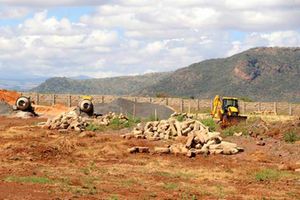
Others include the Sh76 million Mwiki Social Hall and Sh50 million Dandora II Youth Complex, for example, were both reported as stalled because contractors were not onsite following non-payment. The rehabilitation of Makina Market, estimated at Sh42 million, was also stalled over non-payment, while the reconstruction of nine ablution blocks in Embakasi was abandoned after the county failed to pay the first Sh2 million certificate.
The Controller of Budget report findings indicate the county government is increasingly struggling to balance its financial obligations.
Nairobi ended the financial year with Sh86.9 billion in outstanding pending bills up from Sh83.1 billion at the beginning of the year.
In several of the stalled projects, the Controller of Budget linked the delays directly to non-payment of contractors, with some firms leaving sites after failing to receive payment for completed work or certificates.
The report lists contractors as having left sites at projects including the Makina Market, Huruma estate perimeter walls, Kabiro Social Hall and the Mwariro Market electrical works. In some cases, projects had reached substantial levels of completion before work stopped, raising concerns on how long contractors had waited for payment and what happened to the funds committed to the works.
The county paid Sh8.45 billion in pending bills during the year, but incurred another Sh12.36 billion, leaving the stock of unpaid obligations higher at the close of the financial year. More than 72 per cent of the County Executive’s pending bills were aged over two years.
The Controller of Budget has now directed the county to prioritise the payment of genuine pending bills, making them the first charge on the FY2026/27 budget and settling them on a first-in-first-out basis.
The recommendation comes as the county faces a difficult choice over how to allocate limited resources between clearing old obligations and financing development projects.
The county had set aside Sh13.42 billion for development, but spent only Sh3.82 billion which represents 28.47 per cent of the allocation.
Development expenditure fell by 6.6 per cent from the previous financial year, with the Controller of Budget attributing the decline to cash-flow challenges, including weak revenue collection.
Although the county government spent Sh33.10 billion in the financial year, only Sh3.82 billion went to development while recurrent spending accounted for Sh29.28 billion.
Personnel costs alone amounted to Sh17.82 billion, while the county recorded Sh164.93 million in foreign travel expenditure, all incurred by the County Executive.
Nairobi County Governor Johnson Sakaja during a past media briefing at City Hall.
Photo credit: Francis Nderitu | Nation Media Group
Among the listed trips were Sh29.92 million spent on 10 officers travelling to Singapore for a strategic human-resource management programme and Sh29.17 million for 135 officers attending the EALASCA Games in Kampala. Two separate Dubai trips cost Sh16.65 million and Sh15.89 million, while seven officers travelling to Tokyo incurred Sh14.23 million.
The county’s payroll system indicated that while Sh17.49 billion in personnel costs was processed through the Human Resource Information System, a further Sh496.07 million was paid through manual payrolls, representing about 3 per cent of total personnel costs.
The manual payroll covered staff not onboarded onto HRIS, casual workers and top-up allowances for security personnel.
The CoB warned that the continued use of the manual system could expose public funds to abuse, raising questions about the controls governing payments made outside the county’s main payroll system.
The County Executive also has a Sh3.26 billion overdraft at Sidian Bank by June 30, 2026, largely attributed to salaries for May and June that had not been processed. The County Assembly, meanwhile, had a separate Sh35 million overdraft linked to unpaid June salaries.
The salary delays left the county with Sh3.21 billion in salary payables at the close of the financial year. According to the Controller of Budget, Nairobi processed salaries for only 10 months - from July 2025 to April 2026 - with May and June salaries left unpaid because of insufficient budget estimates for personnel emoluments.