William Ruto has built the most expensive presidency Kenya has ever seen. Not the most expensive in absolute terms alone, though it may soon be that too. The most expensive in pace, in appetite, and in sheer contempt for proportion.
In under four years, his Executive has spent about Sh88.8 billion, and is on course to hit nearly Sh100 billion by June 2026. Uhuru Kenyatta, hardly a symbol of frugality himself, spent Sh89.9 billion across the full 10 years of his presidency.
That is the scale of the absurdity here: a decade of presidential spending, compressed into one term that is not even complete.
And that fact matters because this is a story about political character. Budgets are moral documents. They reveal what a government fears, what it values, and what it thinks the public can be bullied into tolerating.
A presidency that spends like this, while lecturing citizens about sacrifice, is ideologically dishonest.
Ruto came into office speaking the language of restraint. Prudence. Efficiency. Better management. A government that would supposedly do more with less. That was the sales pitch. What Kenya got instead was an Executive arm that burns through public money with the urgency of a departing tenant.
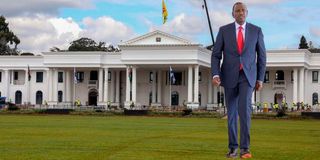
The State House, the Executive Office of the President, the Deputy President’s office, the newly created Prime Cabinet Secretary’s office, all of it has become one large machine for recurrent expenditure: salaries, travel, hospitality, administration, ceremonies, fuel, convoys, entourages, and the endless theatre of officialdom.
Roughly 93.7 per cent of the Sh88.8 billion spent so far is recurrent. Not development. Not assets. Not transformation. Pure, absolute consumption.
It is one thing for a government to spend heavily while visibly building something. A railway, however flawed. A road network. Hospitals. Energy infrastructure. Something concrete that a citizen can point at and argue over honestly. It is another thing altogether for a presidency to become this expensive largely to sustain itself. Kenya is currently in the full time business of financing presidential overhead.
And overhead is exactly what it is. The Office of the President has swallowed tens of billions. State House alone has taken Sh36.3 billion. The Executive Office of the President another Sh35.1 billion. The Deputy President’s office Sh12.5 billion. The Prime Cabinet Secretary’s office, itself an extra unconstitutional layer this administration created, another Sh3.3 billion. The spending has metastasized.
Supporters will say government is complex. They always do. They will say coordination costs money. Hosting delegations costs money. International engagement costs money. Administration costs money. Fine. Nobody is arguing that the presidency should run on zero. Heck, it may not even run frugally in the first place. It is, after all, the presidency. But the point is proportion. The point is that you cannot govern a country through tax pressure, levy fatigue, and endless appeals to austerity, then operate the presidency like an oil-rich monarchy.
Because what makes this presidency especially offensive is its size, but also its timing. This is happening in a country where debt servicing is eating the future in real time. The Treasury’s own 2026 Budget Policy Statement says Consolidated Fund Services now consumes about 48.5 per cent of ordinary revenue, with interest payments alone taking 39.8 per cent of that revenue in FY 2025/26. Nearly half of ordinary revenue is disappearing before the country can seriously think about services, investment, or relief.
So when citizens are told there is no money, that taxes must rise, that belts must tighten, that public frustration is immature and economic pain is simply the price of patriotism, they are entitled to ask a very basic question: no money for whom? Certainly not for the presidency.
The cruelty of this arrangement lies in the contrast. A government asks mwananchi to normalise more extraction while normalising more luxury for itself. It asks traders, salaried workers, small businesses, and struggling families to accept a harder life in the name of national recovery, while the Executive consumes public funds at a rate unprecedented in Kenyan history. This is not the implied shared sacrifice. This is, conversely, stratified sacrifice. Pain below, comfort above.
Even worse, it is waste layered on waste. Keep Uhuru’s already high average of roughly Sh9 billion a year as the baseline and Ruto’s presidency has still spent around Sh55 billion extra so far. Extra. Not total. Additional. Money above an already bloated standard. By June, that excess could approach Sh64 billion.
And in a serious country, Sh55 billion is not rhetorical money. It is hospital money. Classroom money. debt-relief money. Water-project money. Tenwek Hospital just opened a new Cardio-thoracic facility at an estimated Sh5 billion. The extra money this regime has spent, more than what the previous regime would in the same amount of time, could have built 11 of those, fully equipped, across the country.
That is why calling this presidency expensive is still too gentle. Expensive can sound accidental, like a regrettable side effect. This is something harsher. It is indulgent. It is unreasonable. It is a presidency with the spending instincts of a regime that does not believe consequences apply to it.
And maybe that is the truest problem underneath all this. The numbers are outrageous, yes. But the deeper scandal is the attitude they reveal. A presidency that costs this much, in a country this strained, is severely detached, either ignorantly, or just blatantly. Detached from the mood of the country. Detached from the daily arithmetic of ordinary life. Detached from the moral obligation to at least look like it understands restraint before demanding it from everyone else.
Kenya does not just have an expensive presidency. It has a presidency that seems determined to prove, month after month, that it can ask the public for discipline while practicing none of it itself. Tuko Kadi.