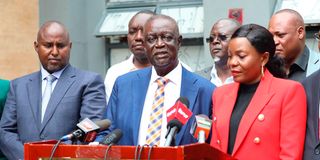
So now ODM is suddenly so clever that it has discovered self-respect? That it wants the country to know it is pausing coalition talks with UDA, demanding dignity, suspending open cheerleading for Ruto’s 2027 bid, but still sending senior leaders to seek an urgent meeting with the same President? That it is in government enough to call itself a “broad-based partner,” yet wounded enough to perform the posture of an aggrieved outsider?
At some point, language stops clarifying politics and starts functioning like stage smoke. You can no longer see where the actors are standing. You only know that someone wants the audience confused. And that is what makes this latest ODM resolution look so ridiculous.
Not ridiculous because parties should never renegotiate terms. No one should be scandalised by a party reviewing its position. That part is normal. What is absurd is the attempt to act newly offended by a game whose design has been obvious from the beginning.
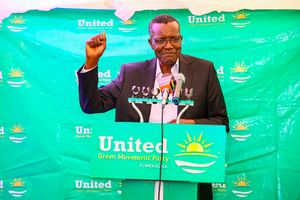
ODM says it now wants “respect” from UDA. It says some UDA leaders have made public remarks that have caused anxiety among ODM members and supporters. It says formal coalition talks are suspended. It says members should stop campaigning for Ruto. It says the party will now focus on rebuilding itself, strengthening its grassroots, holding youth conventions and popularising ODM again.
All very dramatic. All very stern. All very conveniently worded. But Kenyans can hear when a party is trying to sound offended without actually leaving the room.
Because this wasn’t entirely about coalition mechanics. ODM obviously wants protection of its traditional bases. UDA, being UDA, wants room to roam everywhere, field candidates everywhere, eat into every political space it can reach. That is the nature of the ruling party. Expansion is the point. Consolidation is the instinct.
Because if one has watched Ruto closely over the years, one thing becomes clear very quickly: he does not merely defeat opponents. He domesticates them. He pulls them close enough to blur their edges. He gives them enough room to feel relevant, enough access to feel important, enough ambiguity to struggle explaining themselves to their own supporters. Then, before long, they are no longer quite independent, and no longer fully trusted by the people who once saw them as a political home.
A government facing public frustration does not always want to crush dissent outright. Sometimes the smarter move is to capture part of it. To hold a piece of the opposition inside the system. To make sure that when public anger rises, it rises into a room whose exits are already controlled. To convert displeasure into stored energy. To keep it warm, visible, noisy even, but never fully free.
That is why this ODM posture feels a lot like choreography. They want to sound wounded without severing the arrangement. They want to preserve the emotional vocabulary of opposition while retaining the practical privileges of proximity to power. They want the benefits of access without the full burden of identification. They want to complain about the government while still being near enough to negotiate with it as insiders. It is a political costume change being attempted without leaving the stage.
How, for example, is the ODM rank and file meant to process this? Yesterday they were supposed to understand the “broad-based government” as pragmatic statesmanship, as maturity, as a patriotic departure from rigid adversarial politics. Today they are expected to rediscover suspicion, to stiffen their backs, to stop selling Ruto publicly, and to pretend the problem is merely that some UDA people have been rude.
Rude? That is the problem? Not the ideological erosion. Not the slow hollowing out of opposition politics. Not the public confusion over whether ODM still represents a distinct political project. Not the steady conversion of a once-clear opposition force into a formation that often appears to be negotiating the price of its own absorption. No. The issue, apparently, is respect. Tone. Zoning. Hurt feelings.
It would be funny if it were not so insulting. Because the deeper question now hanging over ODM is not whether UDA has respected it enough, or at all for that matter. The more pressing issue is whether ODM still knows what it is.
What does ODM stand for anymore, beyond memory, machinery and bargaining power?
Is it still a party with a coherent ideological spine? Is it still organised around a recognisable view of state power, justice, economic life and democratic contest? Or has it become a large, historically significant vessel now mostly occupied by tactical calculations, elite negotiations and preservation instincts? A party can survive many defeats. What it struggles to survive is conceptual blur. Once the country cannot clearly tell what you are for, you begin living off nostalgia and tribal muscle. You become a brand people inherited rather than a cause they still believe in.
The latest resolution tries to project strength. It says ODM will rebuild. It will mobilise youth. It will complete grassroots elections. It will run competitive nominations. It will reassert itself before any coalition decisions are made. In practice, it sounds like a party aware that its base is restless and that its identity has begun slipping through its own fingers.
Because supporters can tolerate a lot of things. What they cannot tolerate forever is confusion. They can defend a hard decision if the direction is clear. What exhausts people is being told, again and again, that up is down, inside is outside, and proximity to power is somehow proof of resistance.
There is also something almost insulting in the timing of this moral rediscovery. ODM leaders did not just wake up yesterday and discover that UDA is expansionist, dismissive and ruthlessly self-interested. That was not hidden information. That was the deal. That was always the deal. Which means this resolution is not the product of sudden enlightenment. It is a complaint arising from the fact that the terms of co-existence are no longer comfortable enough, or, and this is a more sinister but realistic version, William Ruto is sending them out to consolidate state discontent into a voting bloc that can be reactivated in 2027.
Either way, the games of urban areas are no longer as subtle as they used to be. Kenyans are awake now. 2027 draws closer, with inevitably terminal consequences for the political dreams of so many.