Premium
NTV’s 2007 presidential election story a good start, there’s more to be told
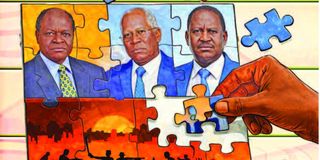
Former President Mwai Kibaki (left) Former Electoral Commission of Kenya chairman Samuel Kivuitu, and former Prime Minister Raila Odinga.

What you need to know:
- Even those who loudly proclaim to have written off mainstream media confessed to sitting down to watch the fresh revelations.
- The response to the feature is a strong reminder that audiences still value credible and relevant journalism.
If there’s a piece of investigative journalism that has sparked interest, attention and reactions in the recent past, it is NTV’s recent one-hour feature on the 2007 Presidential election dubbed “Stolen ballot: Inside the bitter 2007 presidential election heist”, and “Uchaguzi chwara 2007”.
On YouTube, the NTV feature had been viewed 462,000 times in English and 112,000 times in Kiswahili at the last count. Even those who loudly proclaim to have written off mainstream media confessed to sitting down to watch the fresh revelations about Kenya’s darkest moment.
The response to the feature is a strong reminder that audiences still value credible and relevant journalism. Investing in stories that help people to make sense of what has happened or is happening around them is the legacy media’s only survival option.


The 2007 presidential election, which resulted in the country’s worst post-election violence, is an important part of Kenya’s history. It cannot be wished away or buried in the sand and forgotten, as some of the viewers who criticised NMG for airing this story would have wished. For years, it has been referred to as a “disputed” election, especially after Justice Johann Kriegler, who chaired the independent review commission on the election, stated that it was impossible to establish the true winner due to massive systemic failures. For the first time, NTV boldly referred to it as a stolen election.
Duncan Khaemba, the journalist behind the story, starts his narration by quoting Gautama Buddha: “Three things cannot be long hidden: the sun, the moon, and the truth.” He set out to expose some of the hidden truth by piecing together information from some of the people at the centre of the election. Not only did he mine the archives for footage of past interviews and news reports, he also conducted fresh interviews with two commissioners, a former security officer, the former Editor-in-Chief of the Kenya Broadcasting Corporation, and the former CEO of the Kenyatta International Conference Centre, as it was known then, where the dramatic announcement of the election results happened. He used these to weave the story of what transpired on December 30, 2007, the day the chairman of the electoral commission declared then-President Mwai Kibaki the winner, and how it was planned.
The feature has received both praise and criticism, with some viewers accusing the Nation Media Group of pursuing a sinister agenda and others congratulating the media house for unearthing some of the hidden truth. We reached out to the Editor-in-Chief, Dr Joe Ageyo, with some of the questions from viewers, as follows:
Did NMG have a hidden agenda in undertaking this investigation? (A). We never have any hidden agenda with our journalism. Our only agenda is public interest. This story was no exception.
Why did NMG think this story is important to tell today? (A) First, there is never an inappropriate time to tell a public interest story. Specifically, this story is extremely relevant as the country gears up for what could be a hotly contested election. After several “revelations” from Royal Media Services Chairman SK Macharia, who was a key supporter of the now deceased former presidential candidate Raila Odinga, and CS Alfred Mutua, who was a key government official under President Kibaki, we decided to dig deeper and seek out people who held key positions in government, media, electoral commission, and so on, to tie the loose ends. Hearing from the man who was in charge at KICC at the time, the man who was leading KBC’s editorial agenda, and even Dr Mutua’s security officer, on the nefarious roles they all admit to have played, we thought there couldn’t be a more important electoral justice story, and the timing couldn’t be more perfect.
Previously it has been referred to as a disputed election. What gave NMG the confidence to call it “stolen”? (A) The testimonies from the actual players were extremely compelling. The people/institutions that were always suspected to have played a role in subverting the will of the people were finally coming out with details of how it was actually executed. Switching off lights, giving the ECK chair the results to read, whisking him away commando style ... all that sounds more like theft – or robbery – than a mere dispute.
One of the viewers, Mr Mukurima X Muriuki, was particularly critical. He thought the one hour spent watching the feature was a waste of his time. Reason? “What NTV gave us was a carefully arranged opportunity for the people who were complicit to sit in front of a camera, look composed, and explain themselves to nobody in particular.” According to Mr Muriuki, NTV should have sought out the returning officers: “The ones who went quiet. The ones who delayed. The ones who sat on results while the country held its breath and the tension outside turned into something that killed people.”
He asks: “Who were these officers? Who was calling them? Who was pressuring them? What exactly were they being told to do, and by whom, and what did they stand to gain or lose depending on which way they moved?” That is the story, he says.
Indeed, telling the complete story of the 2007 election will take a long time. Mr Muriuki’s suggested angle is an important one that should be pursued and told.
Other viewers have questioned the role of the other media houses in the election fiasco, including their failure to release their independent tallies. This, too, is an angle begging to be told.
For now, NTV takes the crown for taking the story forward by revealing fresh details. The public looks forward to more revelations.
***
Should the media help to tame our leaders’ loose tongues?
There is the tale of two skulls that looked at each other and burst out laughing, each at the other’s baldness. This is what Kenyans have been treated to this week as President Ruto and opposition leaders traded jibes. The question many are asking is: Should the media continue to show the political duels turned ridiculous personal attacks, to their audiences?
While the Media Council’s Code of Ethics, and NMG’s Editorial Policy and Guidelines prohibit the use of foul language, profanity, vulgarity and offensive content, there are situations when the media must show these clips to let citizens see their leaders in their true colours. However, this must still be done in a measured way, editing out expletives — what the print media refer to as “unprintable”, and guarding against slander and libel.
Follow our WhatsApp channel for breaking news updates and more stories like this.
Contact the Public Editor to raise ethical concerns or request a review of published material. Reach out: Email: [email protected]. Mobile number: 0741978786.