Live update: Senators discuss governors snubbing summons
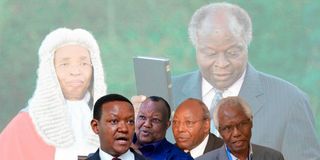
Former President Mwai Kibaki holds the Bible as he sworn in at State House Nairobi, December 30, 2007 by former Chief Justice Evan Gicheru. Inset from left: Alfred Mutua, Julius Karangi, John Michuki and Francis Muthaura.

Electoral Commission of Kenya chairman Samuel Kivuitu had been recorded stating that Mwai Kibaki was the winner of the 2007 Presidential election.
The tape with the recording was safely tucked inside a sock worn by a member of the Kenya Broadcasting Corporation (KBC) team, as instructed by Editor-in-Chief Waithaka Waihenya.
Nimrod Mbai, now Kitui East MP but then a security operative, was stealthily waiting for the lights to go out at the Kenyatta International Convention Centre (KICC), so that he could sneak Kivuitu out of the chaotic tallying centre, as instructed by his boss and government spokesperson Alfred Mutua.
The plan was to broadcast that tape on KBC and have Kibaki sworn in at State House moments later.
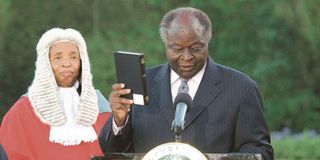
The late President Mwai Kibaki being sworn in by then Chief Justice Evan Gicheru on Sunday, December 30, 2007.
Everyone had been given specific, compartmentalised instructions tied only to their role.
But inside a boardroom in State House sat five powerful men who knew where each piece of the puzzle fit.
They made several calls to the unwitting pawns, all aimed at ensuring that the already chaotic and untidy election, filled with several claims of ballot stuffing and number doctoring, would have only one outcome – Kibaki being sworn in for a second term.
One of those calls would reveal the identities of the power players bent on a Kibaki win.
Kibaki himself was in the room, as were government spokesperson Mutua, Deputy Chief of the General Staff General Julius Karangi, Head of Public Service Francis Muthaura and Internal Security minister John Michuki.
Mutua made a call to KBC boss Waihenya and put him on speaker.
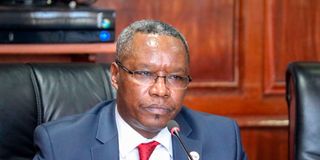
Former Kenya Broadcasting Corporation Editor-in-Chief Waithaka Waihenya.
“At that time, Kibaki was on the line, Muthaura and Mutua were on the line. My phone was ringing like six times simultaneously. I told Mutua that Kivuitu had announced, and he asked me to read it to him. I was on speakerphone, and the then Deputy Chief of the General Staff was also on the line. So I read, and I heard Kibaki, the President now speaking, saying, ‘Nataka kuiona kwa runinga hapo (I want to see it on TV),” Waihenya recalled.
He added that Mutua was the one who maintained the most direct pressure on him throughout the tense hours.
“Of all these people were with the President at State House...Mutua was the one on my case most of the time.”
Mutua himself later confirmed the presence of those officials during a television interview following Kibaki’s death in 2022, revealing that the President had been waiting with his closest advisers as the final announcement was prepared.
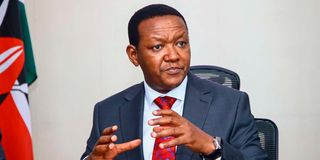
Labour Cabinet Secretary Alfred Mutua says that more job scam victims are coming forward to file complaints.
With the results finally broadcast and the incumbent declared the winner, the tense atmosphere inside State House shifted almost instantly, relief replacing the anxiety that had hung over the compound for hours.
Kibaki and his four visitors embraced in celebration.
Waihenya said his phone rang repeatedly that evening as senior officials pressed him to ensure the declaration was aired immediately.
When the declaration was finally aired, Mutua recalled that the tense mood in the room disappeared almost instantly.
Congratulated Kibaki
“Kibaki hugged me; it was the first time he hugged me. The next time he hugged me was when I told him I was going to vie for governor. At that very moment, Muthaura and Michuki, who were at the State House, also joined us as we embraced and congratulated Kibaki,” Mutua said.
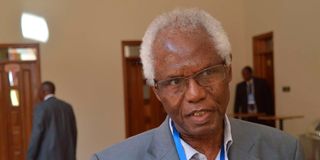
Former head of Civil Service and Secretary to the Cabinet, Ambassador Francis Muthaura.
Within minutes, preparations began for the swearing-in ceremony that evening.
The hurried sequence of events that led to that moment had involved a coordinated set of actions by several powerful figures within government, each performing a specific role in the unfolding plan.
At the centre of the operation was Mutua, who was moving between State House and the Kenyatta International Conference Centre (KICC), which is now the Kenyatta International Convention Centre, where the national tallying centre had been set up.
According to individuals involved in the events of that day, information was tightly controlled and shared strictly on a need-to-know basis, a method commonly used in military operations to ensure operational security by limiting sensitive information to only those whose roles required it.
Different individuals were assigned different responsibilities, and a masterful puppeteer pulled the strings to ensure everyone executed the roles assigned.
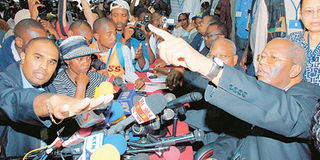
Former Election Commission Chairman Samuel Kivuitu (right) addressing a press conference at KICC just before the announcement of the results of the disputed 2007 General Elections.. PHOTO/ FILE
Mutua’s role was to ensure the results announced by Kivuitu were quickly broadcast on national television and also to drive Kivuitu to State House from KICC.
Michuki, the powerful minister in charge of internal security, was responsible for ensuring that instructions given by the President’s inner circle were carried out.
Karangi, the senior military officer present at State House, followed the developments closely as the situation evolved. He is greatly lauded as one of the best tacticians ever in Kenya’s military history. His ability to break down complex operations into smaller tasks, handed down on a strict need-to-know basis, saw him win many battles.
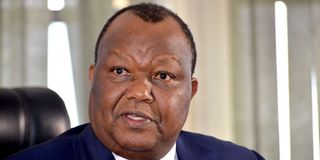
Former Chief of the Defence Forces Gen (Rtd) Julius Karangi.
Often, he ensured several people working towards a singular purpose only knew of their roles while he kept the details of the larger goal close to his chest.
One of his biggest successes as the country's Chief of Defence Forces was how he ran multiple teams with different tasks in the recapture of Kismayu, one of Somali’s most important ports, from the grasp of Al-Shabaab, without losing a single soldier in a mega-operation that lasted a few hours.
Another figure was Philip Kisia, the managing director of the Kenyatta International Conference Centre, who would be drawn directly into the unfolding operation.
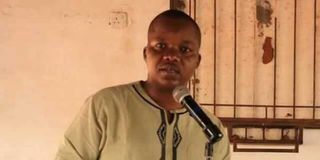
Kitui East MP Nimrod Mbithuka Mbai. He is a former police officer.
Meanwhile, Nimrod Mbai, then a police sergeant attached to Mutua’s security detail and today the Kitui East MP, had been assigned the sensitive task of ensuring that Kivuitu could leave the chaotic tallying centre safely and be escorted toward State House.
Mbai recalled that he had been told to be ready for anything.
“I was told we do not know how the day will end, but we know Kibaki must remain president,” Mbai said.
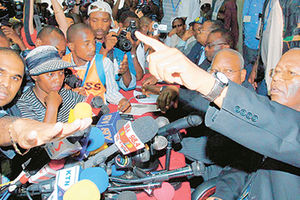
The tense hours that preceded the announcement had unfolded inside the cavernous hall of the KICC, where rival politicians had crowded around the electoral commission table, arguing over constituency results.
Opposition leaders allied to Raila Odinga insisted that the figures being read out did not match the official tally forms signed by their agents at constituency centres.
Security officers from the General Service Unit surrounded the commission’s stage to prevent clashes between rival politicians.
Behind the scenes, however, government officials were increasingly concerned that the delay in declaring the results could create an opportunity for legal intervention that might block Kibaki’s swearing in.
“Our fear was that if Kibaki was declared the winner, Raila would get a judge to obtain an injunction stopping the swearing in,” Mutua later explained.
That concern triggered one of the most controversial decisions of the day.
Mutua recounted how he called Kisia and asked him to switch off the electricity supply to the tallying hall.
“I told him, because I know how cameras work, to turn off the lights at KICC,” Mutua said.
The idea was to briefly disrupt the chaotic environment in the hall where politicians from rival camps were shouting across the stage.
Kisia initially resisted.
He later said the request carried enormous consequences, and he was reluctant to comply.
But the pressure soon intensified as Mutua placed a senior cabinet minister on the line.
That minister was Michuki, one of the most powerful figures in Kibaki’s government and the man responsible for internal security.
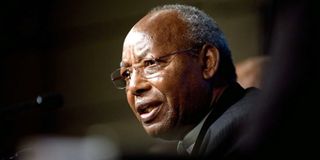
Former Internal Security Minister the late John Njoroge Michuki.
Kisia recalled that the minister read out the names of officials who were seated with the President at State House and insisted that the instructions be carried out. Faced with the authority of the government’s security chief and the knowledge that the President himself was waiting for the outcome, he complied.
Most of the conference centre staff had already gone home, forcing him to walk to the building’s power control room himself with a technician.
Moments later, the hall where politicians had been arguing loudly over the tally was plunged into darkness. As confusion spread inside the building, another operation moved into motion.
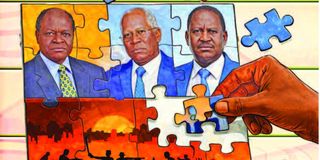
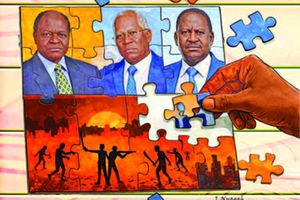
Former President Mwai Kibaki (left) Former Electoral Commission of Kenya chairman Samuel Kivuitu, and former Prime Minister Raila Odinga.
Mbai positioned himself behind Kivuitu and waited for the agreed signal.
“I tapped him on the shoulder and said the password,” Mbai said.
The elderly electoral commission chairman immediately understood what it meant.
Mbai picked up a green file containing the election results and escorted him through a side exit away from the chaos inside the hall.
Outside, a vehicle was waiting, and Mutua was behind the wheel.
The car sped through Nairobi streets toward State House escorted by security vehicles, clearing the route.
Inside State House, the President and his advisers continued to monitor the developments closely.
When the vehicle carrying Kivuitu arrived, the electoral commission chairman was ushered inside, while a few kilometres away, the recording of his declaration was delivered to the studios of the Kenya Broadcasting Corporation under the watchful gaze of police officers.
Waihenya personally carried the tape to the control room to ensure the announcement was aired without delay.
“As the broadcast went live, I heard the President say he wanted to see it on television,” Waihenya recalled.
Moments later, the declaration was aired across the country.
Kivuitu’s voice announced that Kibaki had been elected President of Kenya.
At State House, the tension that had built throughout the day evaporated immediately.
“Kibaki hugged me,” Mutua recalled.
Within minutes, preparations began for the swearing-in ceremony that would take place later that evening at State House.
The rapid sequence of events from the blackout at the tallying centre to the escort of the electoral commission chairman and the broadcast of the declaration would become one of the most controversial episodes in Kenya’s political history.
Across the country, protests erupted within hours of the announcement, spiralling into post-election violence that left more than 1,000 people dead and hundreds of thousands displaced.
Nearly two decades later, the roles played by the powerful figures inside government during those decisive hours give a glimpse into how the 2007 election was ultimately decided, and how the small circle of influential officials surrounding the President moved swiftly to secure his victory.
Follow our WhatsApp channel for breaking news updates and more stories like this.